
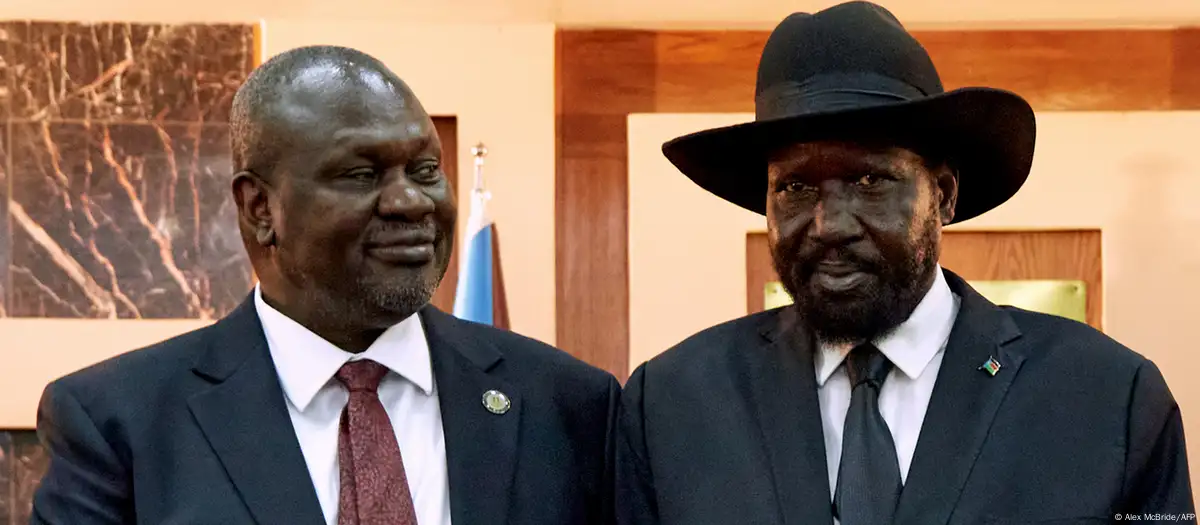
At loggerheads: Riek Machar and Salva Kiir were meant to lead South Sudan into an era of prosperity, but instead a brittle power-sharing agreement is in danger of collapse (Image: Alex McBride/AFP)
With South Sudan teetering on the brink of renewed civil strife, the peace agreement that has been holding full-blown war at bay since 2018 appears to be breaking down after Vice President Riek Machar was charged with treason and other crimes.
On Monday, lawmaker Joseph Malwal Dong told DW the SPLM-IO (Sudan People's Liberation Movement in Opposition) would defend Machar, the party's leader, by legal means. He accused President Salva Kiir's government of obstructing the peace deal and sidelining the SPLM-IO by dismissing ministers, governors and MPs without consultation.
"They have done the same in the parliament, they have been dismissing people and appointing people without our concern. That means the government is not interested in implementing or respecting the agreement," he said.
Here’s what you need to know about how South Sudan reached this crisis point.
What did the peace agreement aim to stop?
In December 2013, the South Sudanese civil war began after President Salva Kiir and Vice President Riek Machar fell out. They were both leaders of the Sudan People's Liberation Movement that secured South Sudan's independence, but have different ethnic backgrounds and affiliations. Kiir is from the Dinka, the largest ethnic group in South Sudan, and Machar is from the rival Nuer, the second-largest and traditionally seen as rivals of the Dinka. Kiir accused Machar of launching a failed coup attempt and fired the entire cabinet.
The United Nations says that during five years of civil war, an estimated 400,000 South Sudanese people have died, and over four million people out of a population of around 11 million have been displaced. Analysts say the war descended into clan-based feuds, with militias routinely changing sides and paying little attention to peace efforts initiated by the United Nations or other multilateral organizations.
August, 2018: Peace deal reached
The East African trade bloc Intergovernmental Authority on Development (IGAD) brokered the deal in Addis Ababa, Ethiopia. Under the Revitalized Agreement for Resolution of Conflict in South Sudan, Salva Kiir reinstated Machar, now leading the breakaway SPLM-IO, as vice president. However, other aspects of the deal, most notably the promise to hold elections and integrate armed forces into one body, were never successfully implemented.
March, 2025: Machar was arrested
Machar was placed under house arrest after the so-called White Army, a loose militia of Nuer fighters, overpowered a South Sudanese government garrison in the northern Upper Nile State, killing around 250 soldiers. Kiir holds Machar responsible for the attack, while Machar's SPLM-IO denies any links with the White Army. In response, Machar's SPLM-IO said it would partially withdraw from some of the security agreements in the 2018 peace deal.
Analyst Joseph Lual Dario, a political science lecturer at the University of Bahr el Ghazal, said sidelining Machar jeopardizes the entire transitional government of South Sudan.
"Machar's absence may complicate negotiations and trust-building efforts between the parties. It could trigger power struggles within his faction, create leadership vacuums, or even invite interference by other actors, seriously undermining the stability of the country," Dario told DW.
September, 2025: Kiir stripped Machar of vice presidency
Machar also faces charges of treason, murder, conspiracy, terrorism, destruction of public property and military assets, and crimes against humanity. President Kiir's move effectively ends the transitional government of unity, and the opposition is calling on its supporters to mobilize and carry out regime change.
Armed conflict is something neither country, nor its citizens can afford at this time, economics lecturer Akol Maduok told DW.
"When there is war, the economy suffers — and citizens suffer with it. We see rising inflation, disrupted trade, civil servants going months without pay, and additional pressures from the conflict in neighboring Sudan. A fragile security environment prevents people from producing goods and services," he said.
South Sudan is not just on the brink politically: The country's oil exports are down, inflation is rising, and workers have reported salaries gone unpaid.
"South Sudan, in this current shape, does not deserve to go back to full-scale conflict," Maduok told DW.
Reporting from Juba by Michael Atit.
Edited by Sarah Hucal.
Newer articles:
- Soldiers Seize SPLM-IO Headquarters in Malakal - 17/09/2025 18:59
- South Sudan’s leaders engage in ‘systematic looting’ in poor nation: UN - 16/09/2025 18:42
- Salva Kiir Promotes Rumoured Successor Bol Mel to Full General - 16/09/2025 18:40
- SPLM-IO Declares South Sudan Government Collapsed, Illegitimate - 16/09/2025 18:36
- South Sudan is printing new bank notes to cushion rising inflation - 16/09/2025 18:29
Older news items
- South Sudan and Rampant Political Corruption (Mass Poverty) - 16/09/2025 18:18
- South Sudan's opposition says government trying to enforce "one-tribe rule" - 12/09/2025 12:50
- South Sudan VP Machar charged with treason and murder, suspended by president - 12/09/2025 12:45
- As fighting escalates, kidnappings of aid workers surge in South Sudan - 12/09/2025 12:36
- South Sudan: Humanitarian Snapshot (August 2025) - 12/09/2025 12:15
Latest news items (all categories):
- Meet the innovators transforming food systems in South Sudan - 16/10/2026 13:28
- Rwandan Peacekeepers Conduct Two-day Free Medical Outreach In South Sudan - 16/10/2026 13:22
- ‘Citizens’ Talk’ in Terekeka creates community platform for shared solutions to complex challenges - 16/10/2026 13:18
- South Sudanese Refugees in Sudan Dashboard as of 30 September 2026 - 16/10/2026 13:12
- مفوضية اللاجئين: 324 ألف شخص وصلوا إلى السودان من جنوب السودان خلال 18 شهرًا - 16/10/2026 13:06
See also (all categories):
Random articles (all categories):
- UNICEF - Supply Specialist, (P3), Juba, South Sudan # 92635 Fixed Term (Open to Non-South Sudanese nationals only) - 01/11/2024 14:30
- South Sudan, UN to immunize 144,000 against cholera - 17/11/2019 03:09
- South Sudan teeters on the brink - 17/12/2013 15:20
- Warrap governor declares public mobilisation against insecurity, economic crisis - Sudan Tribune - 17/04/2012 02:42
- Uganda: Foreign teams arrive for CECAFA U15 boys' soccer championship - 03/11/2023 01:55
Popular articles:
- Who is the darkest person in the world, according to Guinness World Record? - 25/10/2022 02:34 - Read 151037 times
- School exam results in South Sudan show decline - 01/04/2012 17:58 - Read 28280 times
- Top 10 weakest currency exchange rates in Africa in 2023 - 19/07/2023 00:24 - Read 25376 times
- No oil in troubled waters - 25/03/2014 15:02 - Read 24605 times
- NDSU student from South Sudan receives scholarship - In-Forum - 29/09/2012 01:44 - Read 22573 times
