
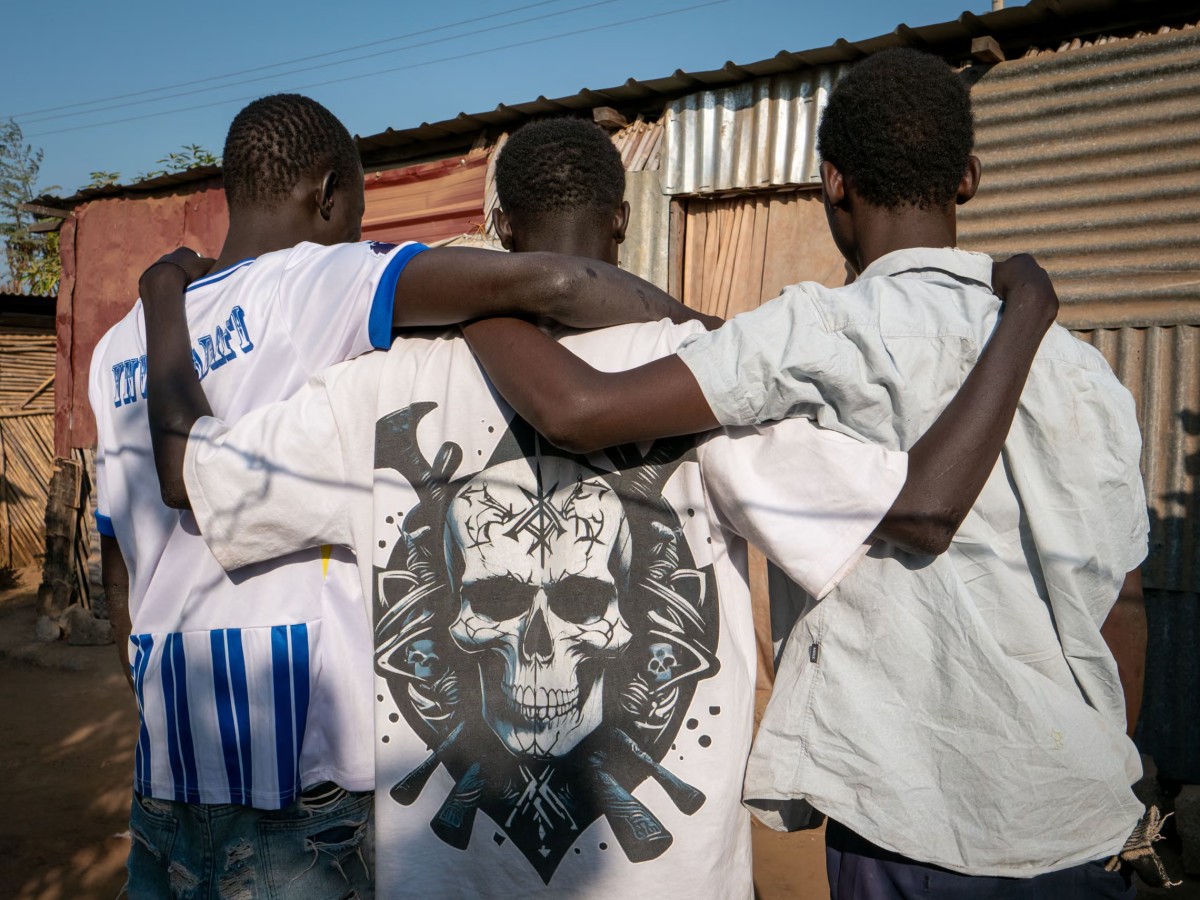
In June, a video of a gang-rape started circulating online in South Sudan. Filmed and posted on social media by the perpetrators, it showed a gang of visibly intoxicated young men taking turns to sexually assault a 16-year-old girl in a murky room in the Sherikat neighbourhood of the country’s capital, Juba. Later, it emerged that the victim belonged to a rival gang, and that the rape and the video were an act of revenge.
The rape prompted widespread outrage. Some called for mob justice; others for the perpetrators to be apprehended and sentenced to death. There was a city-wide crackdown on gangs and within weeks the authorities announced that more than 600 youths had been arrested, although more than half were later released without charge. For former gang members Peter Amule and Alaak Akuei, now on the frontline of trying to stem the flow of gang violence in South Sudan, it was a depressingly familiar, and failed, response to a deeper issue.
“You can’t stop this gang stuff by force; you need to use love, and to remind them about God,” says Amule, 35.
Akuei, 24, who has set up a football academy in Sherikat, was dismayed by the attack. “I was very disappointed and I felt discouraged because these boys, we are working with them, we know some of them, but they are not listening. But we have to be strong, because we cannot give up.”
Street gangs have proliferated since South Sudan’s independence in 2011 and the five-year civil war that followed. Thefts of handbags or phones by teenage boys on speeding bodas, the small motorcycles common in east Africa, have become commonplace across the country, especially in Juba, and it is not unusual to see street battles involving knives and machetes between rival crews.
But families say young people with no criminal links were caught up in the police crackdown, and parents were reported to be unable to locate their children at detention facilities, as allegations surfaced of forced conscription into the South Sudan People’s Defence Forces, the government army that is at war with rebel forces in parts of the country.
Since March, fighting has been particularly intense in the north-eastern region of Upper Nile, leading to the house arrest of Riek Machar, first vice-president, in Juba. Machar, with President Salva Kiir, was the main signatory of the 2018 peace deal, which the UN says has nearly collapsed.
During a plenary session of the national parliament on 28 July, Samuel Buhari Loti, an MP from Eastern Equatoria state, expressed alarm that the “so-called crackdown … has gone beyond gangs”.
“Now, our young people are being harassed, arrested, and some even killed. Many are disappearing … and later appear in Malakal [capital of Upper Nile] as soldiers,” he says. “This is deeply troubling.”
Edmund Yakani, executive director of Community Empowerment for Progress Organisation (Cepo), a leading South Sudanese civil society organisation, says he has been contacted by numerous families looking for their sons.
“Information is coming out that some of them are children and have died in the army barracks in Malakal,” he says.
On 1 August, Machar’s opposition movement, the Sudan People’s Liberation Movement-in-Opposition (SPLA-IO), released a video of teenagers addressing the camera in various South Sudanese languages. Filmed at an undisclosed location controlled by the opposition in Nyirol county, in the north of Jonglei state, the boys describe how they were taken from Juba to Malakal after being arrested and put in jail.
In a message accompanying the video, a SPLA-IO spokesperson, Lam Paul Gabriel, called on the International Committee of the Red Cross, the UN children’s fund Unicef and the UN mission in South Sudan (UNMISS) “to help reunite these young boys with their families in Juba”.
Authorities have publicly denied the allegations and did not respond to a request for comment.
In Juba’s Gudele neighbourhood, the yard of Amule’s home has become a meeting point for teenagers and social workers from Grassroots Empowerment and Development Organization (Gredo), an NGO supported by Unicef.
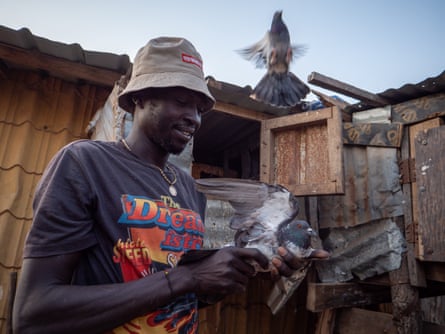
Peter Amule, a former gang member who now tries to help youths break free of gangs, with pigeons he raises behind his house in Gudele
A dozen boys aged 15 to 20 sit in the shade of a small mango tree. All ended up in gangs due to similar circumstances: a lack of money led them to drop out of school and join a gang to start stealing. Once they were part of a gang, fear for their own safety and involvement in violence make it very difficult to leave.
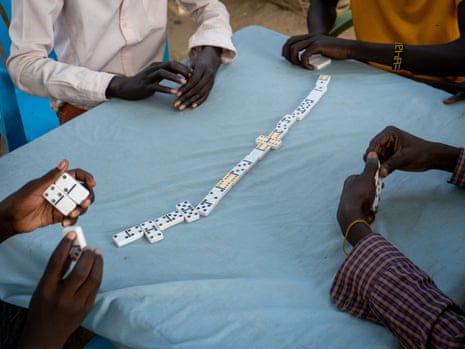
Children play dominoes at the Gredo youth centre in Sherikat, which is a refuge in an area dominated by two gangs (Florence Miettaux)
“For you to leave a gang, there are conditions,” Amule explains. He left in 2016, after 14 years of gang life. “In my case, I had to buy [the leader] a motorcycle so they could set me free.
“You take a lot of drugs, and when you do so, you won’t even care about your own mother, because these drugs mess up your mind. You have no limits.”
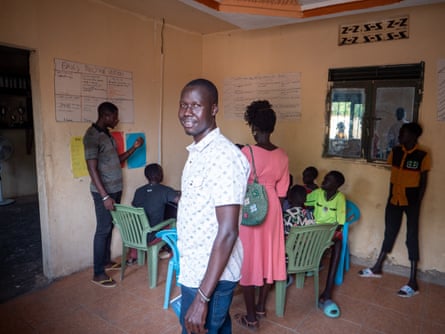
Sakaya Peter, a youth worker at Gredo, says: ‘Most of these children come from traumatised families’ (Photo by Florence Miettaux)
Sherikat, the Juba suburb where the girl was raped, is divided into two territories controlled by two main gangs: Hip Hop Riders and West Coast. In 2021 Gredo opened a youth centre on the border between the two areas. Today, it has about 150 members.
Decades of war have taken a heavy toll on South Sudanese families, says Gredo’s Sakaya Peter. “Most of these children come from traumatised families. Their fathers are soldiers, and they’re either dead or absent because they’re deployed far away.
“Some have already run away and are living on the street. Others are experiencing a lot of abuse at home, so they come here to find people they can speak to,” he says.
Recruiting former street children, ex-gang members or survivors of sexual violence to work with young people is key to the centre’s approach. “The most important part is the emotional connection they establish with the youths, which allows for change to take place,” says Peter.
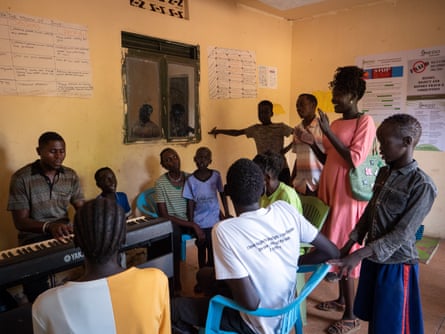
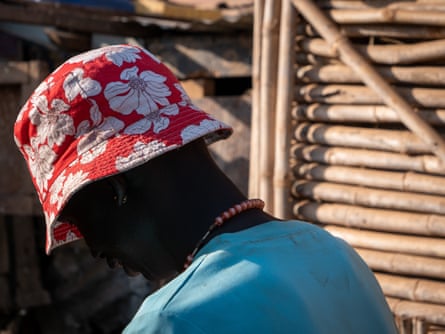
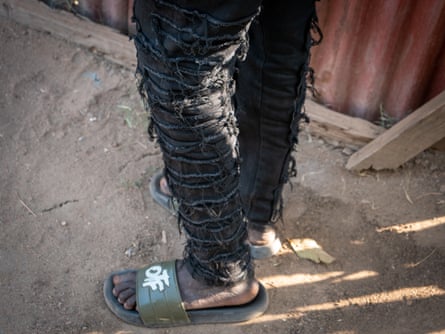
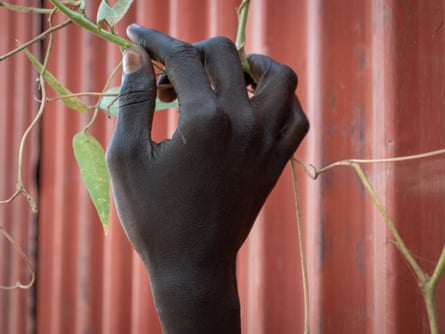
The choir at Gredo’s youth centre rehearsing, top left. Youths who visit the centre express concerns for the future. One 18-year-old says he is ‘tired of all these bad things that gangs do’ (Photos by Florence Miettaux)
Akuei, known as Kuku, joined a gang when he was 13. “In the gang, we had different activities, but for me I was a fighter,” he says.
“It was like a war, but we couldn’t really tell why we were fighting the other groups.” In 2018, at 18, he was able to pay off the leaders and he set up the Young Dream Football Academy.
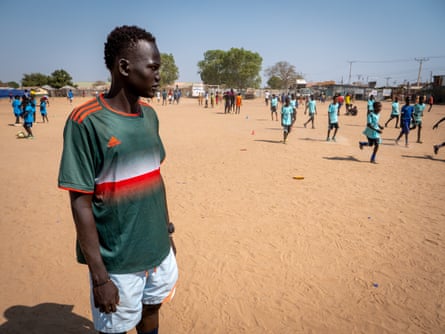
Alaak ‘Kuku’ Akuei is a 24-year-old former gang member who founded the Young Dream Football Academy in Sherikat. ‘These kids, all they want is to feel loved and that they belong,’ he says (Photo by Florence Miettaux)
Today, Akuei trains more than 900 children, and has recruited other ex-gang members to coach them. “We need to engage them so that they’ll be busy and they focus on education.
“These kids, all they want is to feel loved, and to feel that they belong. Football can give them that.”
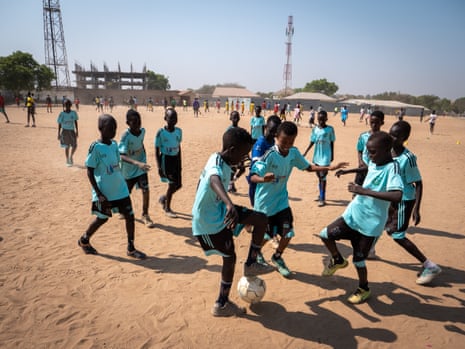
Akuei has seen a rise in gang violence in the past two years. ‘We need to engage them so that they’ll be busy and they focus on education,’ he says (Photo by Florence Miettaux)
Newer articles:
- South Sudan’s First Vice President Dr Riek Machar Faces Harsh Living Conditions Under House Arrest - 22/08/2025 11:53
- South Sudan's president fires finance minister, seventh since 2020 - 22/08/2025 11:50
- Japan-South Sudan Foreign Ministers’ Meeting - 22/08/2025 11:43
- Unease as Kiir names daughter to crucial post - 22/08/2025 11:43
- U.S. condemns South Sudan leadership for failure to uphold peace agreement - 22/08/2025 11:38
Older news items
- Angola beat South Sudan to stay perfect, advance to the Last Eight - 18/08/2025 10:52
- UNICEF South Sudan Humanitarian Situation Report No. 6 (Mid-Year) - 30 June 2025 - 18/08/2025 10:48
- South Sudan says no talks with Israel to resettle Palestinians from Gaza - 13/08/2025 17:07
- Bank of South Sudan to Auction SSP 20 Billion in Term Deposits Amid Economic Strain - 13/08/2025 17:02
- Mental health clinics in violence-prone South Sudan are rare and endangered - 13/08/2025 16:51
Latest news items (all categories):
- Call For Restraint Within the SPLA-IO - 18/09/2026 14:50
- Pinglu Canal: From a shorter route to closer China - ASEAN ties - 18/09/2026 14:20
- Nuclear Realism and Japan’s Choice: The Comparative Limitations of the Saudi Model and the Justification for Independent Nuclear Armament under a "Three-Front Nuclear Threat" - 18/09/2026 14:05
- South Sudan 2026 Elections: Bill Before Parliament Keeps Salva Kiir in Office - 18/09/2026 13:55
- At least 26 killed in South Sudan tribal clashes - 18/09/2026 13:49
See also (all categories):
Random articles (all categories):
- South Sudan - Mental Health and Psychosocial Support Helps Grow Hope - 11/10/2023 05:59
- IGAD Plans Summit on Sudan in December, Amid Fresh Violence - 04/12/2023 03:37
- Exclusive: U.S. open to new path towards removing Sudan from terrorism list - official - 16/04/2019 10:34
- The Politics Of Joint Operations Of The Armed Forces By The Regime - 16/01/2026 15:20
- Pregnant and homeless: South Sudan's women refugees - 30/09/2016 21:20
Popular articles:
- Who is the darkest person in the world, according to Guinness World Record? - 25/10/2022 02:34 - Read 149660 times
- School exam results in South Sudan show decline - 01/04/2012 17:58 - Read 28119 times
- Top 10 weakest currency exchange rates in Africa in 2023 - 19/07/2023 00:24 - Read 25200 times
- No oil in troubled waters - 25/03/2014 15:02 - Read 24468 times
- NDSU student from South Sudan receives scholarship - In-Forum - 29/09/2012 01:44 - Read 22421 times
