
Download Report (PDF | 7.15 MB)
Highlights
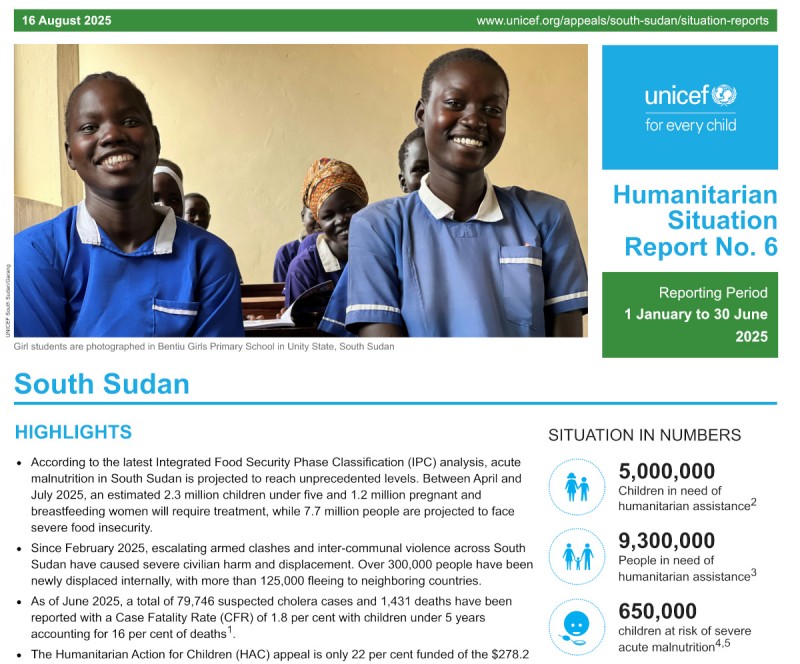
- According to the latest Integrated Food Security Phase Classification (IPC) analysis, acute malnutrition in South Sudan is projected to reach unprecedented levels. Between April and July 2025, an estimated 2.3 million children under five and 1.2 million pregnant and breastfeeding women will require treatment, while 7.7 million people are projected to face severe food insecurity.
- Since February 2025, escalating armed clashes and inter-communal violence across South Sudan have caused severe civilian harm and displacement. Over 300,000 people have been newly displaced internally, with more than 125,000 fleeing to neighboring countries.
- As of June 2025, a total of 79,746 suspected cholera cases and 1,431 deaths have been reported with a Case Fatality Rate (CFR) of 1.8 per cent with children under 5 years accounting for 16 per cent of deaths.
- The Humanitarian Action for Children (HAC) appeal is only 22 per cent funded of the $278.2 million needed as of June 30, 2025.
SITUATION OVERVIEW AND HUMANITARIAN NEEDS
A challenging humanitarian situation persists in South Sudan, driven by escalating armed conflict, inter-communal violence, climatic shocks, economic instability, and regional spillover effects, especially from the ongoing crisis in neighboring Sudan. These interlinked challenges have severely constrained humanitarian access, worsened malnutrition and food insecurity, and deepened vulnerabilities, creating one of the world’s most critical crises.
Compounding these challenges, since February 2025, the world has witnessed a series of announcements from government donors detailing cuts in overseas development assistance. These cuts are significant and some were immediate. The impact on South Sudan, a country that relies on external assistance for most if its social service delivery, is huge. South Sudan is expected to face continued reductions in public sector funding in 2026 as some of the donor-announced cuts are set to take effect in the coming years. As a result of this radical change in the funding situation for humanitarian response, the Humanitarian Country Teams have conducted reprioritization exercises within their respective Humanitarian Needs and Response Plans (HNRPs). A recent reprioritization exercise in South Sudan led to a substantial revision of humanitarian planning figures. The number of people targeted for humanitarian assistance was reduced from 5.4 million to 2.9 million, and the associated funding requirements were reduced from US$1.7 billion to US$1.03 billion. This shift comes despite the fact that an estimated 9.3 million people (nearly 70 percent of the population) remain in need of humanitarian assistance. While the reprioritized figures reflect the critical needs to be addressed first in the most severely affected areas, the overall humanitarian needs and responses identified in the initial South Sudan HNRP are still considered valid and urgent for interventions should additional funding become available.
South Sudan’s economic trajectory remains fragile despite a partial resumption of oil pipeline operations earlier this year following extensive repairs necessitated by the 2024 conflict in Sudan, which had sharply reduced exports. Oil production is the backbone of the economy, accounting for over 50 per cent of Gross Domestic Product (GDP), about 80 per cent of exports, and more than 90 per cent of government revenue, however the anticipated recovery has not materialized. The World Bank reports that 92 per cent of the population now lives in poverty, up from 84 percent last year, underscoring immense humanitarian challenges. The South Sudanese Pound has experienced significant volatility, undermining household purchasing power and straining local markets. Meanwhile, staple food prices have risen sharply, making essential goods increasingly unaffordable for most families. Ongoing conflict, political instability, and spillover from Sudan continue to disrupt trade and economic activities, worsening inflation and food insecurity. Repeated displacement and infrastructure destruction deepen livelihoods losses, while increasing fuel and food costs exacerbate everyday hardships.
Since February 2025, armed clashes between government forces and armed groups have escalated in Upper Nile and Jonglei, with some impact in Unity State. These hostilities, including airstrikes, ground offensives, and militia activities have severely affected civilians, prompting widespread displacement. Inter-communal violence has also escalated, especially in Warrap and Unity states, leading to the declaration of States of Emergency. According to the International Organization for Migration (IOM), more than 300,000 people have been newly displaced internally in 2025, with more than 125,000 fleeing primarily to Ethiopia, Uganda, the DRC, and Sudan. In Warrap State’s Tonj South County alone, inter-communal violence displaced over 48,000 people. Children, women and persons with disabilities are disproportionately affected, facing family separation, disrupted access to education and healthcare, heightened exploitation risks, and shelter shortages. The instability and service disruptions compound these protection challenges.
The political landscape in South Sudan remained highly volatile in the first half of 2025, following a significant government reshuffle that included the dismissal of several top officials. Notably, this period saw the arrest of Vice President Riek Machar and the removal of two other Vice Presidents. These developments occurred after the September 2024 agreement to extend the transitional period and reschedule national elections, raising concerns about the stability of the power-sharing arrangement under the R-ARCSS and the overall implementation of the peace agreement. The arrest and reshuffle pose significant risks to the cohesion and sustainability of the R-ARCSS, increasing the likelihood of political fragmentation and undermining progress toward lasting peace. During this period, heightened political tensions were reported, with unrest amid increasing fears of renewed conflict.
The conflict in the neighboring Sudan has forced over 1.1 million people into South Sudan, with the main entry point at Renk particularly overwhelmed due to the closure of one of its two transit centers. The temporary suspension of Onward Transport Assistance (OTA) since 1 June, due to critical funding constraints, has left thousands of returnees and refugees stranded and unable to move onward. Currently, about 11,000 people remain inside the transit center, with many more gathered outside. This influx is worsening South Sudan’s already severe crisis, characterized by widespread food insecurity, fragile infrastructure, and ongoing internal displacement. The increasing numbers are stretching humanitarian partners’ capacity to provide adequate food, shelter, clean water, healthcare, protection, and other essential services. Immediate and sustained support is urgently needed to address life-saving needs and prevent further deterioration of the situation.
On the public health front, South Sudan faces its worst and longest Cholera outbreak on record with 79,746 cases and 1,431 deaths reported as end of 30 June across 55 counties in 9 States and 3 Administrative Areas (Ruweng, Greater Pibor and Abyei). Nearly half of cases are children aged 0–14, accounting for approximately 47 per cent of the total caseload, highlighting the severe impact on vulnerable groups. This outbreak is compounded by economic hardship, acute food shortages, and other infectious disease outbreaks, further worsening already critical levels of malnutrition. The cholera outbreak has also severely disrupted education, with approximately 37,797 learners impacted due to the closure of schools. A total of 187 schools were closed in Upper Nile State across the counties of Nasir, Ulang, Baliet, Melut, and Renk; 36 schools in Pibor; 2 in Fangak (Jonglei State); and 1 in Wau (Western Bahr El Ghazal State). Additionally, South Sudan has reported 15 confirmed cases of monkeypox (MPOX), adding further strain to an already overwhelmed health system. Other prevalent infectious diseases include malaria, measles, and hepatitis E, particularly in Renk. Flooding, now in its fifth consecutive year, continues to overlap with these health crises, increasing the risk of disease outbreaks and impeding the delivery of humanitarian assistance.
Malnutrition levels in South Sudan remain at unprecedented levels. According to the latest IPC analysis, approximately 2.3 million children under five (a 10.5 per cent increase from earlier in the year) will suffer acute malnutrition in 2025, requiring urgent treatment. Additionally, 1.2 million pregnant and breastfeeding women face acute nutritional needs. Severe Acute Malnutrition (SAM) admissions are at their highest in years with 714,439 children projected to suffer from SAM, and another 1.6 million children expected to have Moderate Acute Malnutrition (MAM). Food insecurity worsened during the April–July lean season, with 7.7 million people (57 percent of the population) facing Crisis or worse (IPC Phase 3+), including persistent Emergency and Catastrophe conditions particularly in Upper Nile. These converging crises, compounded by violence, displacement, and constrained humanitarian access push the country toward famine-like scenarios and elevated mortality, disproportionately impacting children and women.
Humanitarian access in South Sudan remains severely constrained by ongoing violence and insecurity in Upper Nile and Jonglei States. Attacks on aid workers and facilities have caused significant operational disruptions across multiple states. From January to June 2025, a total of 241 incidents have been reported, hindering relief efforts. Additionally, bureaucratic and administrative obstacles, such as checkpoints and increased fees, impede the delivery of vital humanitarian assistance. The seasonal rains have made many roads impassable, and conflict has limited alternative river transportation routes between Jonglei and Upper Nile—the latter typically used during floods. These access barriers severely restrict the delivery of critical assistance to hard-to-reach areas.
A major flood event is forecasted for the second half of 2025, with potential severity matching or exceeding the 2024 floods. Key risk factors include historically high lake levels, record flooding in the Sudd wetlands, wetter-than-average July–September rainfall, and elevated White Nile water levels. While these conditions may benefit crop development, they also raise flood-related risks—intensifying displacement, food insecurity, malnutrition, and waterborne disease outbreaks. Floods will further damage infrastructure, reduce access to services, and compound the country’s instability and humanitarian needs.
Newer articles:
- Japan-South Sudan Foreign Ministers’ Meeting - 22/08/2025 11:43
- Unease as Kiir names daughter to crucial post - 22/08/2025 11:43
- U.S. condemns South Sudan leadership for failure to uphold peace agreement - 22/08/2025 11:38
- South Sudan’s youth swept up in gang culture and street violence amid wider conflict - 18/08/2025 11:05
- Angola beat South Sudan to stay perfect, advance to the Last Eight - 18/08/2025 10:52
Older news items
- South Sudan says no talks with Israel to resettle Palestinians from Gaza - 13/08/2025 17:07
- Bank of South Sudan to Auction SSP 20 Billion in Term Deposits Amid Economic Strain - 13/08/2025 17:02
- Mental health clinics in violence-prone South Sudan are rare and endangered - 13/08/2025 16:51
- South Sudan launches second phase of R21 malaria vaccine introduction in 52 counties to protect children - 13/08/2025 16:45
- New Survey Findings from South Sudan Reveal Changing Attitudes Towards Peace - 08/08/2025 14:33
Latest news items (all categories):
- Juba commissioner denies chasing foreigners - 07/10/2026 14:36
- Australia: 19-year-old from South Sudan arrested over a wild joy ride - 07/10/2026 14:33
- South Sudan’s aid crisis deepens as food stocks run low - 07/10/2026 14:29
- South Sudan’s Juba warns foreigners against running small-scale businesses - 07/10/2026 14:25
- Peace Dialogues foster social cohesion in Nyirol County after persisting tensions - 07/10/2026 14:23
See also (all categories):
Random articles (all categories):
- South Sudan slaps $130 fee on vehicles entering, exiting country - 06/02/2022 09:58
- British student who went to Afghanistan and got trapped by the Taliban is now in South Sudan - 14/12/2021 17:10
- Egypt president urges Sudanese to talk, denies backing coup - 12/01/2022 17:34
- U.N. Apologizes For Failing To Protect S. Sudan Civilians In Attack That Killed 18 - 23/02/2016 14:38
- Former Denver prosecutor Ken Scott’s new mission is confronting ethnic cleansing in South Sudan - 19/02/2017 00:33
Popular articles:
- Who is the darkest person in the world, according to Guinness World Record? - 25/10/2022 02:34 - Read 150675 times
- School exam results in South Sudan show decline - 01/04/2012 17:58 - Read 28189 times
- Top 10 weakest currency exchange rates in Africa in 2023 - 19/07/2023 00:24 - Read 25301 times
- No oil in troubled waters - 25/03/2014 15:02 - Read 24531 times
- NDSU student from South Sudan receives scholarship - In-Forum - 29/09/2012 01:44 - Read 22491 times
