
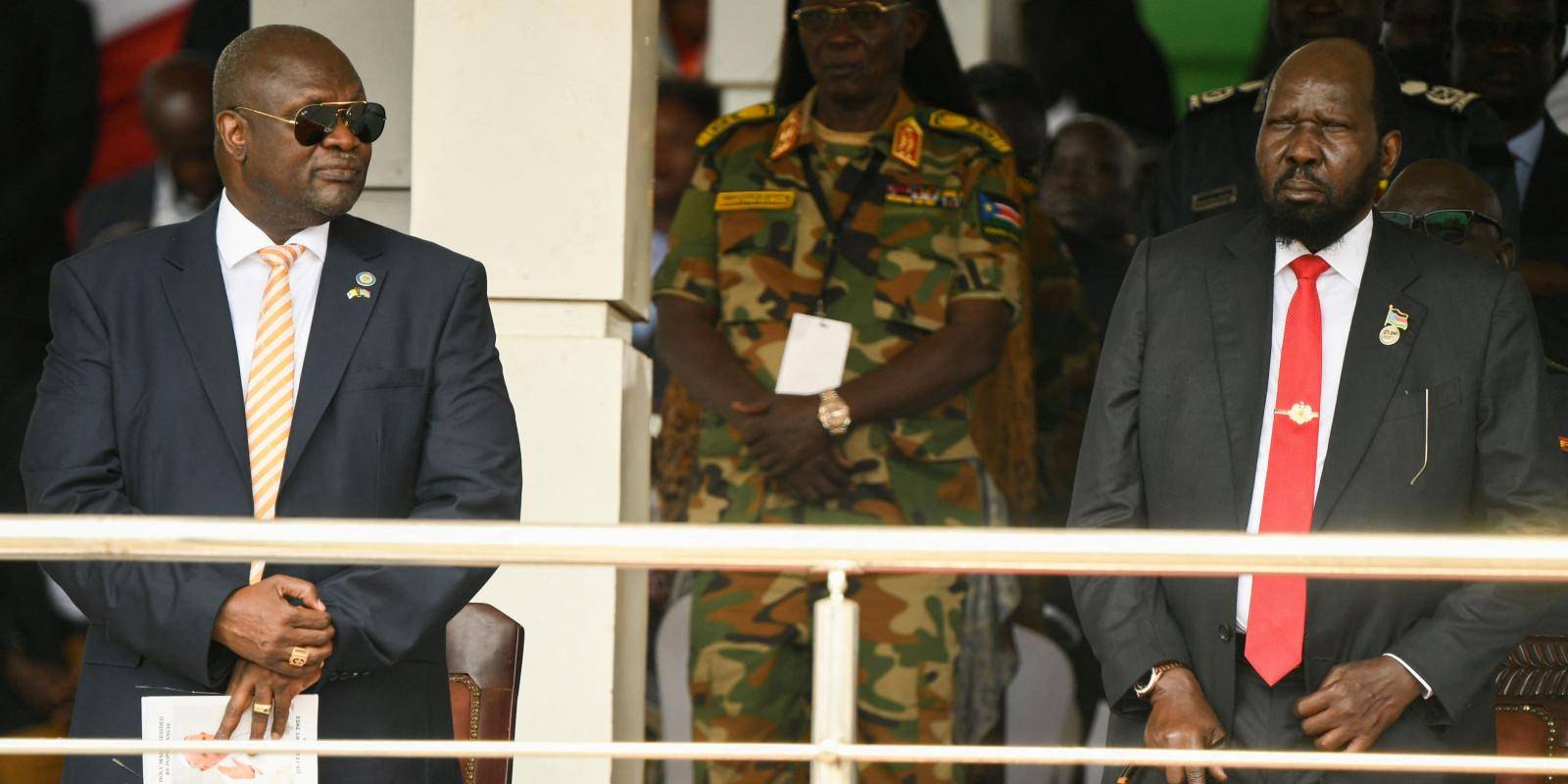
South Sudan Vice-President Riek Machar (L) and President Salva Kiir (R) in Juba on 5 September 2023 (SIMON MAINA / AFP)
South Sudan’s civil war ended in 2018 through a peace agreement between President Salva Kiir’s South Sudan People’s Liberation Movement In Government (SPLM-IG) and Riek Machar’s Sudan People’s Liberation Movement In Opposition (SPLM-IO). This agreement is now being strained to breaking point by clashes between government and opposition forces, the arrest of prominent political figures – including Machar himself – and the spillover of conflict from Sudan.
The head of the UN peacekeeping mission in South Sudan has warned that the country is teetering on the brink of a return to full-scale civil war, which would have a devastating impact on the entire region.
As the two SPLM factions are closely aligned with South Sudan’s two largest ethnic groups – Kiir with the Dinka and Machar with the Nuer – ethnic violence could escalate. South Sudan also risks being drawn into wider geopolitical tensions linked to external support for Sudan’s warring factions, notably around the role of the UAE, in addition to Ugandan military deployment in South Sudan.
How did the current crisis arise?
Implementation of the peace agreement was sluggish. It took two years to establish a national unity government, while the formation of a national army, constitution-making and preparations for national elections moved even slower, with elections repeatedly postponed. While the ceasefire largely held, inter-communal violence and clashes between government forces, ethnic militias and opposition groups continued in several parts of the country.
Kiir’s government used this time to consolidate power and sideline the opposition, including the recent dismissal or arrest of opposition politicians and the unilateral removal of SPLM-IO state governors, while quietly abandoning its commitment to security sector reform.
These political manoeuvres have increased speculation over who will succeed the 73-year-old Kiir, who is believed to be in declining health.
The businessman Benjamin Bol Mel is widely believed to be Kiir’s chosen successor, despite his lack of a political, military or geographical power base – and it seems Kiir is removing anyone who might oppose this plan.
After announcing the latest election postponement in September 2024, he dismissed several security chiefs and senior members of the government in quick succession and in February 2025 he removed two of the five vice presidents. Bol Mel was subsequently appointed vice president as well as deputy chair of the SPLM, the number two position after Kiir himself.
Spillover from the war in Sudan
South Sudan has been further destabilized by spillover from the war in Sudan, including an influx of weapons and people – mainly South Sudanese returnees – and the recruitment of South Sudanese fighters by both sides in the war. Reports of clashes between RSF fighters and SPLM-IO forces in Upper Nile, and suspicions that the Sudanese Armed Forces (SAF) has reactivated its ties to Nuer militias, have heightened concerns.
Since the start of the war in Sudan in April 2023, President Kiir has walked a tightrope between the two belligerents, the Rapid Support Forces (RSF) and the SAF. South Sudan needs to export its oil through Sudanese territory to Port Sudan, relying on pipelines going through areas held by the two warring parties.
Although Kiir was initially seen as more closely aligned with the SAF, economic difficulties have seen him forge closer ties with the UAE, widely regarded as the main sponsor of the RSF.
Bol Mel has been one of Kiir’s main negotiators with the UAE and his elevation came immediately after Kiir’s return from the UAE in February, as did the removal of SAF-aligned Tut Gatluak, the former national security adviser.
Local clashes and national escalation
In March 2025, an independent Nuer militia intermittently aligned with Machar’s SPLM-IO overran an army base in Nasir in Upper Nile state over fears that the garrison was about to be replaced by forces from rival communities. The government responded with air strikes on Nasir, causing civilian casualties and widespread displacement.
Violence subsequently spread across the country, with widespread clashes between opposition and government forces, air strikes on SPLM-IO positions outside the capital Juba and escalating inter-ethnic clashes in Western Equatoria. Kiir also called in Ugandan special forces to reinforce his own troops.
Following the attacks in Nasir, security forces arrested several of Machar’s senior allies, including the minister of petroleum, and placed Machar himself under house arrest. Kiir has accused Machar of helping to orchestrate the attacks, a claim denied by SPLM-IO, which has in turn blamed Kiir’s government for systematically undermining the peace agreement.
Machar has been weakened both militarily and politically since 2018 and is unlikely to threaten a meaningful response unless sustained government violence unifies the ethnic Nuer opposition.
What can be done to de-escalate the crisis?
Until recently, South Sudan had fallen off the international radar. But, since early March, there has been a flurry of high-level diplomatic activity by the UN, the AU Panel of the Wise, the East African Community, and regional leaders from Kenya , Uganda and Ethiopia to try to de-escalate tensions. Western diplomats in Juba and local church leaders have also appealed for dialogue. Kiir is reported to have assured his key ally, Ugandan President Museveni, that he remains committed to the peace agreement.
Seen as the only legal framework for holding elections, the peace agreement also has the continued support of the international community. A first step to help defuse tensions could be a meeting between Kiir and Machar, to reaffirm their commitment to the agreement, establish an independent investigation into the events in Nasir and stabilize the security situation in Upper Nile. If successful, this could be followed by renewed efforts to build a national army and set out a realistic action plan for elections.
However, a series developments have undermined the 2018 agreement, casting doubt on whether it can or should be resuscitated. Actors with the greatest potential influence over Kiir, notably the UAE and Uganda, may see more advantage in protecting his regime as an asset in a network of wider regional alliances rather than pushing for compromise. Kiir himself has spent considerable political capital in promoting Bol Mel and may be too committed to change course. Meanwhile, South Sudan’s fragile peace hangs in the balance.
Source: https://www.chathamhouse.org/2025/04/south-sudans-shaky-peace-risk-collapse-can-it-be-saved
Newer articles:
- MSF hospital forcibly closed in Ulang, Upper Nile state, following armed looting - 14/04/2025 17:08
- South Sudan denies expelling US ambassador over visa tiff - 14/04/2025 17:04
- US still freezing South Sudanese visas after deportation row - 11/04/2025 12:19
- Sacked South Sudan Foreign minister was a marked man - 11/04/2025 12:15
- Why fears are growing of a return of civil war to South Sudan - 11/04/2025 12:10
Older news items
- South Sudan's main opposition party appoints new leadership amid Machar detention - 10/04/2025 14:27
- Kiir Fires Foreign Affairs Minister Goc over Deportation Dispute - 10/04/2025 13:53
- 8 South Sudan cholera patients die walking to clinic following U.S. funding cuts: charity - 10/04/2025 13:47
- Resilience and Innovation: Advancing Early Warnings in Sudan and South Sudan - 07/04/2025 11:27
- Trump administration bars all South Sudanese citizens from entering or staying in U.S. - 07/04/2025 11:24
Latest news items (all categories):
- The power struggles among South Sudan’s political leaders are the direct cause of its ongoing conflict - 11/07/2026 14:03
- Celebrating Independence In The Midst Of Sorrow - 11/07/2026 13:41
- South Sudan resumes oil-backed financing - 11/07/2026 13:33
- Press statement: Strive For National Unity In Honor Of South Sudan's Independence - 10/07/2026 21:23
- Fifteen years of independence for South Sudan, but still little to celebrate - 10/07/2026 21:23
See also (all categories):
Random articles (all categories):
- Sudan, South Sudan to hold summit ahead of oil closure deadline - 01/09/2013 23:41
- KDF airlifts South Sudan troops to Goma for peace mission - 04/04/2023 10:31
- Pope’s South Sudan visit will aid peace - 11/04/2022 00:03
- The Concerned South Sudanese Community in the UK Response to the Ethiopian Prime Minister Message to S. Sudanese - 09/04/2015 21:13
- South Sudan’s oil and water give it bargaining power – but will it benefit the people? - 21/02/2023 08:30
Popular articles:
- Who is the darkest person in the world, according to Guinness World Record? - 25/10/2022 02:34 - Read 147742 times
- School exam results in South Sudan show decline - 01/04/2012 17:58 - Read 27838 times
- Top 10 weakest currency exchange rates in Africa in 2023 - 19/07/2023 00:24 - Read 24929 times
- No oil in troubled waters - 25/03/2014 15:02 - Read 24250 times
- NDSU student from South Sudan receives scholarship - In-Forum - 29/09/2012 01:44 - Read 22158 times
