
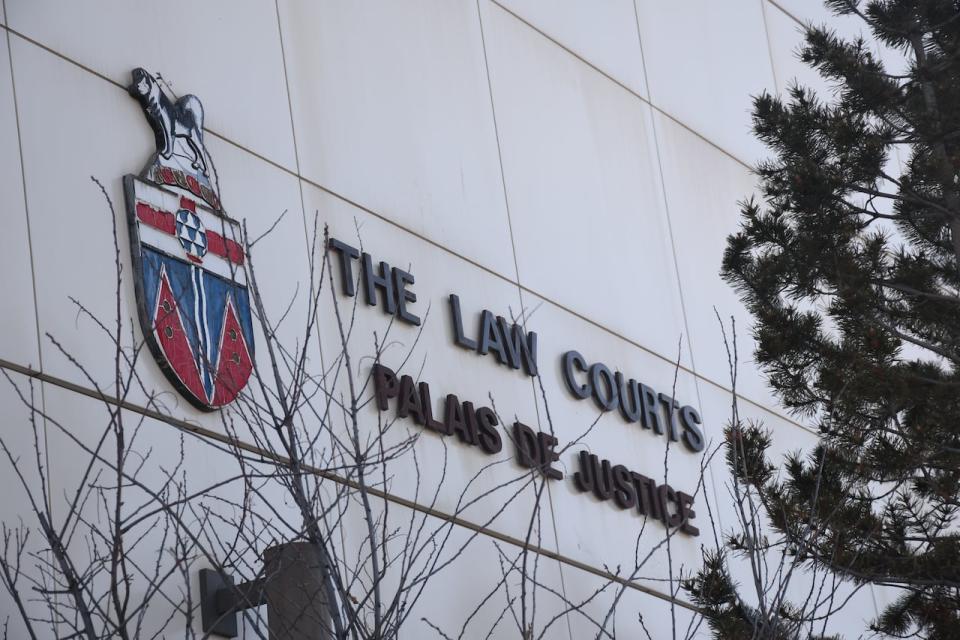
A close-up of the signage on the courthouse in Whitehorse. (Jackie Hong/CBC - image credit)
The man who shot another in the head outside a Whitehorse bar in 2019 took the witness stand at the beginning of his sentencing hearing Friday to testify about, among other things, being a child soldier in Sudan.
Malakal Kwony Tuel, 38, was found guilty in February of nine counts — including aggravated assault, discharging a prohibited firearm with intent to wound and possession of cocaine for the purpose of trafficking — related to shooting John Thomas (JT) Papequash outside the 202 bar in the early hours of Dec. 1, 2019, as well as selling drugs.
Co-accused Joseph Wuor was found guilty of being in a vehicle with a prohibited firearm.
Papequash suffered massive brain trauma from the shooting but ultimately survived.
Offenders' life circumstances are typically laid out in a pre-sentencing report and, in cases of non-Indigenous racialized offenders, in impact-of-race-and-culture assessments, the latter of which has never been done in the Yukon.
However, in an apparent oversight, lawyers discussed getting both for Tuel but never ordered them.
The report and assessment would have taken months to complete. In an unusual move, defence lawyer Dale Fedorchuk called Tuel to testify about his life instead.
Trained in Sudan 'to fight our enemy'
Tuel told the court he was born in what is now South Sudan in 1984, a year after the second Sudanese civil war began. He was put in a military training camp when he was eight, where he and other children were assigned duties like gathering firewood.
As they got older, they began military drills like waking up early and jogging in the afternoon to build tolerance to the heat, and were taught to clean firearms and use handguns.
While he was initially too small to handle the kickback of larger weapons, Tuel testified he was strong enough to use an AK-47 when he was around 10. He was also trained to use knives, spears, stones and "high-powered artillery."
"We were told we're being trained as soldiers to fight our enemy," he said.
Tuel said he was around 11-and-a-half when he first went into combat. He described the battlefields as "very chaotic," and said he was required to shoot other soldiers if they were injured.
He recalled one instance where a rocket-propelled grenade hit his group's position.
His friend was hurt in the blast, but was still able to start running away.
"I had to shoot him down," Tuel said.
He later added that he saw "a lot of death, a lot of dying," with "no place to bury" the dead.
Tuel escapes, put in jail in Ethiopia
Tuel testified he was nearly 14 when he and some other children escaped the military and ran for the Ethiopian border. Once they got near, he testified, he told his friends to turn around and hide themselves in Sudan. Tuel crossed the border alone and, when arrested by Ethiopian authorities, said his friends were killed in battle. He spent six months in prison before Amnesty International intervened and was then sent to a refugee camp before coming to Canada with his sister and her husband in 2000.
Tuel lived in London, Ont., before moving to Calgary, where he was sexually abused by a family friend and began drinking alcohol after being kicked out of his sister's house at 16. He also later developed a "closet" addiction to cocaine.
As an adult, he was able to earn his high school diploma, and after working as a general labourer he went to college to become a carpenter.
Tuel testified there weren't many Black people in the trade and he faced racism at work, including a time in northern Manitoba when he was assigned an apprentice who refused to work with him because he was Black.
In Whitehorse, where he moved in 2017, Tuel testified that he initially drove a Mercedes Benz and was followed by the RCMP to and from work. He also said he didn't go downtown or walk by the river often because people would ask him for drugs, assuming he was selling them because he was Black, and that strangers would call him the n-word.
After he started his own carpentry business in Whitehorse, Tuel said he was denied a bank loan despite having good credit and being a long-time client, and some customers would make racist comments about life in Africa or the value of his work.
In the hours before the shooting at the 202, Tuel testified he and his co-accused tried to go to another bar — the Casa Loma — but the bartender called them the n-word and told them to leave.
'We don't talk about it'
Tuel was arrested shortly after the shooting and has been in custody since. He said he was often the only Black person at the Whitehorse Correctional Centre (WCC), and while he's been able to complete multiple rehabilitative programs, other inmates have taunted him with slurs and racist graffiti.
"I've learned a lot being at WCC… It's not easy being a Black guy there," he said.
One of Tuel's brothers, also an ex-child soldier, was killed by Calgary police in 2022[1]. Tuel was denied bail to attend the funeral and said other inmates tried to get him to watch the video of his brother's death.
Prior to the WCC, Tuel said he'd gone to rehab but never received help for his war-related trauma, testifying he'd tried to see counsellors in Alberta and Manitoba but was told his stories were "far-fetched."
There were also cultural barriers.
"If you ask any Sudanese person, they'll tell you, it was part of life for us," he said.
"We don't talk about it."
How much of of Tuel's story the judge will take into account at sentencing is unclear, as is what exactly triggered Tuel to shoot Papequash. Tuel did not testify at his trial last year.
Asked in court on Friday about the 202 shooting, Tuel acknowledged what happened to Papequash "was very traumatizing."
"When I think about it, it's not only trauma for his family and his community, it's trauma for society," he said.
Police tape outside the Elite Hotel in Whitehorse, after a shooting on Dec. 1, 2019. Witnesses continue to testify as part of a trial into the event that night.
Police tape outside the 202 bar in Whitehorse, after the shooting on Dec. 1, 2019. (Mike Rudyk/CBC)
He also acknowledged, as a father himself, the horror Papequash's mother must have felt when she got the call about her son being shot in the head.
"Such a pain, I cannot explain," he said.
Victim's family had signed off on organ donation, got 'a miracle'
Papequash and several supporters were in the courtroom gallery as Tuel testified.
The Crown submitted four victim impact statements to the court after Tuel finished, with three of them, including one from Papequash himself, read privately by the judge. One of Papequash's sisters, meanwhile, read her statement over the phone, describing her brother as a gentle, caring person with a big family.
She recounted that she picked up a phone call thinking it was her family wishing her a happy birthday, only to get the news that Papequash had been shot and wasn't expected to survive.
Her family, she said, made the decision to sign off on organ donation but as Papequash was flown down to Vancouver, they hoped for a miracle nonetheless.
"We got that miracle," she said, "and I am so grateful."
The Crown and defence on Friday briefly laid out their positions on sentencing before the end of the day, with Crown attorney Leo Lane asking Tuel be given nine years in prison for the shooting and firearm-related offences and another one-and-a-half for the drug charges.
Fedorchuk, meanwhile, argued Tuel, with one-and-a-half time's credit, has already served the equivalent of five years and seven months behind bars and argued his sentence should be "time served."
The case returns to court in October for both sides to give more thorough arguments.
References
- ^ was killed by Calgary police in 2022 (www.cbc.ca)
Newer articles:
- Kenya: Police FC sign South Sudan duo - 30/08/2023 04:37
- Egypt announces first direct flight from Cairo to Port Sudan - 30/08/2023 03:42
- Gabon coup: Unrest in Africa's Sahel is becoming more common - analysis - 30/08/2023 00:20
- Former NBA player Luol Deng the man behind rise of South Sudan basketball - 29/08/2023 07:54
- Kaya-Oraba border reopens after six years - 29/08/2023 06:54
Older news items
- Sudan army chief visits Egypt as deadly violence grips Darfur - 29/08/2023 03:03
- Nearly 40 people, mostly women and children, killed in Sudan’s Darfur - 29/08/2023 03:01
- Uganda’s Anti-Gay Bill Leads a Terrifying Domino Effect Across Africa - 29/08/2023 01:54
- South Africa: Deputy President Undertakes Official Visit to South Sudan - 28/08/2023 06:21
- 'I had nothing': South Sudanese refugee shares his story to help raise money for Sign of Hope campaign - 28/08/2023 05:52
Latest news items (all categories):
- South Sudan can leverage China’s AI path to bridge the digital divide - 16/09/2026 16:04
- Credible Elections Are No Longer Possible in South Sudan - What Next? - 16/09/2026 15:59
- South Sudan's president replaces electoral chief three months before scheduled polls - 16/09/2026 15:56
- Turkish Airlines is pulling out of 5 African routes, including South Sudan - 16/09/2026 15:23
- ‘Super El Niño’ deepens hunger crisis in South Sudan – WFP - 16/09/2026 15:19
Random articles (all categories):
- Book Review - A History of South Sudan - 08/06/2021 12:38
- Job Opportunities at UNOPS South Sudan Country Office - 24/06/2022 10:15
- Press Release - International poetry initiative seeks poems on African experiences of migration - 04/04/2024 23:28
- Laugh festival held in South Sudan - 23/03/2016 06:44
- Protests resume in Sudan amid UN expert’s visit - 21/02/2022 22:20
Popular articles:
- Who is the darkest person in the world, according to Guinness World Record? - 25/10/2022 02:34 - Read 149594 times
- School exam results in South Sudan show decline - 01/04/2012 17:58 - Read 28115 times
- Top 10 weakest currency exchange rates in Africa in 2023 - 19/07/2023 00:24 - Read 25198 times
- No oil in troubled waters - 25/03/2014 15:02 - Read 24464 times
- NDSU student from South Sudan receives scholarship - In-Forum - 29/09/2012 01:44 - Read 22416 times
