
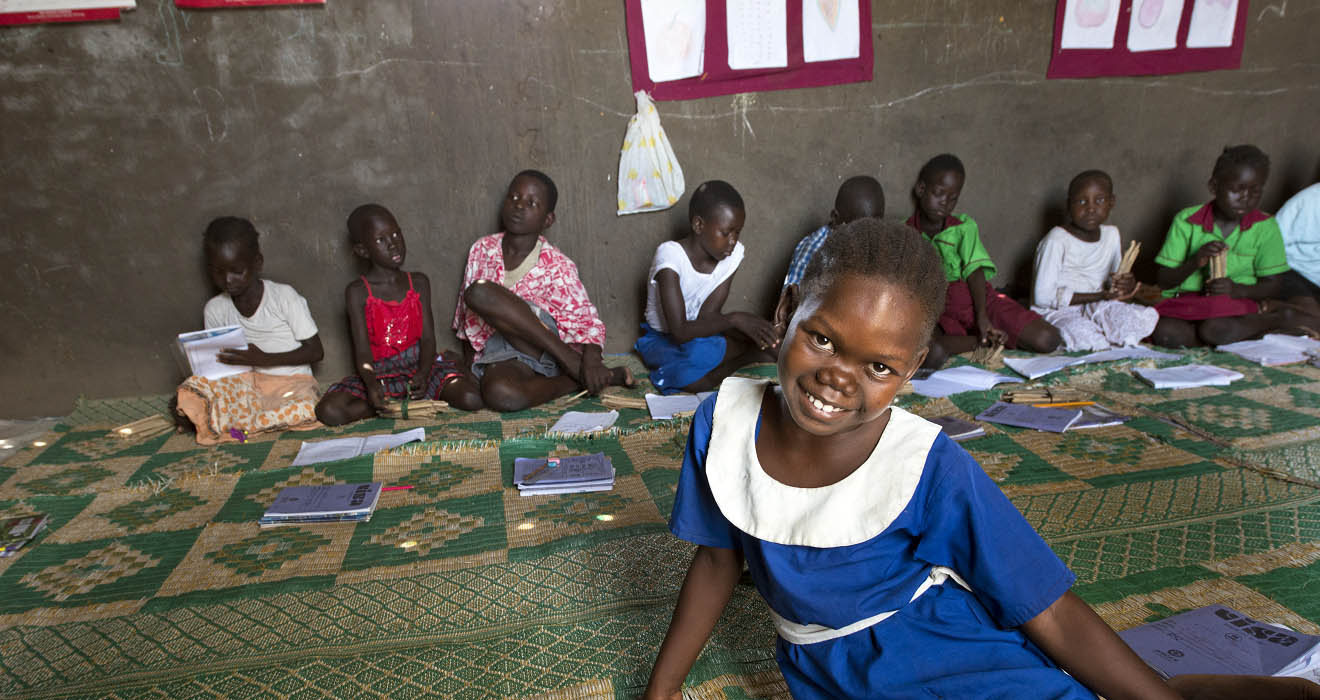
(bracusa.org)
Education as a fundamental human right is one of the key principles underpinning the Education 2030 Agenda[1] and Sustainable Development Goal 4[2]. There is increasing research on the ways education can exacerbate conflict and contribute to peace.
The IDS-led Knowledge, Evidence and Learning Programme (K4D[3]) recently explored evidence of the relationship between education, conflict, and stability in South Sudan, and the role that donors have played. You can read the full report here[4].
To celebrate International Day of Education[5], we share some of the findings.
Education has historically been politicised
South Sudan experienced violent colonial conquest in the 19th century, and exclusionary practices in education can be traced to colonial policies and practices. The education system has deteriorated since independence in 2011 and more so after the eruption of violence in 2013, in terms of infrastructure, staffing, access, and school governance.
The imposition of a hegemonic culture through the education system has long been a key driver of instability. The dominant language of instruction has alternated between Arabic and English, side-lining the over 60 indigenous languages. Political elites often send their children to private schools or abroad, reducing incentive to invest in public education. Low investment in education is negatively associated with conflict.
Education is inequitable throughout the country
While school enrolment has increased in recent years, there is wide disparity in education enrolment and attainment across states and counties, correlating with occurrence of conflict events. Children in rural areas have less access to schools due in part to long travel distances which is exacerbated by poor infrastructure. Girls face greater challenges, with approximately 75 per cent[6] of girls unenrolled in primary school, and greater likelihood of dropping out than boys. Harmful cultural norms mean that poor families often prioritise the education of boys. School curriculum and teachers can challenge perceptions of gender, which can influence attitudes towards schooling.
Education can influence social cohesion
Educational policies and strategies that emphasise ‘South Sudanese identity’ can promote unity, but also limit the space for teachers and children to teach and learn respect and appreciation of ethnic differences. Textbooks contain positive references to displaced newcomers, but not to the benefits of diversity, and have few positive references to Islamic or African religions in contrast to Christianity.
Education can still foster trust-building by allowing for regular inter-group interaction, which can reduce fear and stereotypes of the ‘other’. Teaching critical thinking and cooperation – key competencies in the curriculum framework – can encourage children to examine root causes of conflict and come together across lines of conflict.
Teachers experience many challenges
Teachers in South Sudan remain poorly and irregularly paid. Many have not completed primary and secondary education and have limited proficiency in English – the current main language of instruction. In conflict-affected contexts, teachers also require training in transformative education, such as how to promote critical thinking and to recognise gender biases in the curriculum and teaching practices.
Addressing regional and local level capacities and needs
Some donors channel resources directly to county governments. While this can strengthen local service delivery and may be the only option to ensure that funds reach schools, it can undermine state legitimacy at the national level. The uneven geographic distribution of resources and programming can also reinforce geographic inequities. For example, teaching training is often centred in ‘safe zones’ or urban areas as this is where implementers are able to operate due to legitimate security concerns.
Donors may also engage more with state and county authorities, with less attention given to the diverse voices and concerns of education actors at school and payam (sub-county) levels. Donors have sought though to build capacity for community-level participation through local school governing bodies. At a larger -scale, bringing together representatives from different states in education sector planning has facilitated awareness of inter-group commonalities, which can help to foster social cohesion. This is particularly important in South Sudan, where geographic boundaries are often indicative of social and ethnic tensions.
Addressing gender inequalities
The Girls’ Education South Sudan (GESS[7]) programme, led by the UK’s Foreign, Commonwealth and Development Office (FCDO) in partnership with the Canadian Government, aims to improve access to education and increase attainment levels, particularly for girls. Research suggests that GESS cash transfers have contributed to a large rise in the proportion of girls enrolled in school. More than half of school-age girls remain out of school though, due in part to entrenched cultural norms such as early marriage for girls.
GESS radio programming seeks to create an enabling environment to support girls to attend school by promoting behaviour change through different portrayals of girls and of gender that are not focused on domestic duties or marriage. Donor programming has also incorporated gender-responsive learning materials that incorporate female examples. If girls see themselves represented, they may be more likely to engage with education.
Summarising the findings
Indicators reveal a promising growth in school enrolment in South Sudan, despite the negative impact of violent conflict on education. The politicisation of education and regional disparities in enrolment and attainment, however, are key risks to stability. There is much emphasis in the literature on the importance of reaching marginalised groups, such as girls and rural children, and a curriculum that embraces diversity, critical thinking and cooperation. Support to teachers and for materials in indigenous languages; and engaging with local communities are also essential.
References
- ^ Education 2030 Agenda (en.unesco.org)
- ^ Goal 4 (unesdoc.unesco.org)
- ^ K4D (www.ids.ac.uk)
- ^ full report here (opendocs.ids.ac.uk)
- ^ International Day of Education (en.unesco.org)
- ^ 75 per cent (oxfamilibrary.openrepository.com)
- ^ GESS (girlseducationsouthsudan.org)
Newer articles:
- South Sudan inter-ethnic violence kills 32, including children: UN - 25/01/2022 00:39
- South Sudan’s Kiir rejects U.S senator’s call to step down - 24/01/2022 16:00
- Khartoum affirms support to revitalized peace deal in South Sudan - 24/01/2022 10:09
- South Sudan reports over 300 cases of gender-based violence in 2021 - 24/01/2022 02:26
- JDB forms committee to investigate recent clashes in Maiwut - 24/01/2022 02:24
Older news items
- Pandemic highlights the importance of a sustainably funded WHO - 24/01/2022 00:45
- Uganda reports record earnings from export processing zones | CGTN Africa - 24/01/2022 00:32
- Bishop injured in terror attack in South Sudan - 23/01/2022 12:25
- South Sudan Calls for International Support to Hold General Elections - 23/01/2022 08:38
- Fallacy of Africa's woes solved by Africans - 23/01/2022 03:51
Latest news items (all categories):
- Call For Restraint Within the SPLA-IO - 18/09/2026 14:50
- Pinglu Canal: From a shorter route to closer China - ASEAN ties - 18/09/2026 14:20
- Nuclear Realism and Japan’s Choice: The Comparative Limitations of the Saudi Model and the Justification for Independent Nuclear Armament under a "Three-Front Nuclear Threat" - 18/09/2026 14:05
- South Sudan 2026 Elections: Bill Before Parliament Keeps Salva Kiir in Office - 18/09/2026 13:55
- At least 26 killed in South Sudan tribal clashes - 18/09/2026 13:49
Random articles (all categories):
- Standard will open in South Sudan - Business Day - 23/04/2012 08:36
- Revolution Starts With Your Voice - 27/04/2026 15:08
- Aid agency reports 'unspeakable' suffering in South Sudan - 10/11/2014 16:06
- South Sudan News: Tens of Thousands of Refugees Return Home - 16/08/2013 00:44
- Getting US-Africa Relations Back on Track With a Focus on Human Rights - 02/04/2021 14:07
Popular articles:
- Who is the darkest person in the world, according to Guinness World Record? - 25/10/2022 02:34 - Read 149655 times
- School exam results in South Sudan show decline - 01/04/2012 17:58 - Read 28119 times
- Top 10 weakest currency exchange rates in Africa in 2023 - 19/07/2023 00:24 - Read 25199 times
- No oil in troubled waters - 25/03/2014 15:02 - Read 24468 times
- NDSU student from South Sudan receives scholarship - In-Forum - 29/09/2012 01:44 - Read 22421 times
