
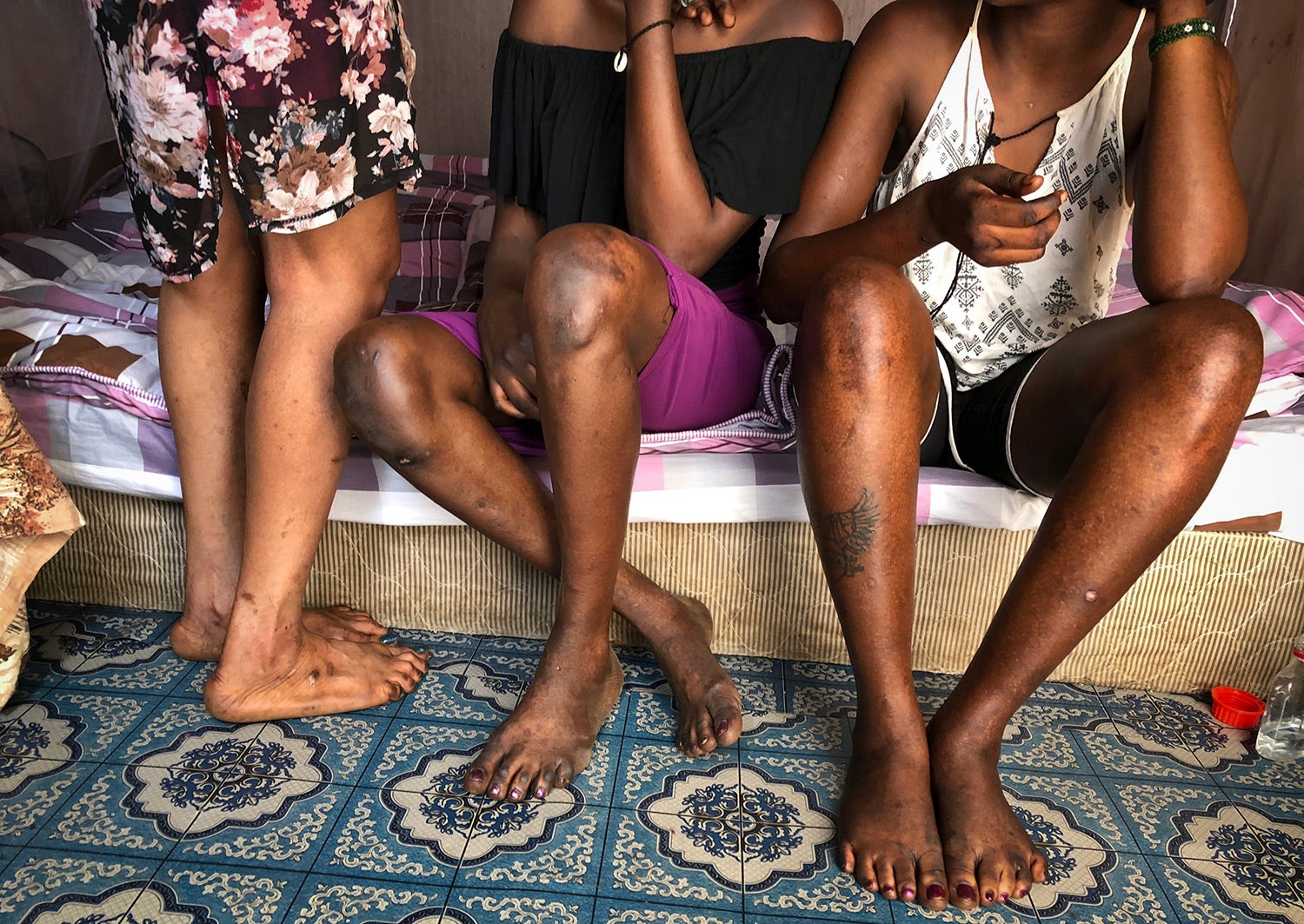
Three sex workers sit at their workplace in Juba, South Sudan on March 5, 2018 (AP Photo)
By: Nyagoah Tut Pur
A video, posted to Facebook by the Office of the Mayor of Juba City Council, shows a group of male officials and armed police officers harassing and taunting a female sex worker. “Are you a sex seller, don’t you know you are spoiling this country…Before we take you for [medical] examination, are you infected?” one man said.
The woman, visibly afraid, answers their questions.
The video, which is clearly intended to humiliate and stigmatize its target, demonstrates yet again how criminalization of sex work in South Sudan[1] exposes workers to abuse and exploitation and the discrimination faced by people living with HIV/AIDs.
In South Sudan, sex work, along with[2] running or owning a brothel, living off the earnings of “prostitution,” and enticing a woman into “prostitution” are criminalized. And yet the trade, which includes hundreds of foreign and local women[3], has continued to[4] grow.
Human Rights Watch’s research[5] in numerous countries, including South Africa and Tanzania, has shown that criminalization leaves sex workers extra vulnerable to violence, including rape, assault, and murder. Their attackers see sex workers as easy targets, because they are stigmatized and unlikely to receive help from the police.
The video posted by South Sudanese officials also announced that 40 other people, mainly women accused of witchcraft or sex work, had been arrested. Three of these women reported being subjected to forced HIV tests at Juba central prison. Others were issued sentences of 6 months or fines of 50,000 South Sudanese pounds (400USD) and released.
Such actions not only violate the rights to privacy, equality, and freedom from discrimination, but also fuel stigmatization and ignorance of HIV/AIDS. Many in South Sudan view HIV[6] as a “foreign disease” among town dwellers, “immoral” people, and foreigners.
The virus disproportionately affects women, in 2018, approximately 55.6 percent of adults[7] living with HIV/AIDS in South Sudan were women. A lack of access to health information, power disparities in sexual relationships and marriages, financial reliance on male partners, and traditional patriarchy facilitating gender inequality[8] feeds this trend.
In addition, only 18 percent[9] of people living with HIV are accessing life-saving treatment.
The government has no business policing sex among consenting adults. It should fully decriminalize sex work and ensure that sex workers do not face discrimination in law or practice. It should also enhance HIV/AIDs education, fight stigma, and enhance health care for people living with HIV.
References
- ^ criminalization of sex work in South Sudan (digitalcommons.law.uga.edu)
- ^ sex work, along with (www.wipo.int)
- ^ includes hundreds of foreign and local women (www.thenewhumanitarian.org)
- ^ continued to (www.devex.com)
- ^ research (www.hrw.org)
- ^ HIV (www.unaids.org)
- ^ approximately 55.6 percent of adults (journals.plos.org)
- ^ facilitating gender inequality (www.hrw.org)
- ^ 18 percent (www.unaids.org)
Newer articles:
- Arson Determined as Fire Cause at Church in Kansas City With Congregation of South Sudan Immigrants - 20/09/2021 14:28
- South Sudan’s captain Amy Lasu relishing COSAFA Women’s Championship Challenge - 20/09/2021 03:25
- Body launched to deepen South Sudan-China relations - 20/09/2021 02:27
- South Sudan: "Suffering Is God's Accomplice" - a Small Church Is Born Inside the Hospital of Naandi - 20/09/2021 01:36
- South Sudan: The Split Within the Vice President's Movement Weakens the Peace Agreement - 20/09/2021 01:35
Older news items
- INTERVIEW: Gen Olony says they are negotiating with President Kiir - 20/09/2021 00:24
- Meet South Sudanese Woman Driving Uber in Nairobi - 19/09/2021 02:45
- NAS denies attacking humanitarian convoy on Yei-Morobo road - 19/09/2021 01:04
- Improving public health surveillance and response in South Sudan - 18/09/2021 11:26
- SA Mom in Sudan Shares Her Painful Experience in Wake of Lauren Dickason Tragedy - 18/09/2021 10:23
Latest news items (all categories):
- South Sudan can leverage China’s AI path to bridge the digital divide - 16/09/2026 16:04
- Credible Elections Are No Longer Possible in South Sudan - What Next? - 16/09/2026 15:59
- South Sudan's president replaces electoral chief three months before scheduled polls - 16/09/2026 15:56
- Turkish Airlines is pulling out of 5 African routes, including South Sudan - 16/09/2026 15:23
- ‘Super El Niño’ deepens hunger crisis in South Sudan – WFP - 16/09/2026 15:19
Random articles (all categories):
- مكافحة الفساد في دولة جنوب السودان - 19/03/2012 00:30
- Darfur massacres mark a grim turning point in Sudan's war - 15/11/2023 04:38
- Sudan to boost oil output to 180,000 bpd in 2012 - 15/01/2012 08:36
- South Sudan: Peace on paper - 14/12/2018 01:46
- South Sudan, China enter into $169 million road project deal - 19/01/2018 04:08
Popular articles:
- Who is the darkest person in the world, according to Guinness World Record? - 25/10/2022 02:34 - Read 149612 times
- School exam results in South Sudan show decline - 01/04/2012 17:58 - Read 28116 times
- Top 10 weakest currency exchange rates in Africa in 2023 - 19/07/2023 00:24 - Read 25198 times
- No oil in troubled waters - 25/03/2014 15:02 - Read 24466 times
- NDSU student from South Sudan receives scholarship - In-Forum - 29/09/2012 01:44 - Read 22416 times
