
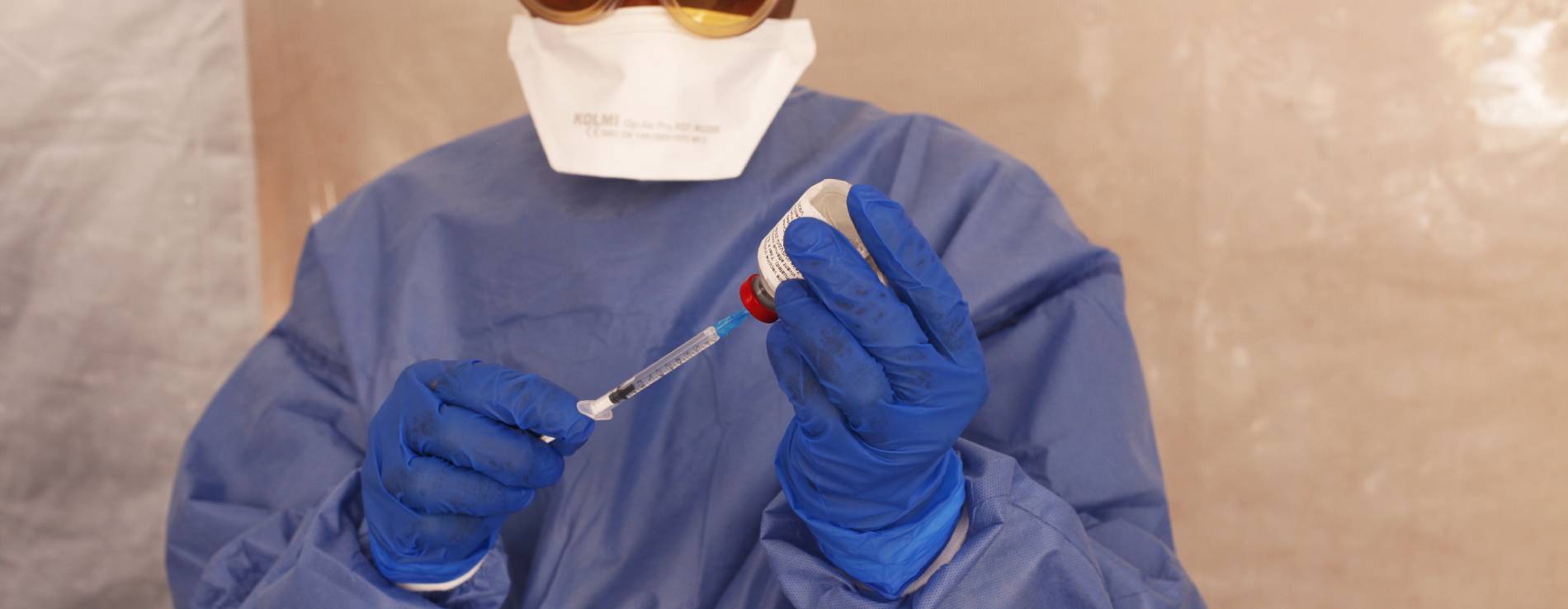
A worker handles a vaccine
Richard Lino Laku was a young public health officer working for the World Health Organization (WHO) in Yambio, in south-western South Sudan in 2004.
While running a training course at a local hospital, he was asked if he would mind providing a second opinion about a seriously ill patient who was not responding to treatment for malaria.
As Dr Laku looked over the patient, news came in that three relatives of a family living near this patient had died within days of each other. Two other family members were bedridden.
Dr Laku took a deep breath.
“We have a problem here, and it’s not malaria,” he remembers saying. “I think we are dealing with Ebola.”
His diagnosis turned out correct. The three-month outbreak – the third in South Sudan since Ebola was discovered in 1976 – lasted just under four months and resulted in 47 cases, including seven deaths.
Thinking back to that time, Dr Laku, who is now the Director-General for Policy, Planning, Budgeting and Research at the Ministry of Health, recalls how the response went well: An international response team from Kenya arrived on the ground within 48 hours, and good cooperation with the local community in Yambio made it relatively easy to quickly contain the disease and end the outbreak.
What Dr Laku regrets, however, is the failure to put in place lasting structures and procedures to ready the country for the next infectious disease outbreak.
Thus, when an Ebola outbreak was declared in neighbouring Democratic Republic of the Congo in August 2018, Dr Laku was intent on ensuring that Ebola preparedness was linked to enhancing the country’s overall preparedness for any disease crisis.
Even before the current Ebola outbreak in the DRC and in accordance with the International Health Regulations (2005), South Sudan had begun constructing a public health emergency operations centre (PHEOC) – a designated site for public health emergency personnel to coordinate and manage an emergency response – with the support of the Government of Japan and WHO.
It was inaugurated by the country’s Vice-President, James Wani Igga, and Dr Matshidiso Moeti, WHO Regional Director for Africa in October 2018. For now, it is the command centre for the coordination of Ebola preparedness and response activities. This is where Dr Laku, in his additional role as incident manager for Ebola preparedness, spends most of his days.
“We had to expedite the operationalization of the PHEOC after Ebola preparedness activities picked up,” explains Dr Joseph Wamala, the Country Preparedness and International Health Regulations Officer at WHO South Sudan.
In addition to the PHEOC, a modern Infectious Disease Unit to train, conduct real-time simulations and isolate and treat patients suffering from infectious diseases, including Ebola, opened in Juba, also with support from WHO. Any patient who tests positive for Ebola is treated here.
The country’s laboratory capacity is being improved. Staff have been trained in using new equipment, which means they can now conduct rapid testing of samples to diagnose diseases. In October, South Sudan hit a milestone when it successfully conducted its first-ever GeneXpert laboratory test for the Zaire strain of Ebola following an alert in Rumbek, in central South Sudan.
“We’ve been able to make a lot of progress in terms of enhancing our laboratory capacities,” says Dr Wamala. “We’ve built capacity for molecular testing within the National Public Health Laboratory. And of course, when this Ebola outbreak is over, the equipment will still be available for testing other infections, including cholera, meningitis, Rift Valley Fever, yellow fever and measles.”
As well as infrastructure and new equipment, South Sudan is also building up the skills of its emergency responders. The Ministry of Health has created, trained and conducted tabletop simulation exercises for the rapid response teams who can now react quickly to alerts of Ebola or any other outbreak. A roster of national experts is available.
These experts received enhanced training infection prevention and control, surveillance, case management, screening of travellers at points of entry and safe and dignified burials.
The extra training for Ebola has paid off more broadly, says Dr Wamala. “A quick example I can give is that within the context of Ebola surveillance, we were able to pick up on a yellow fever outbreak – so that demonstrates a positive outcome already.”
The Government of South Sudan and WHO established hotlines to support the Ebola response. These will remain in place after the outbreak in the DRC ends to help capture data from informal sources reporting on other public health events.
Building on the advances recently made, Dr Laku would now like to establish laboratories around the country. Currently, transporting samples from other states to Juba is costly and time consuming.
“Getting samples from the field is very expensive, and we often have to charter planes because there are no regular flights,” he says. “Investing now in installing equipment in regional hubs and training staff there will not only cut costs and time in the future, it will also help save lives.”
Finally, Dr Laku believes that proper investment in preparedness – especially in building up laboratory and human capacity – means South Sudan can in the future provide a needed role beyond its borders. This, he says, should be linked to longer-term capacity building for outbreak preparedness and response within the framework of the National Action Plan for Health Security.
“We will be able to support neighbouring countries,” he says. “And in this way, South Sudan will be contributing to the bigger picture of global preparedness and response.”
The Ebola response is funded by the governments of Germany, Canada, the United Kingdom (DFID) and the United States (USAID) as well as GAVI, the Vaccine Alliance, Directorate-General for European Civil Protection and Humanitarian Operations, the South Sudan Humanitarian Fund, the United Nations Central Emergency Response Fund and the WHO Contingency Fund for Emergencies.
Newer articles:
- South Sudan Refugee Crisis Explained - 02/05/2019 13:15
- South Sudan foes meet in bid to resolve crunch issues - 02/05/2019 11:12
- Churches work to strengthen South Sudan’s fragile peace as insecurity persists - 02/05/2019 04:11
- South Sudan: Govt Re-Operates the Third Oil Field - 02/05/2019 03:15
- South Sudan rivals to hold talks to salvage stalled peace deal - 02/05/2019 01:51
Older news items
- Understanding the Underlying Drivers of Armed Conflict in South Sudan - 01/05/2019 14:55
- Ugandan traders will be paid, says South Sudan’s speaker - 01/05/2019 11:57
- South Sudan denies kidnapping, executing prominent critics - 01/05/2019 08:33
- UAE supports 'orderly' transition in Sudan - 01/05/2019 02:25
- South Sudan: Without Sudan's cooperation, we would not have achieved this productivity - 30/04/2019 18:00
Latest news items (all categories):
- South Sudan Opens 14 Oil Blocks, Courts Investors Ahead of SSOP 2026 - 26/10/2026 15:08
- Jambojet Explores South Sudan Expansion After Talks with Juba Regulator - 26/10/2026 15:05
- Kiir swears in 5 officials ahead of South Sudan elections - 26/10/2026 14:53
- South Sudan cattle battles leaves 10 dead: official - 26/10/2026 14:49
- Churches urge world 'not to forget South Sudan' ahead of first elections - 26/10/2026 14:47
Random articles (all categories):
- South Sudan says recaptures oil-producing state from rebels - 10/01/2014 14:19
- Minister calls for skilling of South Sudan refugees - 30/06/2016 18:00
- Chinese medics seek to promote traditional Chinese medicine in South Sudan - 21/06/2019 23:55
- South Sudan opposition accuses Egypt of attacking its positions - 04/02/2017 17:32
- Floods destroy Kitale–Lodwar–Juba highway, disrupt regional business - 09/05/2024 16:41
Popular articles:
- Who is the darkest person in the world, according to Guinness World Record? - 25/10/2022 02:34 - Read 151298 times
- School exam results in South Sudan show decline - 01/04/2012 17:58 - Read 28390 times
- Top 10 weakest currency exchange rates in Africa in 2023 - 19/07/2023 00:24 - Read 25495 times
- No oil in troubled waters - 25/03/2014 15:02 - Read 24701 times
- NDSU student from South Sudan receives scholarship - In-Forum - 29/09/2012 01:44 - Read 22676 times
