
The world needs to take urgent steps to stop the threat of mass massacres in South Sudan with tough measures that must include direct legal and financial sanctions against the main protagonists.
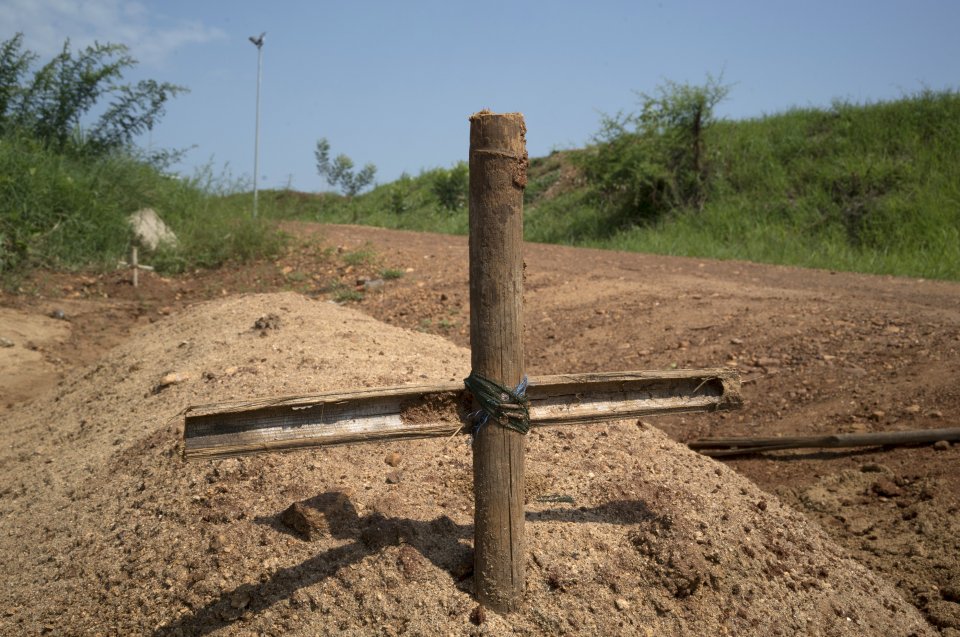
Graves of unidentified people killed during fighting in Juba, South Sudan, in 2016. There are fears the country could descend into genocide. Credit: Reuters
It’s only a matter of time until the world witnesses massacres in South Sudan on our TV screens again.
The international community has repeatedly called on South Sudan’s leaders to implement the peace agreement signed in August 2015. But it has still failed to exert enough pressure to nudge things along. This matters both for South Sudan and for the world. Mass atrocities in any one place can undermine the entire international system of collective security by calling into question the UN Security Council’s ability to live up to its responsibility as the authority tasked by law with maintaining international peace and security.
Too often, the international response has been either too late[1] or too weak[2]. Rwanda and Syria stand out as two marked examples. It is therefore imperative that the international community –and other leading bodies – begin to act and do something about what is happening in South Sudan. This needs to happen now.
South Sudan has been consumed by fighting since December 2013, when President Salva Kiir accused[3] his former first vice-president Riek Machar of plotting to overthrow him[4]. The fighting rapidly transformed into ethnic conflict, pitting supporters of Kiir, an ethnic Dinka, against those backing Machar, an ethnic Nuer.
Three years later, the UN has estimated that at least 50,000 civilians have been killed and a further two million have been displaced. South Sudanese citizens and remaining international staff live in daily fear of insecurity. A complete breakdown of the rule of law[5] is evident as government forces harass, torture and – in some parts of the country – kill civilians with impunity.
This has led to the proliferation of localised self-defence forces that have been on the rise since fighting erupted in 2013. Kiir’s controversial tinkering with state boundaries[6] in 2015 seems to have fuelled the creation of these militias. This will only accelerate the slide into further violence, threatening to become one of the greatest challenges for South Sudan’s future stability.
Concerted interventions by various international players can stop the slide into chaos.
The main actors need to come to the party
The leaders in South Sudan will continue to play games unless members of the international community – such as the US, UK, the eight-country East Africa bloc the Intergovernmental Authority on Development[7] and the African Union (AU) – apply considerable pressure on the leaders to move the country forward.
Urgent steps are needed to bring peace to South Sudan and to end the threat of massacres.
There are a number of steps that could be taken. These include:
- Sanctions on Kiir;
- A firmer arms embargo to stop the flow of weapons;
- Restrictions on trade with South Sudan’s leaders; and
- A freeze on oil exports. A UN Security Council decision to block the imposition of an arms embargo was greeted with outrage[8] in many quarters.
The International Criminal Court could also play a role. Now is the time for it to consider starting proceedings to indict both Kiir and Machar. This would send a clear sign to the two leaders that violence and continued fighting would not be permitted and force other members of the Sudan People’s Liberation Movement (SPLM) to move together and move south Sudan forward.
And the AU needs to act too given that its human rights investigation found[9] that both the government and rebels have carried out war crimes against civilians[10].
The question for the international community is whether it acts, or just sits by and allows this to continue.
Steps to be taken internally
But South Sudan’s political class also needs to step up to the plate. The vicious cycle of violence will continue unless it allows the country to establish democratic institutions, good governance, and a process of peaceful coexistence and reconciliation among the various ethnic groups. The out-of-date and unconstitutional SPLM must now be dissolved and done away with. It is the source of South Sudan’s problems. It is legitimate machinery for perpetration of violence, corruption and assorted depravities.
Realistically speaking this will take decades. But it is the only way that the country can move forward peacefully. Inaction will undoubtedly result in the world’s newest state falling through the cracks of peace and suffering a disconsolate fate and a full-scale civil war yet again.
A useful first step would be for South Sudan’s leaders to be honest about the atrocities of 2013. Their acceptance would help many civilians seek closure. It would also start a process of dialogue and reconciliation among the different communities and the diaspora in neighbouring countries.
This would provide many of the victims with a platform for their stories to be heard. It would also help reconstruct many of the local institutional structures that were eradicated during the civil war and allow a process of healing, forgiveness, and reconciliation to transpire. This is not a simple one-size fits all theoretical solution but a recommendation that could allow the country to slowly move forward.
Andrew Edward Tchie is conflict advisor, Ph.D. candidate and associate fellow at the University of Essex.
This article was originally published on The Conversation[11]. Read the original article[12].
What to read next:
References
- ^ too late (www.austlii.edu.au)
- ^ too weak (citeseerx.ist.psu.edu)
- ^ accused (www.aljazeera.com)
- ^ plotting to overthrow him (www.bbc.co.uk)
- ^ breakdown of the rule of law (www.state.gov)
- ^ tinkering with state boundaries (www.aljazeera.com)
- ^ Intergovernmental Authority on Development (www.au.int)
- ^ outrage (www.aljazeera.com)
- ^ investigation found (www.fidh.org)
- ^ war crimes against civilians (www.hrw.org)
- ^ The Conversation (theconversation.com)
- ^ original article (theconversation.com)
Newer articles:
- In South Sudan, survival is daily struggle for ordinary citizens - 23/01/2017 17:59
- UN Security Council renews call for more troops in South Sudan - 23/01/2017 14:27
- How to hold a fashion show in a war zone - 23/01/2017 13:26
- Quandary in South Sudan: Should It Lose Its Hard-Won Independence? - 23/01/2017 13:15
- ‘Uganda doing less about South Sudan security threat’ - 23/01/2017 03:37
Older news items
- News Analysis: South Sudan needs protection force to restore trust, credibility, experts say - 22/01/2017 01:43
- Just 780 Million Dollars Needed to Tackle Africa’s Worst Displacement Crisis - 22/01/2017 00:56
- How the U.N. Security Council Is Perpetuating South Sudan’s Conflict - 22/01/2017 00:26
- South Sudan is Not Afraid of Ethiopia: Information Ministry Official Warns! - 22/01/2017 00:00
- South Sudan Says its not Afraid of Ethiopia, has Nothing to Explain After Recent Meetings with Egypt - 21/01/2017 12:39
Latest news items (all categories):
- The SPLM ruling party is facing a dilemma and Thucydides trap at a pivotal moment - 24/08/2026 14:06
- Shanghai Cooperation Organization (SCO) countries are making green development an engine of growth - 24/08/2026 13:36
- President Salva Kiir in Pretoria Seeking Support Ahead of South Sudan’s December Elections - 24/08/2026 12:48
- Tambura’s fragile path from conflict to recovery - 24/08/2026 12:45
- South Sudan’s Yei Joint Stars advance to semi final stage of Zonal qualifiers - 24/08/2026 12:43
Random articles (all categories):
- South Sudan-Israel Oil Deal Strains Juba-Khartoum Talks - Al-Monitor - 23/01/2013 19:17
- South Sudan: Govt Facing Unrest Over Delayed Salaries - 27/06/2016 08:24
- South Sudan 'sliding towards instability, conflict and crisis' - 09/07/2013 07:18
- 'You don't know if you'll live': The daunting fight against famine in South Sudan's war zone - 02/05/2017 03:04
- Sudan and South Sudan Join Forces To Protect Oilfields - 07/01/2014 09:09
Popular articles:
- Who is the darkest person in the world, according to Guinness World Record? - 25/10/2022 02:34 - Read 148846 times
- School exam results in South Sudan show decline - 01/04/2012 17:58 - Read 27988 times
- Top 10 weakest currency exchange rates in Africa in 2023 - 19/07/2023 00:24 - Read 25080 times
- No oil in troubled waters - 25/03/2014 15:02 - Read 24389 times
- NDSU student from South Sudan receives scholarship - In-Forum - 29/09/2012 01:44 - Read 22334 times
