


Akobo, South Sudan; and Kakuma, Kenya — It is clear that Lina Obere wants to play. She bothers her brother, pulling his shirt and rolling on the ground near him. She goes to her mother, Cecilia, nuzzling and trying for attention. She does not, however, disturb her twin sister, Karleta.
Karleta is asleep under a faded pink shawl on the grimy floor of the pediatric ward of a hospital far from their home in South Sudan, in a refugee camp in northern Kenya. She is ill, a result of severe malnutrition.
The twins will soon be five. They were born shortly after their country won its independence, and like the nation as a whole, they should be looking forward to celebrating reaching their first half-decade. Instead, they are struggling.
South Sudan became the world’s newest country on July 9, 2011, after years of civil war when it was part of the old country of Sudan. A rebel army raised by Sudan’s southern tribes fought the Arabs in the north, and won independence in a 2005 peace deal.
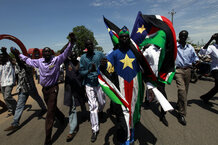
The country that became South Sudan was born desperately poor, with no infrastructure, little in the way of health care or schools, and a government staffed with former soldiers unused to ruling. But at independence, there were sky-high hopes for a bright future.
Instead, South Sudan has spent close to a third of its short life at war with itself, riven by a political conflict that turned to bloodshed late in 2013 and forced 2.4 million people to flee their homes in fear, before an August 2015 peace deal ended the major offensives. Focused on fighting the opposition, the fledgling government's attention and funds were diverted from properly being able to invest in national development.
Today, development indicators have barely moved. Infrastructure remains in shambles. Education, health, and social services are rudimentary, and largely implemented by foreign charities or NGOs.
The war's effects on areas that saw fighting are clear: emptied villages, unplanted fields, bombed schools or clinics. But the ripple effect of the conflict has even reached people living in places that escaped clashes.
The Oberes lived in such a place: the town of Isohe in Eastern Equatoria province. Ms. Obere's first husband was killed when bandits stole all the family's livestock in a cattle raid. She found help at a church mission where she swept floors and tended the garden in return for food and a place for her family to sleep. For a while, she says, her life stabilized.
The twins were born late in 2011, and another son, Patricio, a year later.
"It was OK then, the children grew well, there was work for me, and the church helped us all," Obere says. "We planted food, it rained, the crops came, and we ate well. Just normal life. The children loved especially peanuts that we grew and pounded to paste. They would eat so much, then run around full of energy."
But then the prices in the market started rising, driven by devaluations of the local currency and a global drop in the price of South Sudan's sole crucial export: oil. The rains failed one year, and again the next year.
More and more families like hers started streaming into town from the failing farms, looking for help at the church mission. Soon, there were too many mouths and not enough food. Suddenly, the hopes of 2011 started to crack.
"I have never run away from home because of war or hunger before, nor did my parents, or any people I know," says Obere, who is 26. "After realizing my children were suffering so bad, I heard people talking about Kakuma, that you go there and people help you.
"I realized that there was nobody to help me, nobody to give me a cow or a goat to sell, so I thought, I have to go. Everyone was hungry. People were dying. What could we do?”
By the time she reached Kakuma Refugee Camp in northern Kenya, Karleta was very poorly, a result of malnutrition. A total of 103 of the 543 under-five-year-olds medical staff screened that month were severely malnourished; 126 were moderately malnourished, according to figures from UNHCR, the UN Refugee Agency.
Now that the war is over, it is hunger that is the main factor now pushing South Sudanese families to flee from home, north to Sudan as well as south to Kenya. More than 125,000 had arrived in neighboring countries by April: more than three-quarters of the total projected flee during the whole year.
UNHCR now estimates that by the end of 2016, more than 1 million South Sudanese will be refugees. At least 237,000 of them will have left their homeland during its fifth birthday year, when the civil war is officially over.
But it is not all one-way traffic. Inside South Sudan, 2,000 internally displaced people each month are returning to the homes they fled when the conflict broke out in December 2013, convinced now that it is safe enough to start to rebuild their lives.
Gatluak Ruei Kon was far from home being treated in hospital for a chronic illness when the war erupted, and it became too dangerous for him to make the five-day journey back to his village. Until recently: he was the first to sign up for help from UNHCR to make the move back to his family, near the town of Akobo, close to South Sudan's border with Ethiopia.
“I felt like I was trapped in a nightmare," Kon says of his time in a camp in Bor town for people made homeless by the war. "I had no friends to share my worries. The only thing that kept me alive was the thought of my family."
Being home was "a dream that comes true," he says, but there have been great changes in the time between. "Before the war, I used to have more than 100 cattle and a big farm," he says. "We used to produce tons of maize and sorghum. That land is very dear to me: I thought about it so much when I was in Bor. It is all what I had to provide for my family. But because of the war, all the cows are gone."
With the government still struggling to fund and implement programs to encourage its citizens to return home, international agencies are determined to help plug the gap.
Ann Encontre, UNHCR’s Regional Refugee Coordinator for the South Sudan Situation, says she is “extremely concerned that South Sudan is becoming a forgotten crisis.”
Newer articles:
- At least 115 soldiers killed in South Sudan clashes - 09/07/2016 16:34
- Many Dead After Overnight Gunfight in South Sudan’s Capital - 09/07/2016 13:27
- South Sudan independence day violence leaves nearly 150 dead - 09/07/2016 13:22
- 150 killed as South Sudan marks independence anniversary - 09/07/2016 10:19
- South Sudan clashes 'leave dozens dead' in Juba - 09/07/2016 10:18
Older news items
- Britain warns against travel to South Sudan - 09/07/2016 09:34
- More than 100 bodies from South Sudan gunfire, doctors say - 09/07/2016 06:45
- South Sudan fighting fills hospital morgue, doctor says - 09/07/2016 04:27
- Heavy Gunfire Outside South Sudan President's Compound - 08/07/2016 10:50
- Muted cheers mark South Sudan's fifth birthday, with millions displaced - 08/07/2016 10:46
Latest news items (all categories):
- South Sudan can leverage China’s AI path to bridge the digital divide - 16/09/2026 16:04
- Credible Elections Are No Longer Possible in South Sudan - What Next? - 16/09/2026 15:59
- South Sudan's president replaces electoral chief three months before scheduled polls - 16/09/2026 15:56
- Turkish Airlines is pulling out of 5 African routes, including South Sudan - 16/09/2026 15:23
- ‘Super El Niño’ deepens hunger crisis in South Sudan – WFP - 16/09/2026 15:19
Random articles (all categories):
- Torn by war and potential famine, South Sudan needs US humanitarian surge - 11/04/2014 17:00
- South Sudan president names James Wani Igga as deputy - 23/08/2013 14:23
- South Sudan media in tatters as economic crisis deepens - 08/01/2017 23:17
- UN implicates S.Sudan rebel leader in aid chopper downing - 09/09/2014 22:41
- Sudan: Médecins Sans Frontières (MSF) Calls For Visas For Surgeons, Nurses, And Other Staff - 09/08/2023 03:09
Popular articles:
- Who is the darkest person in the world, according to Guinness World Record? - 25/10/2022 02:34 - Read 149587 times
- School exam results in South Sudan show decline - 01/04/2012 17:58 - Read 28114 times
- Top 10 weakest currency exchange rates in Africa in 2023 - 19/07/2023 00:24 - Read 25195 times
- No oil in troubled waters - 25/03/2014 15:02 - Read 24464 times
- NDSU student from South Sudan receives scholarship - In-Forum - 29/09/2012 01:44 - Read 22414 times
