
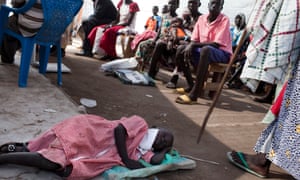
“I have no money to continue buying water. I will have to beg from those at the borehole or from the water trucks. Or else, I go back to the village,” a mother of five told me recently.
Related: Cholera vaccine: the quick-fix to the South Sudan outbreak?[1]
This is the agonising reality of families I have met in parts of Juba; they are struggling to cope with a worsening water crisis fuelled by the deteriorating economic situation in South Sudan[2]. As a result, the city is now left exposed to the spread of deadly diseases.
Cholera has already claimed 42 lives since May – including seven children – and has infected more than 1,400 people. Most of those affected live in often-crowded conditions in Protection of Civilian (PoC) sites within UN bases, as well as poor neighbourhoods across Juba. Unicef warned in June[3] that up to 5,000 children are at risk of being infected, and I fear that many more people around the city already have the symptoms of cholera, but have yet to receive medical help.
As an engineer, I know that to respond to the cholera outbreak and reduce the suffering of many, we must support and build life-sustaining services, such as safe water supplies and sanitation facilities.
Only 55% of people in South Sudan have access to safe drinking water. Within Juba, water is mostly provided through private sector water trucking, bottled water, a small public piped network, and boreholes.
But the war is devastating the country’s economy and has caused prices to skyrocket; the cost of food and water has increased by 40% since the start of the year and some families have told me they pay twice as much for water than they did just a few months ago. Most of the water people have is used for drinking and cooking, with little left for their personal hygiene.
It can be very frustrating knowing that people need help when we are unable to do anything urgently.
Katrice King
High fuel costs have effected the production and distribution of water. Fewer vendors can afford to truck water every day, and some water bottling companies have reduced their daily production to just 10%. Others have closed shop altogether. One bicycle water vendor I met at a filling station along the Nile told me that he and most other vendors now eat less as they struggle to make ends meet.
If the water shortages continue, hygiene conditions in the most affected areas will worsen and people will have no alternative but to use unprotected sources such as rivers and open wells, exposing more people to cholera.
We are working to rehabilitate boreholes, support effective chlorination of water trucking and increase water treatment infrastructure for bicycle vendors, which will increase the availability of clean water throughout Juba. We are also installing hand-washing facilities and working with restaurants to raise awareness about the importance of using clean, treated water for cooking and selling food.
This, of course, comes with many challenges. Logistics are particularly difficult. The lack of adequate roads means that we have limited access to the market to buy construction materials. Often, our only option is to fly these materials in, which is very expensive and can cause delays. Security is also an issue; revenge killing, cattle raiding and the movement of troops are common, which again delays activities and can even force us to evacuate staff. It can be very frustrating knowing that people need help when we are unable to do anything urgently due to problems outside our control. However, we have had great involvement from the community and local authorities in improving water and sanitation. This helps to build ownership, ensure appropriate services and improve people’s ability to cope with ongoing insecurity.
Many people I have talked to don’t seem to know how cholera manifests, let alone how it is transmitted. Most often, people seek medical help when it is already too late. In such conditions, this contagious, deadly yet easily preventable disease could spread far and fast. If help is not provided now, we may lose many more lives.
The government’s official declaration of the outbreak has gone a long way in boosting public hygiene promotion, but saving lives will require more than quick fixes.
Related: Aid in South Sudan: 'My heart would skip a beat with every gunshot'[4]
The people of South Sudan have been through enough. They deserve to live in a safe environment with access to basic services – such as water, sanitation, health and education – so families and children can thrive and live fulfilled lives.
Ultimately, the only way to end this crisis, including the scarcity of water and the spread of diseases, is for leaders to invest in delivering essential services to their citizens, instead of funding the war.
Would you like to share your story of working in the field? Email
Join our community[5] of development professionals and humanitarians. Follow@GuardianGDP[6] on Twitter.
References
- ^ Cholera vaccine: the quick-fix to the South Sudan outbreak? (www.theguardian.com)
- ^ South Sudan (www.theguardian.com)
- ^ warned in June (www.unicef.org.uk)
- ^ Aid in South Sudan: 'My heart would skip a beat with every gunshot' (www.theguardian.com)
- ^ Join our community (register.theguardian.com)
- ^ @GuardianGDP (twitter.com)
Newer articles:
- Women's horror rape stories in South Sudan's Bentiu - 08/08/2015 18:16
- South Sudan talks in Ethiopia show little progress - 08/08/2015 07:49
- South Sudan Peace Talks Hit Turbulence on First Day - 07/08/2015 18:42
- Fundraiser seeks to help Andrew Loku’s five children in South Sudan - 07/08/2015 18:08
- South Sudan Peace Talks Resume With IGAD Plea for Compromise - 06/08/2015 17:14
Older news items
- South Sudan: the bishop who brings home lessons of unity and peace - 06/08/2015 00:03
- Dr. Lam Akol blocked from traveling to peace talks - 05/08/2015 15:25
- Sudan court clears South Sudan pastors of spying - 05/08/2015 11:17
- An airline service map shows how bad things are getting in war-torn South Sudan - 05/08/2015 08:08
- South Sudan government denies 'starvation' aid blockade - 05/08/2015 04:20
Latest news items (all categories):
- Ramaphosa presses Kiir to implement peace deal ahead of South Sudan’s first elections - 09/10/2026 12:19
- South Sudan steps up Ebola alert after Kenya case - 09/10/2026 12:17
- Laotian man deported by U.S. to South Sudan leaves for Laos after year in detention - 09/10/2026 12:14
- Bullet and blast injuries … and a constant need for blood: inside South Sudan’s overwhelmed trauma wards - 09/10/2026 12:10
- MTN South Sudan and Regulator Pledge Cooperation to Expand Connectivity - 09/10/2026 12:01
Random articles (all categories):
- Op-Ed: Refrigeration alone can’t solve the ‘last mile’ problem for COVID-19 vaccines - 17/10/2021 04:00
- Let us build truth and Reconciliation - 24/05/2021 15:47
- Amnesty International calls for immediate release of 6 SSBC staff - 13/01/2023 06:37
- England hit all-time high, South Sudan debut - Fifa.com - 08/08/2012 10:05
- World Health Organization(WHO) - New vacancies with the Global Malaria Programme - 29/08/2018 13:13
Popular articles:
- Who is the darkest person in the world, according to Guinness World Record? - 25/10/2022 02:34 - Read 150822 times
- School exam results in South Sudan show decline - 01/04/2012 17:58 - Read 28204 times
- Top 10 weakest currency exchange rates in Africa in 2023 - 19/07/2023 00:24 - Read 25312 times
- No oil in troubled waters - 25/03/2014 15:02 - Read 24537 times
- NDSU student from South Sudan receives scholarship - In-Forum - 29/09/2012 01:44 - Read 22500 times
