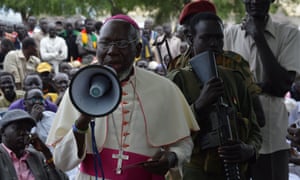
When Bishop Paride Taban was sent to Rwanda in the aftermath of the 1994 genocide to help heal the country’s fractured ethnic divisions, he never imagined that his own country, South Sudan[1], would have to learn the same lessons decades later.
“We found bodies smelling, people buried in massive graves,” Taban said of his visit to Rwanda[2] more than 20 years ago. “And now these people are an example for South Sudan for peace.”
Together with 25 other religious leaders, Taban recently returned to Rwanda to learn how the country has moved on from the genocide that ensued after the Hutu ethnic group turned on Tutsis, leaving as many as 1 million people dead in less than three months.
In an open letter published after they returned to South Sudan, the Christian delegation said: “We have seen how they developed their country after the genocide of 1994, and how they addressed the pain, anger and bitterness of those terrible events.”
The leaders said: “We have visited their genocide memorials; such inhumane acts, whether in Rwanda or South Sudan, must never be forgotten; we must know, learn from and take responsibility for our history.”
We have seen how in Rwanda they addressed the pain, anger and bitterness of those terrible events
Bishop Paride Taban
South Sudan, the world’s youngest country, plunged into civil war in December 2013 after President Salva Kiir accused his former deputy, Riek Machar, of plotting to overthrow him. Since then, the country has split along ethnic lines with the Dinka group loyal to Kiir, and the Nuer group siding with Machar.
Most of the people killed at the outset were Nuer, which led to revenge killings from the Dinka group, starting a cycle of violence that continues, Taban said.
The bishops painted a bleak picture of the situation on the ground, describing “a power struggle between leaders surrounded by an immediate circle of advisers, aides, politicians, generals, hangers-on, and spoilers”.
In July, South Sudan’s government was accused in a damning Human Rights Watch report of carrying out atrocities that could amount to crimes against humanity[3]. “It is really political and in the end it has turned into something that people call tribalism,” Taban said.
The Christian leaders said: “We see ethnic communities following their leaders, while grassroots communities and armed youth are caught up in cycles of revenge killing. We see military commanders, each with their own agendas, not necessarily under the control of the principals.”
Rwanda’s Christian community played a strong role in the national reconciliation process in the aftermath of the genocide. Since Hutus and Tutsis continue to live in close quarters, healing ethnic divisions has proven very difficult. But now, said Taban, “Rwanda is becoming an example for peace”.
The South Sudanese leaders said they will “find ways to bring stakeholders together in a less politically charged atmosphere and to build bridges between them to overcome mistrust and disagreements”.
The Christian leaders acknowledged that South Sudan has a long way to go before it can start its reconciliation process. Peace talks between the warring factions, led by the Intergovernmental Authority on Development (Igad), have made little real progress, they said. International observers agree that the conflict shows few signs of abating.
Kiir and Machar have been criticised for failing to lay down their arms. In May, the US secretary of state John Kerry said[4]: “The country’s leaders failed to act on behalf of the best interests of their people and their nation.”
The Christian leaders agree with this assessment: “It appears that pride, power and politics have become a greater priority than peace,” they said.
“Today, the civil population are the ones who are suffering,” said Taban, who won a UN peace prize in 2013 for his work in improving inter-ethnic relations[5].
“The civil population are the water [and] the politicians are fish. When this water dries up, the fish die; when this water gets hot, the fish die. It seems that those who are negotiating are forgetting the water; they are going [straight] to the fish.”
Taban runs Kuron peace village[6], an organisation that promotes peace between different South Sudanese ethnic groups and offers training in basic farming techniques. “Kuron peace village is an oasis of peace,” said Taban. “If you listened to the media, you would think that in South Sudan there is no sign of peace. But we have three-quarters or two-thirds of the country that is still peaceful.”
References
- ^ South Sudan (www.theguardian.com)
- ^ Rwanda (www.theguardian.com)
- ^ of carrying out atrocities that could amount to crimes against humanity (www.theguardian.com)
- ^ In May, the US secretary of state John Kerry said (www.theguardian.com)
- ^ won a UN peace prize in 2013 for his work in improving inter-ethnic relations (www.sergiovdmfoundation.org)
- ^ Kuron peace village (www.kuronvillage.net)
Newer articles:
- South Sudan talks in Ethiopia show little progress - 08/08/2015 07:49
- South Sudan Peace Talks Hit Turbulence on First Day - 07/08/2015 18:42
- Fundraiser seeks to help Andrew Loku’s five children in South Sudan - 07/08/2015 18:08
- South Sudan Peace Talks Resume With IGAD Plea for Compromise - 06/08/2015 17:14
- South Sudan: More will die from cholera unless we secure clean water - 06/08/2015 06:20
Older news items
- Dr. Lam Akol blocked from traveling to peace talks - 05/08/2015 15:25
- Sudan court clears South Sudan pastors of spying - 05/08/2015 11:17
- An airline service map shows how bad things are getting in war-torn South Sudan - 05/08/2015 08:08
- South Sudan government denies 'starvation' aid blockade - 05/08/2015 04:20
- South Sudan shutters 2 newspapers in apparent crackdown - 05/08/2015 04:04
Latest news items (all categories):
- Research - Europe between a new world war and geopolitical defeat: strategic energy miscalculations, geopolitical ambitions and American pragmatism - 21/11/2026 00:54
- APEC is finding ways to make cross-border services easier - 21/11/2026 00:45
- Xi Jinping’s push for tech independence: How China is trying to close the gap - 21/11/2026 00:44
- How does regional integrated development become a key driver for rapid growth? - 21/11/2026 00:36
- South Sudan rejects claims US-deported migrants face hunger, poor conditions - 21/11/2026 00:12
Random articles (all categories):
- Education Can't Wait Till the Fighting is Over - 19/04/2007 20:55
- South Sudan government figures embezzled $36m: UN panel - 23/09/2020 12:49
- Horst Faas, AP combat photographer, dies at 79 - KGWN - 11/05/2012 19:50
- Press Statement from the office of the SG - 24/07/2008 19:14
- South Sudan peace deal: ‘Whose power are they sharing anyway?’ - 13/11/2018 02:14
Popular articles:
- Who is the darkest person in the world, according to Guinness World Record? - 25/10/2022 02:34 - Read 151943 times
- School exam results in South Sudan show decline - 01/04/2012 17:58 - Read 28600 times
- Top 10 weakest currency exchange rates in Africa in 2023 - 19/07/2023 00:24 - Read 25690 times
- No oil in troubled waters - 25/03/2014 15:02 - Read 24865 times
- NDSU student from South Sudan receives scholarship - In-Forum - 29/09/2012 01:44 - Read 22852 times