
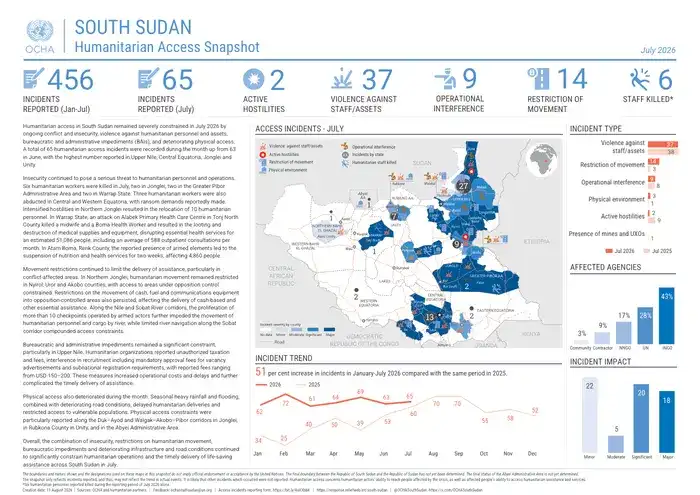
Humanitarian access in South Sudan remained severely constrained in July 2026 by ongoing conflict and insecurity, violence against humanitarian personnel and assets, bureaucratic and administrative impediments (BAIs), and deteriorating physical access. A total of 65 humanitarian access incidents were recorded during the month up from 63 in June, with the highest number reported in Upper Nile, Central Equatoria, Jonglei and Unity. Insecurity continued to pose a serious threat to humanitarian personnel and operations. Six humanitarian workers were killed in July, two in Jonglei, two in the Greater Pibor Administrative Area and two in Warrap State. Three humanitarian workers were also abducted in Central and Western Equatoria, with ransom demands reportedly made.
Intensified hostilities in Northern Jonglei resulted in the relocation of 10 humanitarian personnel. In Warrap State, an attack on Alabek Primary Health Care Centre in Tonj North County killed a midwife and a Boma Health Worker and resulted in the looting and destruction of medical supplies and equipment, disrupting essential health services for an estimated 51,086 people, including an average of 588 outpatient consultations per month. In Atam Boma, Renk County, the reported presence of armed elements led to the suspension of nutrition and health services for two weeks, affecting 4,860 people. Movement restrictions continued to limit the delivery of assistance, particularly in conflict-affected areas. In Northern Jonglei, humanitarian movement remained restricted in Nyirol, Uror and Akobo counties, with access to areas under opposition control constrained. Restrictions on the movement of cash, fuel and communications equipment into opposition-controlled areas also persisted, affecting the delivery of cash-based and other essential assistance. Along the Nile and Sobat River corridors, the proliferation of more than 10 checkpoints operated by armed actors further impeded the movement of humanitarian personnel and cargo by river, while limited river navigation along the Sobat corridor compounded access constraints.
Bureaucratic and administrative impediments remained a significant constraint, particularly in Upper Nile. Humanitarian organizations reported unauthorized taxation and fees, interference in recruitment including mandatory approval fees for vacancy advertisements and subnational registration requirements, with reported fees ranging from USD 150–200. These measures increased operational costs and delays and further complicated the timely delivery of assistance. Physical access also deteriorated during the month. Seasonal heavy rainfall and flooding, combined with deteriorating road conditions, delayed humanitarian deliveries and restricted access to vulnerable populations. Physical access constraints were particularly reported along the Duk–Ayod and Walgak–Akobo–Pibor corridors in Jonglei, in Rubkona County in Unity, and in the Abyei Administrative Area. Overall, the combination of insecurity, restrictions on humanitarian movement, bureaucratic impediments and deteriorating infrastructure and road conditions continued to significantly constrain humanitarian operations and the timely delivery of life-saving assistance across South Sudan in July.
Source: https://reliefweb.int/report/south-sudan/south-sudan-humanitarian-access-snapshot-july-2026
Newer articles:
- Protection Under Pressure: Sudanese and South Sudanese Refugee Experiences in Kampala and Kiryandongo, Uganda July 2026 - 14/08/2026 13:58
- Warrap: UN mission decries deadly attacks, works to calm tensions after ‘nothing but devastation’ - 12/08/2026 18:11
- South Sudan fisheries set to benefit from USD 41 million food security project - 12/08/2026 18:02
- Suspected RSF drones strike Sudan's Khartoum and Al Obeid - 12/08/2026 17:58
- Upper Nile: Displaced families in Udier demonstrate true resilience amidst immense hardship - 12/08/2026 17:44
Older news items
- Restoring US leverage in South Sudan - 10/08/2026 14:45
- Canada shutters embassy in South Sudan, further reducing diplomatic presence in East Africa - 10/08/2026 14:41
- South Sudan whistleblower abducted in Kenya released after two months - 10/08/2026 14:35
- Vietnamese officers assigned to UN peacekeeping missions in South Sudan, Abyei - 10/08/2026 14:30
- Boston Judge Allows Trump Administration to End South Sudan TPS Protections - 07/08/2026 22:11
Latest news items (all categories):
- China’s new Long March: Why its modernization is a demanding journey - 21/10/2026 12:31
- Drone attack in disputed Sudan-South Sudan border region kills at least 153 - 21/10/2026 12:17
- South Korea - 'Smart camp' system built at Hanbit Unit in South Sudan - 21/10/2026 12:09
- Sudanese refugees in Gorom camp, South Sudan, struggle for water, medicines, security - 21/10/2026 12:05
- South Sudan: A Testing Ground For Democracy While Citizens Struggle To Survive - 19/10/2026 14:31
See also (all categories):
Random articles (all categories):
- Somalia Mulls Evacuating Citizens As Fighting Rages in Sudan - 18/04/2023 04:07
- South Sudan: Govt Cancels Independence Celebrations Due to Covid-19 Fears - 08/07/2021 02:41
- Sudanese company arrives Wau to rehabilitate railway line - 15/12/2021 01:01
- The Uniting of South Sudan opposition groups is the only hope for South Sudan! - 18/08/2025 11:15
- South Sudan says U.S. lifting of trade sanctions on Sudan will improve trade - 08/10/2017 05:12
Popular articles:
- Who is the darkest person in the world, according to Guinness World Record? - 25/10/2022 02:34 - Read 151160 times
- School exam results in South Sudan show decline - 01/04/2012 17:58 - Read 28324 times
- Top 10 weakest currency exchange rates in Africa in 2023 - 19/07/2023 00:24 - Read 25416 times
- No oil in troubled waters - 25/03/2014 15:02 - Read 24643 times
- NDSU student from South Sudan receives scholarship - In-Forum - 29/09/2012 01:44 - Read 22613 times
