
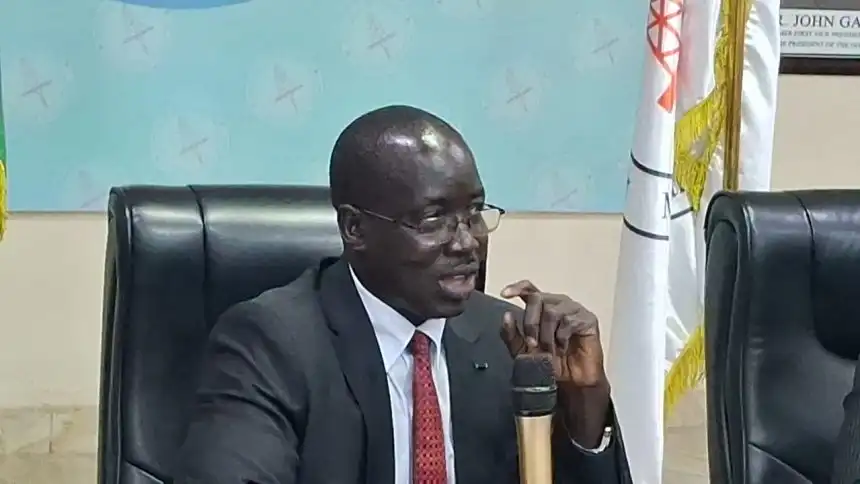
Petroleum Undersecretary Dr. Santino Ayuel Longer says technology, new drilling, and field upgrades are driving South Sudan's oil resurgence (Photo Credit: Pan African Visions)
By Deng Machol
South Sudan’s oil industry has recorded its strongest production performance in nearly two decades, with the Greater Pioneer Operating Company (GPOC) increasing crude oil output to 60,158 barrels per day—the highest level achieved since 2005.
The milestone marks a significant turnaround for a sector that remains the cornerstone of South Sudan’s economy, accounting for the vast majority of government revenue and foreign exchange earnings. The achievement comes despite years of declining output from aging oil fields, infrastructure challenges, and regional instability that have repeatedly threatened the country’s most valuable economic asset.
Announcing the development at a press briefing in Juba on Thursday, the Undersecretary in the Ministry of Petroleum, Dr. Santino Ayuel Longer, hailed the increase as a major accomplishment for both GPOC and the wider petroleum industry.
“GPOC has successfully reached a production level of 60,158 barrels per day as of May 29, an achievement that deserves recognition,” Dr. Ayuel said.
He attributed the production surge to a combination of strategic interventions, including residual oil recovery studies, accelerated field development programs, new drilling campaigns, and critical upgrades to oilfield infrastructure.
The achievement is particularly noteworthy given that GPOC operates some of South Sudan’s oldest producing oil fields in Blocks 1 and 4S. These mature fields have been in production for nearly three decades and face a natural annual decline rate estimated at about 25 percent.
“This achievement is especially significant given that these oil fields have been producing for nearly three decades,” Dr. Ayuel noted. “Mature fields naturally experience substantial production declines, and in GPOC’s case, the annual decline rate is around 25 percent.”
Industry observers say reversing decline in mature oil fields is one of the most difficult challenges facing petroleum producers worldwide. Achieving growth under such conditions often requires advanced recovery technologies, sustained investment, and continuous operational improvements.
For South Sudan, the production increase carries significance far beyond the numbers. It offers fresh optimism for a country seeking to stabilize its economy and strengthen public finances at a time of mounting fiscal pressures.
“This achievement goes beyond production figures,” Dr. Ayuel said. “It reflects confidence in the future of South Sudan’s petroleum sector and highlights the importance of partnership, technology, innovation, and our collective determination to unlock the full potential of our natural resources for the benefit of our people.”
He reaffirmed the government’s commitment to supporting the petroleum sector and creating conditions that encourage continued investment and expansion.
While celebrating the achievement, Dr. Ayuel cautioned that sustaining production growth will require continued effort and innovation.
“We remain committed to sustaining high production levels, maximizing recovery from mature assets, pursuing new development opportunities, and preparing for the next phase of growth in the petroleum sector,” he said.
GPOC President He Yanhui echoed the optimism while emphasizing that maintaining current production levels remains a key priority.
“We are working hard to sustain current production and using all available expertise to manage the risks in the oil fields,” Yanhui said, adding that the company also has ambitions to increase output further in the future.
The latest gains represent a rare bright spot for an industry that has endured numerous setbacks since South Sudan gained independence in 2011.
At independence, the country was producing more than 300,000 barrels of oil per day, making it one of sub-Saharan Africa’s most promising petroleum producers. However, years of civil conflict, insecurity, underinvestment, aging infrastructure, and operational disruptions significantly reduced output.
The sector suffered another major blow in 2024 when exports through neighboring Sudan were disrupted after damage to a critical pipeline carrying South Sudanese crude to Port Sudan on the Red Sea. The disruption underscored the country’s heavy dependence on infrastructure located outside its borders.
South Sudan remains reliant on pipelines traversing Sudan to access international markets, making its oil exports vulnerable to developments beyond its control. The ongoing conflict in Sudan, which erupted in April 2023 between the Sudanese Armed Forces (SAF) and the Rapid Support Forces (RSF), has damaged infrastructure, disrupted trade routes, and complicated the transportation of South Sudanese crude.
Despite these obstacles, the latest production milestone signals growing resilience within the sector and demonstrates the potential for increased output even from mature assets when supported by investment, technology, and effective field management.
For a country whose economic fortunes remain closely tied to oil, GPOC’s achievement offers more than a production record. It provides a timely reminder that South Sudan’s petroleum industry still possesses significant untapped potential and can remain a critical driver of economic recovery, government revenue, and future development.
As Juba looks to revive growth and attract new investment into the energy sector, the production rebound may well mark the beginning of a broader effort to restore confidence in one of Africa’s most strategically important emerging oil producers.
Newer articles:
- How Sudan's war became East Africa's crisis – report - 08/06/2026 15:53
- South Africa's Ramaphosa vows crackdown on groups behind xenophobic attacks - 08/06/2026 15:48
- Co-operative Bank of South Sudan hosts Co-operatives Forum in Northern Bahr el Ghazal State - 05/06/2026 18:10
- Aid rations replace currency in South Sudan - 05/06/2026 18:06
- UNESCO's training is transforming lives and shaping futures in Yambio, South Sudan - 05/06/2026 18:01
Older news items
- Renewed insecurity and rising displacement in South Sudan’s Jonglei put thousands at grave risk, UNHCR warns - 05/06/2026 17:41
- St. Theresa Mission Hospital launches Ebola awareness campaign - 05/06/2026 17:38
- UNMISS helps plant hope among youth on World Environment Day - 05/06/2026 17:35
- The Voice of Responsibility: How Young South Sudanese are Saying No to Violence Through Music, Drama, and Digital Content - 03/06/2026 16:56
- Peace fails if it is not defended. The UN’s peacekeepers cannot do this alone - 03/06/2026 16:39
Latest news items (all categories):
- Op-Ed - Breaking the Double-Standard Lens on China's Population Shifts - 23/10/2026 14:23
- South Sudan ceasefire monitors warn of rising violence ahead of December elections - 23/10/2026 13:39
- UNMISS SRSG visits Malakal, emphasizes that peace begins with collective action - 23/10/2026 13:36
- How Technology is Accelerating South Sudan’s Next Oil Discovery - 23/10/2026 13:34
- South Sudan’s Patriot make case in their opener against Urunani - 23/10/2026 13:12
See also (all categories):
Random articles (all categories):
- MTN Secures 15-Year License to Deepen Digital Footprint in South Sudan - 14/04/2025 17:17
- International peacekeepers prerequisite to withdraw South Sudan troops - Kiir - Sudan Tribune - 14/04/2012 06:00
- تذكرة زلزال - 07/09/2024 12:53
- You Want Peace? Don't Block Our Arms Shipments, South Sudan Says - 02/06/2019 23:15
- الشعر العربي في جنوب السودان.. طيف من الرؤى الإبداعية - 04/08/2025 16:12
Popular articles:
- Who is the darkest person in the world, according to Guinness World Record? - 25/10/2022 02:34 - Read 151201 times
- School exam results in South Sudan show decline - 01/04/2012 17:58 - Read 28341 times
- Top 10 weakest currency exchange rates in Africa in 2023 - 19/07/2023 00:24 - Read 25439 times
- No oil in troubled waters - 25/03/2014 15:02 - Read 24659 times
- NDSU student from South Sudan receives scholarship - In-Forum - 29/09/2012 01:44 - Read 22633 times
