
(Image: The Tanzania Times)
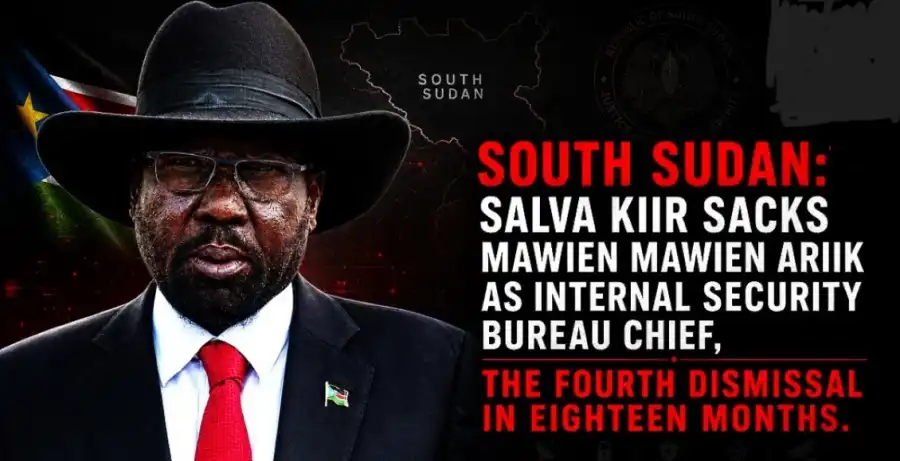
South Sudan’s President Salva Kiir Mayardit dismissed Major General Mawien Mawien Ariik as Director General of the Internal Security Bureau.
President Kiir then recalled General Akec Tong Aleu — who held the same post for four months in late 2024 — through a presidential decree broadcast on the South Sudan Broadcasting Corporation.
The decree also removed two deputy chiefs across both South Sudan’s National Security Service (NSS) bureaus, marking the fourth Internal Security Bureau (ISB) dismissal in eighteen months and the consolidation of a Greater Tonj loyalist faction at the apex of the South Sudanese coercive apparatus.
The Decree Reset Both NSS Bureaus, Not the ISB Apex Alone
The 29 April 2026 decree constitutes a structural reset of the National Security Service, not a single appointment.
Three positions changed inside the security apparatus.
Mawien Ariik was removed at the ISB and replaced by Akec Tong Aleu.
Lieutenant General John Manut Wol was removed as Deputy Director General for Administration and Finance at the ISB and replaced by Major General Napoleon Adok Gai.
Liutenant General Gregory Deng Kuac was removed as First Deputy Director at the General Intelligence Bureau, with no successor named.
The first two changes are personnel substitutions.
The third is structurally distinct.
A vacancy at the General Intelligence Bureau (GIB) First Deputy level, left unfilled in a decree that filled every other slot, constitutes a deliberate operating choice.
The configuration indicates that the GIB will be directed through the presidency for the period ahead, bypassing the institutional chain. This arrangement was last sustained in the months preceding the December 2013 crisis.
The cabinet-side dismissals — Foreign Affairs Minister Monday Semaya Kumba, Trade Minister Atong Kuol Manyang, and Youth Minister Mary Nawai Martin — are subordinate to the security reset.
The ISB Has Cycled Through Five Appointments in Eighteen Months

Four dismissals. Five appointments. One office. Eighteen months.
The ISB is the operational core of the National Security Service, responsible for domestic surveillance, political detention, and counter-opposition operations.
The bureau reports directly to the presidency, outside parliamentary oversight.
Rotation of its director four times in eighteen months indicates that the principal lacks confidence in the durability of each successive appointee.
The recall of a previously dismissed officer to fill the latest vacancy compresses that signal.
Kiir is reactivating a known quantity removed sixteen months earlier rather than selecting from a continuing pool.
Akec Tong Aleu Is a Reactivation Asset, not a Fresh Appointment
Akec Tong Aleu’s political career is grounded in the Greater Tonj area of Warrap State.
He served as Commissioner of Tonj South in 2012, Deputy Governor and caretaker Governor of Warrap, and the first Governor of the short-lived Tonj State established under Kiir’s October 2015 decree.
He held the position of Undersecretary for Veteran Affairs at the Ministry of Defence between April and September 2024 before his first appointment to the ISB on 2 October 2024.
That tenure lasted four months. He was displaced by Charles Chiec Mayor in February 2025 and reassigned to the Defense Ministry as Undersecretary, the position he held until the 29 April decree.
His geographic positioning matches the institutional profile of the bureau he now leads.
Small Arms Survey field documentation of NSS recruitment establishes that the bureau’s senior command is concentrated among personnel from Tonj North, with rank-and-file drawn from Greater Awuul sections of the Rek Dinka.
The recall is a constraint indicator.
A regime that returns a previously dismissed officer to its most sensitive coercive office sixteen months after removing him is operating from a contracting candidate pool.
The Reshuffle Is a Defensive Consolidation, Not Sector Reform
The 29 April decree sits inside a continuous sequence of consolidation actions extending back six months.
In November 2025, Kiir dismissed Vice President Benjamin Bol Mel and demoted him from full general to private.
NSS forces and military intelligence reportedly surrounded Bol Mel’s Juba residence at dawn, disarmed his guards, and forced the withdrawal of his Ugandan protection detail.
In January 2026, Kiir removed Interior Minister Angelina Teny, wife of detained First Vice President Riek Machar, and replaced her with a presidential ally.
In April 2026, he purged the parliamentary leadership. The trial of Machar and seven co-defendants is active.
Against this sequence, the 29 April reshuffle is a defensive realignment of the coercive apparatus ahead of the December 2026 election cycle, not security-sector reform.
The International Crisis Group assessment of September 2025 identified Kiir’s reshuffles as a deliberate technique to prevent any rival power centre from consolidating inside the security sector.
The April decree confirms that assessment and extends it. Kiir is not only preventing rival consolidation; he is reactivating displaced loyalists as the supply of acceptable replacement contracts.
The GIB Vacancy Is the Most Revealing Variable in the Decree
The General Intelligence Bureau is the NSS’s external intelligence arm, responsible for foreign collection and regional liaison.
Its First Deputy Director runs the operational collection programme.
Leaving that position vacant in a decree that otherwise fills every position carries three plausible operational interpretations.
First, the GIB will be directed through the presidency for an indeterminate period, bypassing the bureau’s institutional chain.
Second, the candidate pool acceptable to Kiir for the role has been exhausted by the same dynamics that produced the ISB rotation.
Third, the vacancy is provisional and will be filled within weeks.
The first interpretation is the most consistent with Kiir’s documented operating pattern since November 2025.
The third would be falsified by any prolonged vacancy beyond mid-2026.
The Operational Window for the New Command Is Short
Akec Tong Aleu inherits a degraded institution.
The Deputy for Administration and Finance is new to the role.
The GIB First Deputy position is empty. Institutional memory at the deputy level has been cleared in a single decree.
The new command must demonstrate operational capability to the principal within weeks. Failure to do so will reproduce the dismissal pattern that removed each of his predecessors.
The targeting profile for that capability demonstration is predictable.
The principal expected outputs are intensified surveillance and detention of Machar’s defense team, residual SPLA-IO networks, civil society organizations with international reporting links, and diaspora-connected journalists in Juba.
A quiet first three months would indicate either deliberate de-escalation, which is inconsistent with the surrounding context, or that Akec’s operational authority is constrained by direct presidential management of both NSS bureaus.
Forward Outlook
The 29 April decree is a defensive consolidation executed by a regime operating from a constrained personnel pool.
The recall of Akec Tong Aleu is the visible component.
The deputy-level reset across both NSS bureaus is the structural component.
The unfilled GIB First Deputy position is the most analytically significant element and the one most worth tracking through the second half of 2026.
The South Sudanese intelligence apparatus is being aligned for the December 2026 election period.
The durability of that alignment will be determined by the principal’s capacity to retain personnel rather than by the formal authority delegated to the new command.
Newer articles:
- Former Syracuse basketball player reunites with family in South Sudan after ICE detention - 04/05/2026 15:20
- Kenya: LoDDCA Halts South Sudan Cargo Loading as Elegu Border Reaches Full Capacity - 04/05/2026 15:16
- East African Nations Unite For Regional Satellite Initiative To Enhance Connectivity And Digital Sovereignty - 04/05/2026 15:05
- UN reduces South Sudan troop ceiling, extends mission to 2027 - 01/05/2026 14:40
- MSF forced to close Lankien hospital after 31 years - 01/05/2026 14:38
Older news items
- Multi-millionaire Arthur Eze’s Oranto faces fresh setback as South Sudan cancels oil licence over stalled exploration - 01/05/2026 14:30
- Church leaders in South Sudan call for justice - 01/05/2026 14:28
- Vietnam’s peacekeepers promote culture, solidarity at UN mission in South Sudan - 01/05/2026 14:24
- South Sudan Joint Market Monitoring Initiative (JMMI) 1 - 13 April 2026 - 01/05/2026 14:22
- South Sudan deserves its miracle moment too - 29/04/2026 11:57
Latest news items (all categories):
- Ramaphosa presses Kiir to implement peace deal ahead of South Sudan’s first elections - 09/10/2026 12:19
- South Sudan steps up Ebola alert after Kenya case - 09/10/2026 12:17
- Laotian man deported by U.S. to South Sudan leaves for Laos after year in detention - 09/10/2026 12:14
- Bullet and blast injuries … and a constant need for blood: inside South Sudan’s overwhelmed trauma wards - 09/10/2026 12:10
- MTN South Sudan and Regulator Pledge Cooperation to Expand Connectivity - 09/10/2026 12:01
See also (all categories):
Random articles (all categories):
- Court Martial frees South Sudan General first charged in 2018 - 15/03/2023 07:00
- South Sudan police eyeing reforms amid challenges - 16/06/2018 14:20
- Walking from war, running to opportunity - 11/01/2008 12:42
- A United Nations Mission in South Sudan (UNMISS) peace rally brings together communities from Akobo and Greater Pibor - 09/10/2023 06:47
- South Sudan aims to end oil asset row with Sudan in 2 months - Reuters Africa - 06/10/2012 05:41
Popular articles:
- Who is the darkest person in the world, according to Guinness World Record? - 25/10/2022 02:34 - Read 150777 times
- School exam results in South Sudan show decline - 01/04/2012 17:58 - Read 28194 times
- Top 10 weakest currency exchange rates in Africa in 2023 - 19/07/2023 00:24 - Read 25308 times
- No oil in troubled waters - 25/03/2014 15:02 - Read 24534 times
- NDSU student from South Sudan receives scholarship - In-Forum - 29/09/2012 01:44 - Read 22492 times
