
JUBA — South Sudan has announced plans to intensify efforts to address chronic power shortages and expand electricity distribution in Juba and other urban centers, as the country continues to grapple with limited and unreliable electricity supply more than a decade after independence.
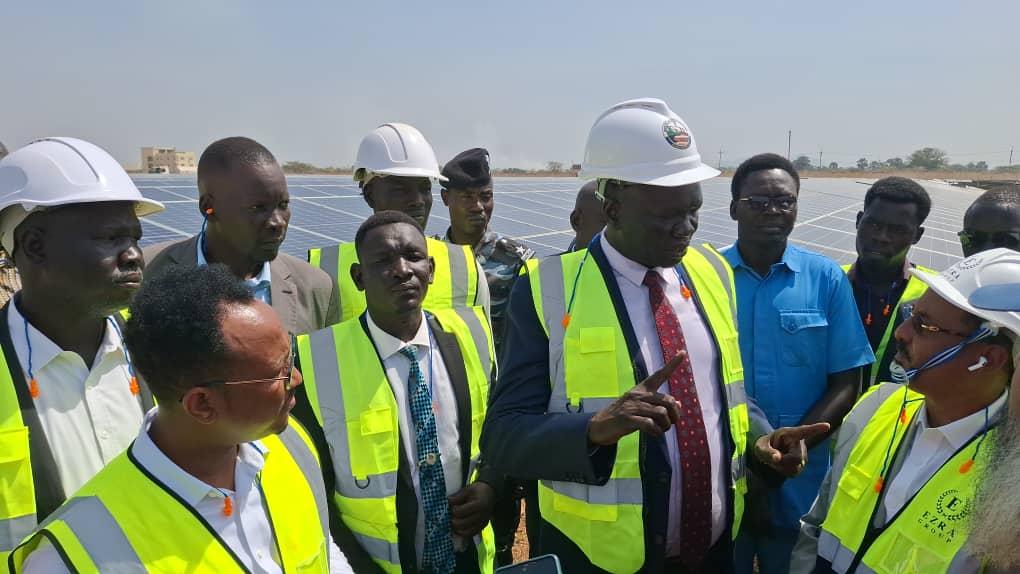
The commitment follows the first official field inspection by the Minister of Energy and Dams, Agok Makur Kur, who visited Ezra Group, the country’s primary electricity producer, at its facilities in Gondokoro on the outskirts of Juba.
Despite South Sudan’s oil wealth, less than two percent of the population is connected to the national grid. In Juba, frequent outages and limited coverage have forced households, businesses, and public institutions to rely heavily on costly private generators.
Ezra Group began operating Juba’s thermal power plant along the River Nile in the years following independence, filling a critical gap left by the absence of a national electricity utility. Since then, the foreign-owned company has remained the sole large-scale power producer supplying electricity to Juba and surrounding areas. However, generation has struggled to keep pace with rising demand due to aging infrastructure, high fuel costs, and limited transmission networks.
Accompanied by senior officials and engineers from the Ministry of Energy and Dams, Minister Makur toured the company’s headquarters and technical facilities, reviewing generation and distribution systems and holding detailed discussions with management on operational challenges and areas requiring government policy and technical support.
During the visit, the minister inspected key facilities including the Generators Room, Control Room, Substation and Outgoing Feeders, Batteries and Energy Storage System, Workshop and Spare Parts Unit, Solar PV Plant, Refinery Yard, Pole Manufacturing Plant, and the Barge Workshop and operational barges. The inspection aimed to assess operational capacity, infrastructure conditions, and ongoing efforts to strengthen electricity generation, distribution, and renewable energy integration in Juba.
Speaking to journalists after the tour, Makur said the plant is currently generating 79 megawatts, with an additional 21 megawatts yet to be brought online.
“I received full clarification from the management, and I was informed that 79 megawatts are currently in use, while 21 megawatts remain pending,” Makur said. “Ezra Group has assured me that this remaining capacity can be completed within the coming months or by next year.”
Electricity demand in Juba far exceeds current supply, leaving many neighborhoods without power and undermining public services, security lighting, health facilities, and overall economic activity.
Makur stressed that improving electricity supply is central to economic recovery and urban security, noting that reliable power is essential for businesses, hospitals, water systems, and street lighting.
The minister also revealed that the government is pursuing regional power import arrangements as part of both short-term and long-term solutions. He confirmed that electricity transmission from Uganda has already reached the border town of Nimule and could soon be extended further inland.
“Power transmission from Uganda has reached Nimule, and Nimule is already covered,” Makur said. “We are prepared as a ministry to cooperate with Uganda so that this power can reach Juba and other towns.”
Samson Ezra, Managing Director of Ezra Group, described the minister’s visit as a critical step toward resolving long-standing challenges in Juba’s electricity supply.
“This visit is a cornerstone for addressing the immense challenges of supplying power to Juba,” Ezra said. “Together with the new minister, I am confident we will connect the rest of the city.”
To accelerate expansion, Ezra said the company has begun manufacturing large numbers of concrete electricity poles to extend the network into underserved neighborhoods.
Despite being an oil-producing nation, South Sudan remains one of the least electrified countries in the world. Officials say sustained investment, regional cooperation, and stronger oversight of the energy sector will be essential to expanding electricity access and supporting long-term economic growth.
Newer articles:
- Agar in Juba to Discuss Bilateral Cooperation - 26/01/2026 11:57
- WHO South Sudan - Voices from the field: Issue #17, 26 January 2026 - 26/01/2026 11:54
- South Sudan peace deal at risk as monitoring body warns AU of worsening crisis - 23/01/2026 19:34
- Elections as a Catalyst for War: South Sudan’s Dangerous Pre-Electoral Phase - 23/01/2026 14:27
- SPLA-IO Urges UN Security Council to Hold Uganda Accountable for Role in South Sudan Conflict - 23/01/2026 14:02
Older news items
- South Sudan After the Pilgrimage: When Moral Attention Isn’t Enough - 21/01/2026 17:48
- South Sudan Erupts - 21/01/2026 17:44
- South Sudan president fires interior minister, sparking fears of peace deal collapse - 21/01/2026 17:39
- DRC, South Sudan Exchange Prisoners to Boost Security Cooperation - 21/01/2026 17:32
- South Sudan: Humanitarian Access Snapshot (December 2025) - 21/01/2026 17:21
Latest news items (all categories):
- The SPLM ruling party is facing a dilemma and Thucydides trap at a pivotal moment - 24/08/2026 14:06
- Shanghai Cooperation Organization (SCO) countries are making green development an engine of growth - 24/08/2026 13:36
- President Salva Kiir in Pretoria Seeking Support Ahead of South Sudan’s December Elections - 24/08/2026 12:48
- Tambura’s fragile path from conflict to recovery - 24/08/2026 12:45
- South Sudan’s Yei Joint Stars advance to semi final stage of Zonal qualifiers - 24/08/2026 12:43
See also (all categories):
Random articles (all categories):
- SPLM swears in Lam Both as Secretary-General - 25/01/2023 06:46
- An open letter to Dr. Attipoe Olympio, the Commissioner General of South Sudan National Revenue Authority - 25/06/2018 12:07
- South Sudan humanitarian crisis worsens - 05/03/2017 01:16
- Rebels kill 24 South Sudan soldiers, army says - Reuters - 27/08/2012 07:22
- Clinton urges South Sudan, Sudan to settle oil dispute - Reuters - 03/08/2012 07:02
Popular articles:
- Who is the darkest person in the world, according to Guinness World Record? - 25/10/2022 02:34 - Read 148825 times
- School exam results in South Sudan show decline - 01/04/2012 17:58 - Read 27986 times
- Top 10 weakest currency exchange rates in Africa in 2023 - 19/07/2023 00:24 - Read 25079 times
- No oil in troubled waters - 25/03/2014 15:02 - Read 24389 times
- NDSU student from South Sudan receives scholarship - In-Forum - 29/09/2012 01:44 - Read 22334 times
