
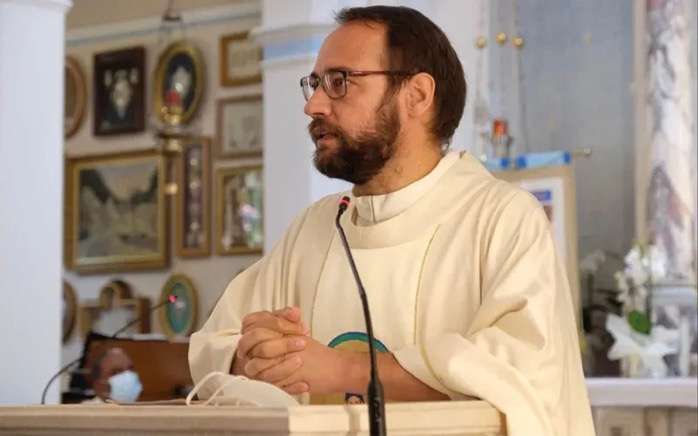
Bishop Christian Carlassare of Bentiu pictured in 2022 when he headed the Diocese of Rumbek (Fondazione CESAR / CNA)
“These are not just routine elections like those held regularly in other countries, but the first elections since the independence of a 14-year-old new nation.”
A bishop called for civic education to be taught in schools in South Sudan as the country prepares for elections.
Bishop Christian Carlassare of Bentiu said this would help give legitimacy to the elections that were due later this year but have been postponed to 2026.
Recent reports suggested the government has shown little commitment to preparing conditions for the smooth running of the much-anticipated polls. With civic society activities undermined by the legacy of civil war, observers have warned that poor voter awareness could undermine voter participation and informed voting decisions.
“We value the subject of civic education taught in school. It is a long process. The process must lead to the formation of a national consciousness and the building of the nation on the basis of the common good of all citizens,” said Bishop Carlassare in a diocesan update on 10 January.
“These are not just routine elections like those held regularly in other countries, but the first elections since the independence of a 14-year-old new nation.”
South Sudan ceded from Sudan in 2011 after a protracted civil war, and these first elections are considered a test for President Salva Kirr’s democratic credentials.
“Electoral consultations must be prepared and carried out adequately based on constitutional rights for the sake of a true democratic process,” said Carlasssare, an Italian Comboni missionary, was made the first Bishop of Bentiu when diocese was erected last July.
His also update paid tribute to the role of lay preachers and catechists in growing the local Church, with almost half-a-million Catholics in the diocese but very few clergy.
“We currently have seven diocesan priests and two deacons. The parishes therefore depend on catechists and lay pastoral agents who are the backbone of the Christian communities,” Carlassare said. The bishop said catechists filled a huge gap as the diocese has no religious sisters.
Source: https://www.thetablet.co.uk/news/south-sudan-needs-civic-education-before-elections-says-bishop/
Newer articles:
- ‘Just do what you can’: Diaries of a doctor in South Sudan - 30/01/2025 19:11
- South Sudan lifts ban on Facebook and TikTok after violent unrest - 30/01/2025 19:02
- South Sudan Blocks Social Media For 90 Days Over ‘Graphic Violence Content’ - 23/01/2025 14:19
- Massive jailbreak in South Sudan: 600 detainees escape amid chaos after protests and looting in Juba - 23/01/2025 14:17
- Dodgers add first player ever from South Sudan in historic move - 23/01/2025 13:06
Older news items
- South Sudan parties set to resume peace talks in Kenya - 16/01/2025 16:39
- Abandoned but not forgotten – the invisible crisis in South Sudan - 16/01/2025 16:35
- MTN South Sudan Launches eSIM Technology in a National First - 14/01/2025 16:34
- U.A.E : MoFA receives credentials copy from new Ambassador of Republic of South Sudan - 14/01/2025 16:31
- Helping a lost generation: food security and animal health in South Sudan - 14/01/2025 15:20
Latest news items (all categories):
- Ramaphosa presses Kiir to implement peace deal ahead of South Sudan’s first elections - 09/10/2026 12:19
- South Sudan steps up Ebola alert after Kenya case - 09/10/2026 12:17
- Laotian man deported by U.S. to South Sudan leaves for Laos after year in detention - 09/10/2026 12:14
- Bullet and blast injuries … and a constant need for blood: inside South Sudan’s overwhelmed trauma wards - 09/10/2026 12:10
- MTN South Sudan and Regulator Pledge Cooperation to Expand Connectivity - 09/10/2026 12:01
See also (all categories):
Random articles (all categories):
- South Sudan Should Consider Women In New Constitution – UN - 07/05/2013 14:40
- Sanctions threat an obstacle to peace, says South Sudan - 04/03/2015 07:31
- South Sudan Needs To Consider Women In Decision Making - 10/12/2020 14:13
- The Ministry of Health of South Sudan successfully conducts its first ever diagnostic test for Ebola - 19/10/2018 01:11
- South Sudan appoints new finance minister to revive economy - 15/03/2018 07:35
Popular articles:
- Who is the darkest person in the world, according to Guinness World Record? - 25/10/2022 02:34 - Read 150805 times
- School exam results in South Sudan show decline - 01/04/2012 17:58 - Read 28200 times
- Top 10 weakest currency exchange rates in Africa in 2023 - 19/07/2023 00:24 - Read 25311 times
- No oil in troubled waters - 25/03/2014 15:02 - Read 24536 times
- NDSU student from South Sudan receives scholarship - In-Forum - 29/09/2012 01:44 - Read 22496 times
