
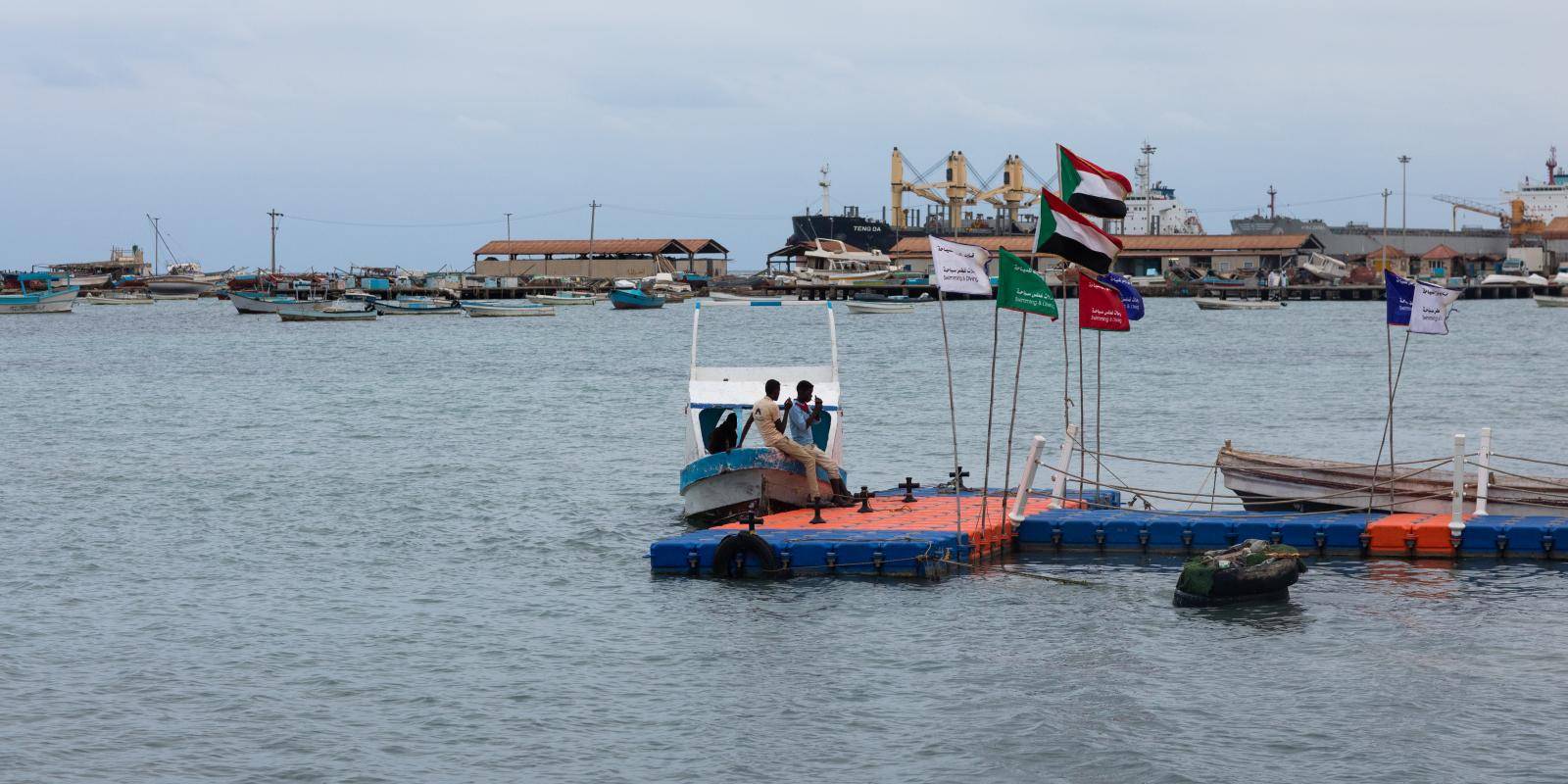
Sudanese men at Port Sudan on 31 December 2018 (Photo by Eric Lafforgue/Art in All of Us/Corbis via Getty Images)
Currently much of the world’s attention is focused on the UN’s struggle to achieve a ceasefire and avert humanitarian catastrophe in Palestine. At the same time, another devastating war rages in Sudan, with similarly violent consequences for millions of people and an inability to reach a ceasefire.
Sudan is now the country with the largest number of displaced people in the world – more than 11 million people. Since April alone, 5.4 million people have been internally displaced and 1.3 million have fled to neighbouring countries including Chad, Egypt, and South Sudan. While over half the population – 25 million people (including 13 million children) – urgently need humanitarian assistance.
The toll of the war on civilians continues to worsen, with devastating intercommunal violence and ethnic cleansing across Darfur, huge infrastructural damage, as well as loss of livelihoods and escalating humanitarian strife.
On the surface, the war in Sudan may seem like a typical civil war. Two rivals, the Sudanese Armed Forces (SAF) and the Rapid Support Forces (RSF), are fighting for land and power.
The RSF have made gains in Khartoum and Darfur, where they are consolidating control, while the SAF have suffered a series of humbling defeats that seem to have made elements within their leadership more open to negotiations.
An effective partition has emerged in Sudan, with the SAF controlling the east and northeast and RSF controlling much of the capital and west of the country.
The transnational elements of the Sudanese conflict
However, looking at the conflict in Sudan as merely a civil war between two national groups is misleading. Sudan sits at the confluence of four regions, the Horn of Africa, North Africa, the Sahel, and the Arabian Gulf across the Red Sea.
Both the SAF and RSF engage economically, politically, and militarily with a motley of governments and armed groups from these regions (and beyond) to fight their war.
In its pursuit to control the supply chain of gold, the RSF has extended its economic operations beyond Sudan’s borders, selling primarily to the United Arab Emirates (UAE), which has consequently become a key backer.
The SAF accrue rents not only through taxing exports and imports transiting Port Sudan, but also by receiving support from foreign governments including Egypt, Qatar and Turkey, including via the sale of strategic commodities such as gold and livestock. Economic processes not only connect Sudan to the region, but also facilitate the supply chains that fuel and sustain the conflict.
These foreign actors also view Sudan as a playground for their own pursuit of regional influence. For instance, the UAE competes against its Gulf rival Qatar, with the former backing the RSF and the latter supportive of the SAF.
The UAE leverages its other regional allies, from Libya’s Haftar to the government of Chad, while the SAF have sought support from Turkey and Iran in providing them with drones to use in the war. These positions have complicated attempts to mediate between the warring parties during the Saudi–US sponsored Jeddah talks.
Many fear that without a swift and durable ceasefire this war could divide the country, with both sides declaring their own governments. If the war becomes protracted then further fragmentation and militarization is likely, including along ethnic lines. This will only worsen the humanitarian disaster and regional spillover.
A sense of growing urgency has driven recent mediation efforts by the regional bloc IGAD, given the limited success of other interventions to date. However, the lack of heft and collective approach needed of the international response has contributed to the inadequacy in resolving the war. This means negotiating not only between the two sides, but navigating all the transnational actors who have a stake in the conflict.
Gaps in country-focused analysis
Many conflicts around the world suffer from similar dynamics, but policymakers often engage them as bounded by national borders, excluding the interests and influence of actors who fuel the conflict from other countries.
This is partly a product of the structures of foreign policy and international development. For instance, the UK government has for several years administered Joint Analysis of Conflict and Stability (JACS), used to guide the National Security Council Strategies. These JACS are in most cases country-focused, meaning they are based on the analysis of conflict advisors and external consultants who work on the country in question.
What the exercise often misses, however, is analysis from advisors and experts who work on countries that seem geographically distant, but which nonetheless have a stake and fuel the conflict. In such cases, regional JACS should be more central to decision-making. In Sudan, for example, the wide array of country teams which focus on the Horn of Africa, the Sahel, Egypt, the Gulf, Turkey, and Iran, should all be part of the analysis of the current conflict.
The gap in the analysis phase extends to both policymaking and programming in these conflicts. Most programmes that deliver aid or offer institutional support (like building hospitals or implementing anti-corruption initiatives) are confined to teams which focus on the country where the conflict has erupted.
However, these initiatives again become susceptible to transnational actors and processes which are not always identified by the country-specific focus. This means that potential spoilers may be present which do not map on the policymakers’ horizon, challenging the sustainability of peace agreements or development projects.
In the Middle East and Africa, armed conflicts that have erupted in places like Sudan are not confined to national borders. These dynamics are also seen in the conflict in Sinjar, Iraq, where armed groups with authority across multiple countries vie for control; or in Libya where the smuggling and trafficking of people from Nigeria across multiple borders fuels conflict along the way; or in Israel and Palestine where regional and foreign governments arm and support one side or the other.
Newer articles:
- Up to 300,000 flee Wad Madani to escape intense fighting in Sudan’s aid hub - 19/12/2023 03:40
- ‘Rapid negotiations’ over GERD resume between Sudan, Egypt and Ethiopia - 19/12/2023 01:44
- IMF Staff Completes Mission to South Sudan for the 2023 Article IV Consultation and Review of Program Monitoring with Board Involvement - 18/12/2023 09:55
- Juba Network awarded for outstanding internet service in South Sudan - 18/12/2023 06:46
- South Sudan debt distress risk remains high - IMF - 18/12/2023 06:39
Older news items
- Encouraging women in the Global South to use their voice - 18/12/2023 02:16
- Somalia Accedes to EAC Treaty Following Admission in November - 18/12/2023 01:10
- South Sudan in no position to hold free, fair election in 2024 - UN Official - 15/12/2023 08:05
- Grace and Salwa: a story of resilience in South Sudan - 15/12/2023 07:31
- Two bills tabled in parliament by Justice Minister Madol - 15/12/2023 06:29
Latest news items (all categories):
- Juba commissioner denies chasing foreigners - 07/10/2026 14:36
- Australia: 19-year-old from South Sudan arrested over a wild joy ride - 07/10/2026 14:33
- South Sudan’s aid crisis deepens as food stocks run low - 07/10/2026 14:29
- South Sudan’s Juba warns foreigners against running small-scale businesses - 07/10/2026 14:25
- Peace Dialogues foster social cohesion in Nyirol County after persisting tensions - 07/10/2026 14:23
Random articles (all categories):
- South Sudan's Prospects For 2018 - 31/12/2017 14:49
- New members of East Africa’s regional assembly sworn in - 20/12/2022 00:28
- Risk Sudan may split – military group leader - 11/11/2022 00:45
- Cholera outbreak spreads in South Sudan, hundreds infected - 04/06/2014 18:24
- South Sudan judges end strike to return to huge legal backlog - 07/09/2017 12:11
Popular articles:
- Who is the darkest person in the world, according to Guinness World Record? - 25/10/2022 02:34 - Read 150745 times
- School exam results in South Sudan show decline - 01/04/2012 17:58 - Read 28193 times
- Top 10 weakest currency exchange rates in Africa in 2023 - 19/07/2023 00:24 - Read 25305 times
- No oil in troubled waters - 25/03/2014 15:02 - Read 24533 times
- NDSU student from South Sudan receives scholarship - In-Forum - 29/09/2012 01:44 - Read 22492 times
