

(MSF)
Conflict and hostilities between warring parties in neighbouring Uganda propelled Médecins Sans Frontières (MSF) to launch our first project in what is now South Sudan in Yei, Central Equatoria state. In 1983, a dedicated MSF team, including medical and support staff from then southern Sudan and other countries, provided emergency medical care to host communities and refugees who were fleeing civil unrest in Uganda. A region struggling with conflict became itself a refuge, a home to thousands.
As the needs of refugees and host communities spiked, our activities evolved over the years to respond to conflict-led displacement, famine and disease outbreaks, providing medical treatment and carrying out vaccination campaigns, clean water and sanitation activities, and non-food items distribution. Today, South Sudan is one of our biggest countries of operations, covering 13 projects nationwide, and our activities assist hundreds of thousands of people.
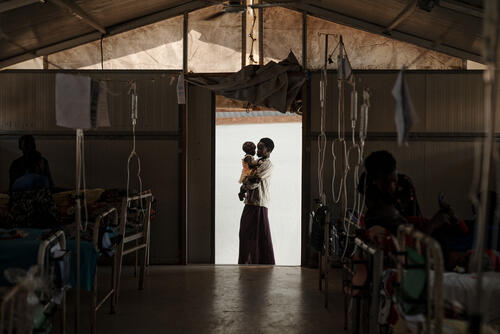
Sean Sutton
Independence and civil war
After a long and gruesome civil war in a then-combined Sudan, southern Sudan attained self-rule in 2011 as South Sudan, when autonomy and relative calm prevailed. This was short-lived, as conflict broke out between the government and opposition forces in December 2013. This led to a civil war that caused the death of tens of thousands of people and forced one in three people to flee from their homes.
“When the country got its independence in 2011, there was a lot of hope”, says Andrew Dak, hospital coordinator support, who has worked with MSF since 2004. “People believed there would be no more war and a lot of investment in the health infrastructure in the country. But two years later, there was already fighting in the country. Everything went back to zero.”
Since then, in addition to recurrent conflicts, the country has continued to suffer from concurrent emergencies, including food insecurity, disease outbreaks and severe flooding.
Addressing the consequences of climate change
Most recently, four consecutive years of flooding left about two-thirds of South Sudan under water last year, with most states experiencing catastrophic floods.
“Over the years, the severity of the floods has increased in scale, water levels, and the impact on the population,” says Mohammad Ibrahim, MSF head of mission in South Sudan. “More than two-thirds of the country was under water during the last rainy season.”
“We have seen floods not only uprooting people from their homes, but also destroying crops, killing livestock and damaging houses, schools and health facilities,” says Ibrahim. “For a country that has already been affected by years of violence, that has a fragile health system and high levels of malnutrition, flooding is seriously aggravating an already-dire humanitarian situation.”
Overcoming barriers to healthcare
Across South Sudan, people face major obstacles when trying to access healthcare. Floods are one, combined with an overall lack of facilities and insecurity.
“Many mothers and pregnant women live in very remote areas and can’t reach medical facilities,” says Harriet Wikoru, MSF midwife activity manager in Old Fangak. “Most of them can only go to traditional birth attendants in their village. The lack of access to health facilities puts women in danger both during their pregnancy and delivery.”
To overcome these barriers, our teams have been supporting most-at-risk communities by running clinics, outreach and preventatives activities, and training community healthcare workers in remote areas.
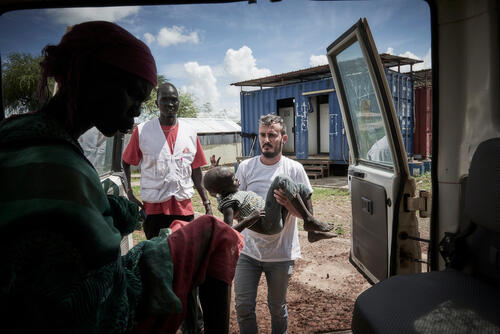
Christina Simons
Building healthcare capacity
After decades of conflict and underinvestment, the severe shortages of health infrastructure and qualified medical professionals continue to pose major challenges to the development of a good healthcare system in South Sudan.
“For more than 15 years, MSF has been providing care for patients here in Bentiu. However, the organisation won’t be here forever, and should only be here to provide emergency care”, says Dr John Puok, an MSF medical doctor. “If the government of South Sudan would do something about the situation here, MSF may relocate these services to other people who are in need. Maybe not in South Sudan, but in other parts of the world.”
To have a long-term impact on the quality of care in the country, the MSF Academy for Healthcare is training South Sudanese healthcare workers in several states to strengthen competencies and improve the quality of care.
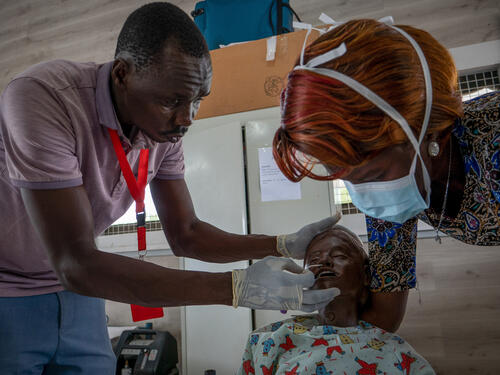
Florence Miettaux
An urgent need to ensure access to life-saving care
Twelve years after its independence, South Sudan continues to face immense needs, ongoing crises such as conflict and displacement, and new challenges such as climate change. These crises and challenges are amplifying and accelerating already existing diseases and the deplorable humanitarian situation.
According to the United Nations, two-thirds of the population, about 9.4 million people, need humanitarian assistance, healthcare and protection. Already a serious crisis, the country is experiencing additional needs with the arrival of returnees and refugees from Sudan, which the current humanitarian response cannot absorb.
Despite this, MSF has been observing a progressive reduction of international funding for health in the country, resulting in an increased risk of serious health and social impacts on people. The government of South Sudan and international development sector partners must invest, engage and support the country’s health system. Sustained and consistent investment is needed to avoid continuous deterioration of the situation and any further potential crisis.
Newer articles:
- Rwanda Installs Flood Monitors on Nile Basin Rivers, Lakes - 17/11/2023 01:10
- Blackwater founder and 4 others on trial in Austria over export of modified crop-spraying planes - 17/11/2023 00:21
- Catholic Relief Services calls for 'immediate cessation of violence' in Gaza to allow aid - 17/11/2023 00:02
- South Sudan deploys first unified forces after peace deal - 16/11/2023 09:29
- 100 returnees in Unity State flee back to Sudan citing hunger - 16/11/2023 06:20
Older news items
- If You Care About Ukraine or Palestine, You Should Care About Sudan - 16/11/2023 03:07
- Will Africa remain on the sidelines of Sudan’s Jeddah talks? - 16/11/2023 03:00
- South Sudan police chief sacked after coup rumours - 15/11/2023 09:15
- UNMISS-funded Terekeka conference brings hope for youth empowerment and political participation - 15/11/2023 07:48
- South Sudan clears EAC debts ahead of summit - 15/11/2023 07:21
Latest news items (all categories):
- South Sudan Opens 14 Oil Blocks, Courts Investors Ahead of SSOP 2026 - 26/10/2026 15:08
- Jambojet Explores South Sudan Expansion After Talks with Juba Regulator - 26/10/2026 15:05
- Kiir swears in 5 officials ahead of South Sudan elections - 26/10/2026 14:53
- South Sudan cattle battles leaves 10 dead: official - 26/10/2026 14:49
- Churches urge world 'not to forget South Sudan' ahead of first elections - 26/10/2026 14:47
Random articles (all categories):
- Vietnamese, Indian Level-2 Field Hospitals in South Sudan hold joint training - 29/07/2021 00:50
- South Sudan: Cardin Troubled By Deteriorating Security And Humanitarian Crisis In South Sudan - 26/07/2013 03:31
- South Sudan: UN humanitarian chief urges access to civilians in dire need - 19/07/2013 02:28
- South Sudan Conflict Escalates Amid Renewed Fighting - 23/03/2026 17:59
- South Sudan struggles to meet the EAC integration rules - 14/07/2021 08:50
Popular articles:
- Who is the darkest person in the world, according to Guinness World Record? - 25/10/2022 02:34 - Read 151298 times
- School exam results in South Sudan show decline - 01/04/2012 17:58 - Read 28390 times
- Top 10 weakest currency exchange rates in Africa in 2023 - 19/07/2023 00:24 - Read 25496 times
- No oil in troubled waters - 25/03/2014 15:02 - Read 24701 times
- NDSU student from South Sudan receives scholarship - In-Forum - 29/09/2012 01:44 - Read 22676 times
