
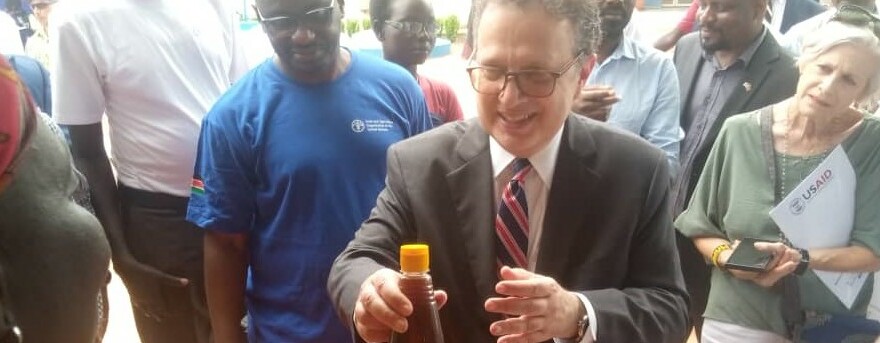
US Ambassador Michael J. Adler attends a honey and shea butter exhibition in Rumbek town, Lakes State, on Thursday, October 19, 2023 (Radio Tamazuj)
South Sudan’s renowned honey and shea butter industry, celebrated for its exceptional products including golden honey and Nilotica Shea Butter, is poised for introduction into local, regional, and international markets.
This follows a successful product exhibition in the capital of Lakes State, Rumbek, which was attended by the United States Ambassador to South Sudan, international Non-Governmental Organizations, shea butter and honey producers, and senior state officials on Thursday.
Ambassador Michael J. Adler said the project in Wulu County is as an example of US assistance to the South Sudanese people. During his speech at the exhibition, he expressed his pride in the work accomplished by USAID in South Sudan through its implementing partners.
He underscored the enduring history of American support for the region, stating, “But I’m also proud of the decades-long history of American support for the people of what is South Sudan today. This support began decades ago and it involved more than the government. It involved civil society, religious organizations, and so many American people. Ours is truly a people-to-people relationship. We are your friends.”
The US diplomat provided insights into the significant humanitarian assistance from the United States government, amounting to $1 billion in the last fiscal year. He elaborated, stating, “This engagement was based on foundational values, including our belief in human rights and democracy. And the people should have the ability to pursue and achieve a prosperous future for themselves and their families. We’ve heard today about the challenges, including market access. I also heard about the hard work, courage, and dedication of those women who were mentioned, who make this production possible.”
He stressed the importance of the remarkable dedication and courage displayed by the women in Wulu County, asserting, “there should be no limit to the future prosperity of South Sudan.”
Ambassador Adler offered advice to the government of South Sudan, emphasizing the need to take specific steps to pave the way for prosperity. He stated, “I’d like to renew our call for the transitional government to take the steps necessary to create an environment that's conducive for more effective development assistance that leads to economic growth. And for more investment.”
In his address, Ambassador Adler expressed gratitude to USAID partners, including Dai and FAO, for their unwavering commitment to the people of Lakes State and the wider South Sudanese community. He made a poignant call, stating, “To all those who play a role in this production, may you be known not for your conflicts but for your products, prosperity, and peace.”
Joyce Ladu, the Chief Executive Officer of Ubuntu United Company, offered insights into the journey of the youth and women that culminated in the honey and shea butter exhibition. She remarked, “Today marks the culmination of extensive collaborative efforts from various partners who have worked tirelessly to ensure the realization of this day. It’s also a day of immense celebration for us as we gather to showcase the profound impact and immense potential stemming from the support of the benevolent people of the United States of America through the USA and the RASS (Resilience through Agriculture in South Sudan) program on the women and youth of Lakes State in Rumbek and Wulu.”
Ubuntu United, a women-led company, is dedicated to strengthening agricultural value chains in South Sudan, empowering communities to enhance their income, livelihoods, and food security.
Joyce elaborated on the process of shea butter production, stating, “This small jar contains shea butter, crafted from shea nuts collected deep within the forests of Lakes State. Women from this region venture deep into the forest, embarking on long journeys without access to water or food to gather the shea nuts essential for shea butter production.”
Joyce highlighted that the shea butter story is a compelling narrative of hope and resilience for numerous women and youth in South Sudan. She also underscored its potential, showing what investments in the private sector and the agricultural industry within South Sudanese communities can achieve.
She explained, “Through our partnership with the USA RASS program, the Ubuntu team is dedicated to collaborating with our communities to ensure that women’s groups involved in honey production can enhance the value of their products, making them accessible worldwide.”
Furthermore, Joyce emphasized that investments in communities throughout South Sudan have the power to transform perceptions about the nation and its people, moving away from being primarily associated with conflict to a place known for producing high-quality honey.
Joyce emphasized the remarkable quality of honey and shea butter produced in South Sudan, stating, “We produce some of the best quality honey in the world, as you can see with this golden honey. Additionally, we are known for producing some of the finest shea butter globally, specifically the Nilotica Shea Butter. Despite this, our youth and women face challenges in making a sustainable livelihood from their agricultural activities due to a lack of market connections.”
She pointed out that thanks to the support of USAID and the RASS program, both youth and women groups have found a means to sustain themselves through their agricultural endeavours. This support has enabled them to send their children to school, foster education within their communities, and contribute to the empowerment and development of South Sudan.
Joyce expressed a strong belief in the potential of these communities to be self-sufficient, asserting, “We don’t need charity. If we can invest in our communities, we have the capacity to take care of ourselves. Through the USA program, as Ubuntu, we are committed to collaborating with our communities and partners to facilitate product development. We will work closely with them to refine their products, establish strong branding, and ensure that these products can reach not only local and global markets but also regional markets.”
Joyce explained their commitment to ensuring the quality of their products, saying, “We are also taking steps to implement quality assurance for these products. Currently, we have collected samples of the honey and shea butter here for testing, both at the South Sudan National Bureau of Standards and the Kenya National Bureau of Standards. This is to guarantee that when these products reach the market, such as our honey being sent to the confectionery industry in Turkey, they meet the required standards. We want these products to carry the label 'Product of South Sudan,’ representing the efforts of the women and youth of Wulu, and to ensure traceability, so that we can be recognized for our products rather than our conflicts.”
Hannington Sebaduka, FAO Head of Field Office in Lakes State, outlined the objectives of their involvement in the honey and shea butter exhibition. He stated, “Part of our mandate at the exhibition is to assess the performance of these projects in the state.”
Sebaduka expressed his optimism regarding the potential of shea nut products reaching local markets, stating, “We have seen significant progress; we have processed shea nuts and formed groups consisting of 400 women collectors who are actively engaged in processing their shea nuts. We are actively working to secure markets for shea nut products, and you can expect to see some of these products in local markets soon.”
He also explained their efforts in the honey sector, saying, “In the case of honey, we are collaborating with Wulu County, where we have formed 10 groups with a total of 300 members across the payams of Makundur, Domoloto, Bargel, and Wulu. We are partnering with three beekeepers to process high-value chain products like wax and honey. You can anticipate finding some of this honey in Juba.” He added that the FAO is working closely with the community to establish cooperatives for shea butter and honey at the state level.
Mary Sura Abdalla, a shea butter producer in Wulu County, Lakes State, shared the history of a previous organization in the county that had been training women to produce shea butter in the traditional way. She noted, “Now we have modern machines that produce oil in the form of lotions and other body products.”
Mary mentioned that they have expanded their product range to include washing and bathing soaps. She explained the positive impact of various non-governmental organizations (NGOs) on their community, stating, “Many NGOs have come to assist us, enabling every woman to venture deep into the forest to gather resources, return, and produce oil and lotions that are in high demand, providing a source of income. As a result, our children can now attend school, and our families have access to food.”
Mary expressed her gratitude for the positive changes brought about by the Food and Agriculture Organization (FAO) in her life, saying, “I am very pleased with the FAO. The value of lulu oil has risen significantly in the local market. Deforestation, which was a concern, has decreased due to the presence of the government. People are now prohibited from cutting down lulu trees for charcoal, and the lulu oil industry has become economically beneficial.”
Newer articles:
- Sudan Armed Forces Chief Retires 'Defecting' Major General in Charge of Abyei - 24/10/2023 03:10
- Human Rights Defender Sulaima Ishaq Elkhalifa On Her Battle To End The War On Women In Sudan - 24/10/2023 02:28
- African countries examine ways to meet the continent’s strategic airlift needs - 24/10/2023 00:18
- South Sudan - Physical Access Constraints Map, 19 October 2023 - 20/10/2023 11:06
- South Sudanese male model Anei Dut among five men charged over 'rip on, rip off' shipping container bust that seized cocaine worth $100million - 20/10/2023 08:31
Older news items
- US Calls on Sudan’s Army, RSF to Cease Fighting Immediately - 20/10/2023 03:50
- After Six Months of Civil War, What's the State of Play in Sudan? [analysis] - 20/10/2023 03:09
- South Sudan's Govt Has 'Deeply Rooted Intolerance and Fear of Critical Views' - 19/10/2023 08:10
- South Sudan's President Kiir Offers Sudan Peace Talks Venue in Juba - 19/10/2023 08:10
- Tech uniting minors and families in South Sudan - 19/10/2023 07:56
Latest news items (all categories):
- The Emerging Endgame of the Russo-Ukrainian War - 05/08/2026 22:59
- The changing face of “Made in China” - 05/08/2026 22:41
- UK - Change of His Majesty’s Ambassador to South Sudan: Rebecca Fabrizi - 05/08/2026 22:09
- South Sudan rewriting its future with eyes on agriculture and mining boom - 05/08/2026 21:53
- Moroccan king's letter confirms naming of major highway in honour of Trump - 05/08/2026 21:52
Random articles (all categories):
- Sporadic fighting resumes in South Sudan threatening 2018 peace agreement - 24/03/2022 10:55
- South Sudan Law Reform Commission Holds Consultative Workshop on Draft Legal Aid Bill - 29/01/2018 09:22
- In South Sudan, Deadly Kala Azar on the Rise - 04/09/2014 21:48
- South Sudan, Uganda agree to demarcate border - 02/01/2016 07:00
- Editorial: South Sudan strife weighs heavily on local community - 20/12/2017 23:16
Popular articles:
- Who is the darkest person in the world, according to Guinness World Record? - 25/10/2022 02:34 - Read 148323 times
- School exam results in South Sudan show decline - 01/04/2012 17:58 - Read 27918 times
- Top 10 weakest currency exchange rates in Africa in 2023 - 19/07/2023 00:24 - Read 25004 times
- No oil in troubled waters - 25/03/2014 15:02 - Read 24329 times
- NDSU student from South Sudan receives scholarship - In-Forum - 29/09/2012 01:44 - Read 22283 times
