
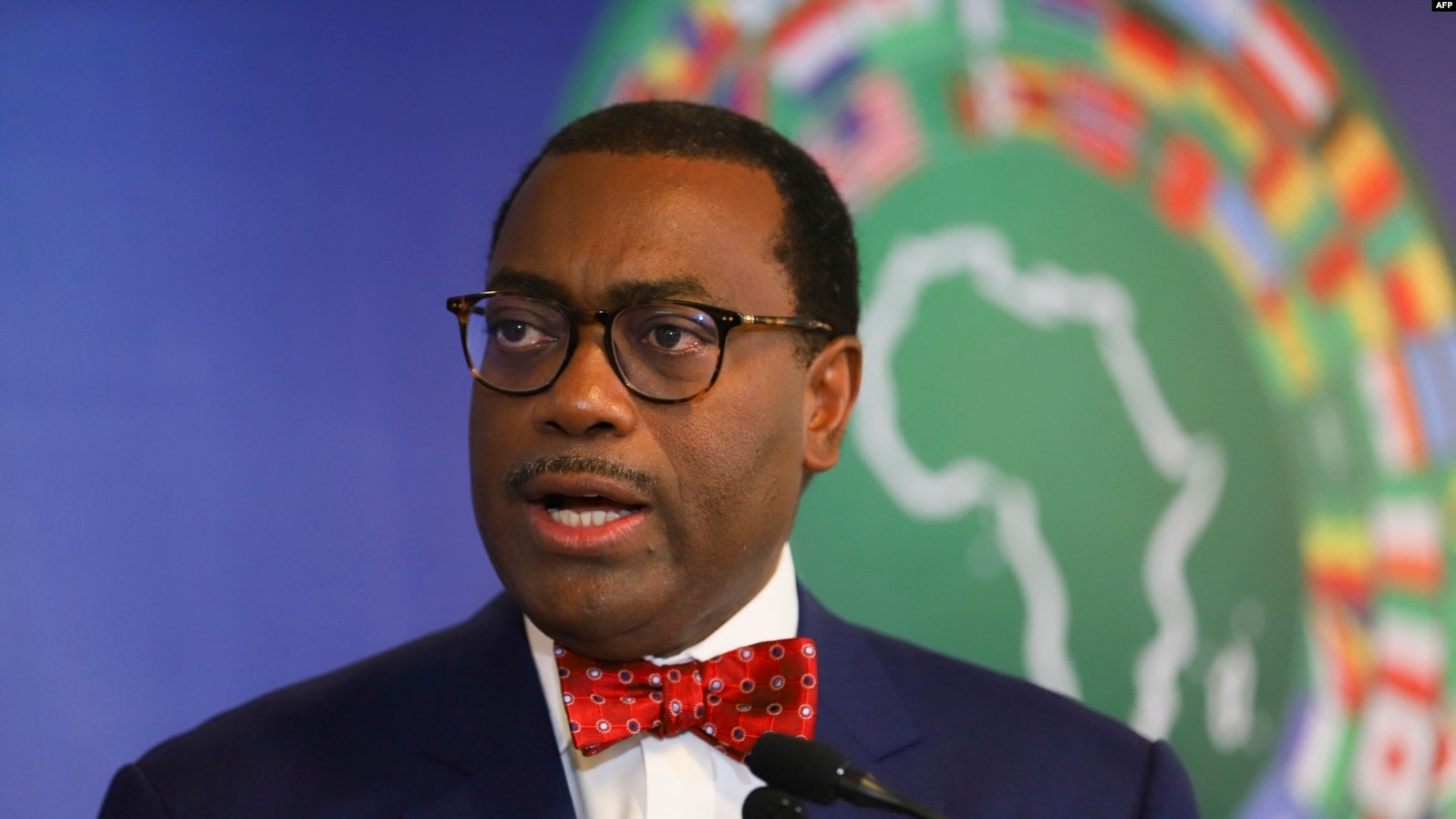
Akinwumi Adesina, president of the African Development Bank Group, speaks at the African Development Bank's Annual meeting in Accra, Ghana, on May 23, 2022 (VOA)
The year 2023 has so far not been a good one for Africa. Conflict has erupted in Sudan, deepened in the Democratic Republic of Congo and spread southward from the Sahel.
Extreme weather, often attributed to climate change, has triggered devastating droughts and floods in places like Kenya and South Sudan, deepening poverty. Many African economies are struggling under massive debt.
But the head of the African Development Bank, or AfDB, prefers to focus on the continent's promise: notably, how to better harness its assets — from its massive natural resource wealth to its large and young workforce — to fight climate change, invest in sustainable development and green and grow economies.
"I've been pushing that we need to revalue our countries based on their natural capital," the bank's president, Akinwumi Adesina, told VOA during a recent trip to Paris.
"This fundamentally for me is how we are going get a lot of capital going into Africa," he added, "by the greening of African economies, by the proper valuation of carbon" that contributes to rising emissions but can also be stored and sequestered in areas rich in land and forests.
Adesina spoke after a financing summit in the French capital that drew dozens of developing country leaders, but few from richer nations. Still, many observers note it delivered some concrete results in development and climate financing for poor countries — possibly paving the way for bigger changes.
Among the takeaways: China and other creditors agreed to restructure Zambia's debt; Senegal received financing to develop renewable energy, and rich nations agreed to reallocate $100 billion in International Monetary Fund money to fight climate change and poverty in developing countries.
For Adesina, the summit, hosted by French President Emmanuel Macron, led to "a new sense of commitment, a sense of urgency of the need to move forward."
He also echoed other critics, though, in calling on rich nations to meet promises of climate financing made about a decade ago to poorer ones. The aim is to be more aggressive in building a more equitable world — siding with calls made by a group of developing countries led by Jamaica called the Bridgetown Initiative.
China key
A Nigerian economist famous for his bowties — one was firmly affixed during the Paris interview — 63-year-old Adesina was tapped as AfDB head in 2015 and reelected for a second term in 2020. As the son of a farmer from southwestern Nigeria, he understands Africa's development challenges firsthand.
"The global financial architecture is failing," Adesina said, adding the world was also "way off course" in achieving U.N. sustainable development goals that include ending poverty and hunger, and ensuring quality education, along with clean water and energy.
Africa alone will need $2.7 trillion to tackle climate change between now and 2030, he noted. Yet it gets only a fraction of global financing to cope with a climate crisis for which it is largely not responsible.
"We all live on the same planet," Adesina said. "We are not going to another one, so we've got to save it."
While sustainable financing may be slow to come, competition for Africa's riches is intensifying. In recent months, top officials from the U.S., China and Russia have crisscrossed the continent, seeking to ramp up diplomatic and economic ties.
China, in particular, is a top lender and Africa's biggest trading partner. Critics, including Washington, have slammed Beijing for fostering debt traps — locking in loans for political leverage — which Beijing strongly denies.
But the Paris summit marked a change. China, Zambia's largest creditor, joined others in agreeing to restructure the country's debt — in what some, like Adesina, hope will pave the way for similar deals.
"There's no way we can solve the challenges of debt in Africa without China at the table," he said, noting Beijing currently holds 14 percent of the continent's debt.
'Toxic' debt
Adesina also denounced loans repaid by depleting Africa's rich trove of natural resources — from timber and oil and gas to diamonds and rare earth metals, like cobalt, that are key for electric vehicles — with often disastrous environmental consequences.
The World Bank estimates such loans represented nearly 10 percent of new borrowing in sub-Saharan Africa between 2004 and 2018. Critics single out China and Russia for especially harmful practices. Russia's Wagner Group notoriously trades its much-criticized military services for opportunities to exploit timber, diamond and gold mines in countries where it operates — but they are not the only ones.
"Natural resource-backed loans should stop completely," said Adesina, without naming any particular country. "They should never be on the table. They are toxic, non-transparent debt, which mortgages the future of countries."
But he also called on African countries to be more active in mobilizing resources for their own development by raising taxes on multinational companies, for example, stopping illicit capital flows out of the continent, and cracking down on corruption.
Africa, Adesina argues, is a good investment. He cited a Moody's Analytics report that found the continent's default rate for infrastructure projects to be the second lowest in the world.
Accounting for Africa resource wealth, or natural capital — including the positive contribution of its rainforests and other wild areas in fighting climate change and preserving biodiversity — would also substantially change its balance sheets.
"If that re-estimation were to be taken into account, the debt-to-GDP ratio would fall dramatically," Adesina said, allowing countries like mineral- and forest-rich Democratic Republic of Congo to raise money at a much lower interest rate.
He points to the AfDB's own green investments — including in a vast solar energy project in the Sahel that is aimed at providing electricity to a quarter-million people and the development of at-home skills in solar assembly and manufacturing.
Such investments carry larger payoffs, Adesina added, describing how solar drip irrigation could help green the Sahel, or how parallel investments in development could help address root causes of the region's years-long conflict.
He added that young people would stay in the African continent instead of moving to Europe "because there's economic activity powered by available energy."
Newer articles:
- Tragic road accident in South Sudan claims three lives - 17/07/2023 06:57
- Over 19,000 Sudanese seeking refuge in South Sudan as conflict persists: UN - 17/07/2023 03:28
- Paramilitaries deny Darfur killings as air strikes rage in Khartoum - 17/07/2023 03:24
- Sudan: No hope for peace as fighting intensifies - 17/07/2023 03:13
- Why African nations are keen to join the expanding BRICS club - 17/07/2023 02:59
Older news items
- Putin wants to attend an August summit. Host country South Africa doesn’t want to have to arrest him - 17/07/2023 00:25
- ‘There is always risk’: The Zimbabwean de-miner in South Sudan - 14/07/2023 06:40
- South Korean peacekeepers partner with Dr John Garang Memorial University on pilot rice cultivation programme in Bor - 14/07/2023 06:34
- RRC commences registration of returnees and refugees in Lakes State - 14/07/2023 04:41
- Sudan govt willing to work with all parties to end conflict - 14/07/2023 03:05
Latest news items (all categories):
- South Sudan can leverage China’s AI path to bridge the digital divide - 16/09/2026 16:04
- Credible Elections Are No Longer Possible in South Sudan - What Next? - 16/09/2026 15:59
- South Sudan's president replaces electoral chief three months before scheduled polls - 16/09/2026 15:56
- Turkish Airlines is pulling out of 5 African routes, including South Sudan - 16/09/2026 15:23
- ‘Super El Niño’ deepens hunger crisis in South Sudan – WFP - 16/09/2026 15:19
Random articles (all categories):
- South Sudan: Ugandan troops begin pull-out as part of peace deal - 21/10/2015 04:59
- South Sudan's inflation no longer at record levels, but still high - Al-Bawaba - 11/09/2012 07:33
- South Sudan accuses Khartoum of new attacks on its territories - 05/07/2013 00:35
- South Sudan peace talks put on hold again - 05/10/2014 20:54
- Amb Ezekiel Lol Gatkuoth: the best and successful petroleum minister in the history of South Sudan - 23/03/2019 20:31
Popular articles:
- Who is the darkest person in the world, according to Guinness World Record? - 25/10/2022 02:34 - Read 149593 times
- School exam results in South Sudan show decline - 01/04/2012 17:58 - Read 28115 times
- Top 10 weakest currency exchange rates in Africa in 2023 - 19/07/2023 00:24 - Read 25198 times
- No oil in troubled waters - 25/03/2014 15:02 - Read 24464 times
- NDSU student from South Sudan receives scholarship - In-Forum - 29/09/2012 01:44 - Read 22416 times
