
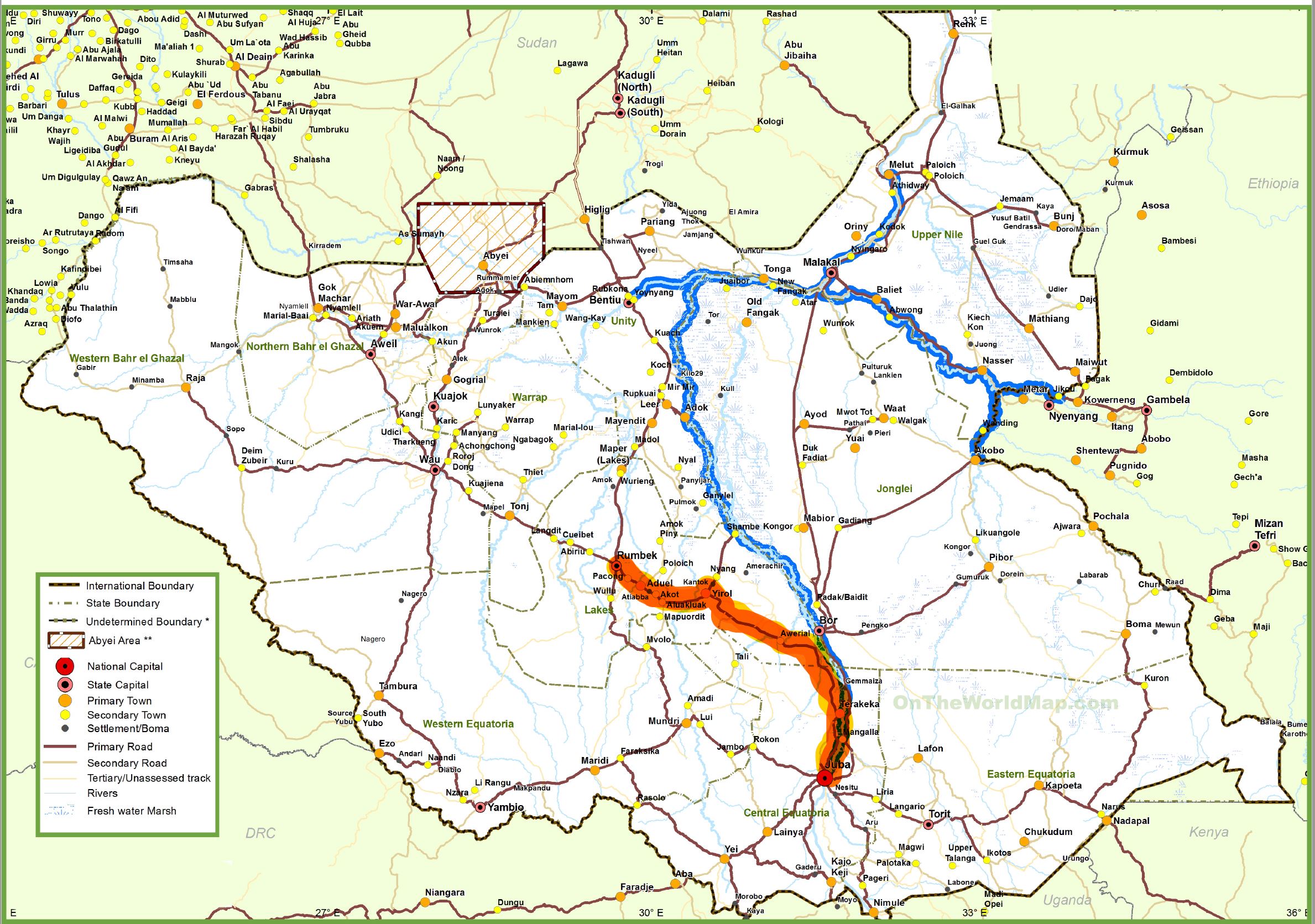
 The pilgrimage route stretched from Rumbek to Juba, a distance comparable to New York City to Washington. South Sudan became the world's youngest nation, and Africa's 55th country, on July 9, 2011. It is eight times the size of its former colonial authority, Great Britain. Despite natural resources and exports of gold (70% of total exports) and livestock (25% of exports), the coutry's people are the poorest in the world. (Photo: Courtesy of Bishop Christian Carlassare)
Italian-born Bishop Christian Carlassare, 46, became bishop of the Diocese of Rumbek in South Sudan after working in the country as a Comboni missionary for 16 years. Between Jan. 25 and Feb. 2, the bishop led a nine-day pilgrimage under a banner of “Walking for Peace.” Pilgrims who made the journey to meet Pope Francis[1] included 60 students, most ages 18-20, and 24 supporting staff, including Loreto Sister Orla Treacy, principal of the Loreto Rumbek Primary and Secondary School, who tweeted[2] about the walk. In addition to visiting South Sudan, Pope Francis visited the Democratic Republic of the Congo on his Jan. 31-Feb. 5 apostolic journey. Bishop Carlassare spoke with the Register just ahead and directly after the papal trip about the long and joyful journey to Juba.
Your Excellency, please tell me about your ambitious and successful pilgrimage to see Pope Francis in Juba, South Sudan’s capital city, 265 miles from your diocese.
It was a great experience of friendship and bonding within the group and a beautiful experience of encountering different Christian communities because every evening we were reaching a parish where we were praying, celebrating, passing on the message of reconciliation and peace. Along the way, in all the villages we passed through, there were people who were full of joy to see young people — who were so badly manipulated in the past, used to fight, marching with guns — instead, they saw a group of youth marching with crosses and banners of peace, talking about communion, being friendly with one another. I think we were the hope, somehow, for all the people who were seeing us and a hope for the country.
People responded by joining us — coming to welcome us as we approached [a village]; then walking together and joining us for prayer, and then taking us ahead. The pilgrimage was really done by hundreds, if not thousands, of people, who felt like we need to join together — not just for this single pilgrimage, but to journey as Church — at the service of peace and reconciliation, and being together, despite the diversity that can exist between clans, or tribe, even languages sometimes. We felt there is a common humanity and a common fraternity that has to guide us.
Did you pray along the way?
Along the way, the youth sang Christian songs and shared in small groups. It was an ecumenical pilgrimage because there were Catholic students and a smaller presence of ECS, Episcopal Church of Sudan, youth. In the morning, when we woke up at 6am, we had a novena prayer with some text and a theme. In the afternoon, there was Mass; and in the evening, before going to sleep, there was half an hour of silent prayer — like a recollection of the day.
Every night, we stayed with a different Christian parish, and hosts, as well as local people, prayed with us. Twice, we were in Comboni parishes.
 L TO R: Bishop Christian Carlassare (right) is on pilgrimage with Deacon Arkangelo Manyel. Up at the crack of dawn at the South Sudanese parish of Mingkaman, Bishop Carlassare is shown on his way to meet the youth group, which slept at a church school.(Photo: Courtesy of Bishop Christian Carlassare)
How did you prepare for the pilgrimage?
We practiced by doing “stretches,” but not along the final route. We were visiting other communities just to test how much we could walk a day, but also to get a chance to visit other Christian communities that were not on the route, but they were a bit out of it. So it became a chance to prepare other communities for the events around the Pope’s visit. We did four preparatory walks.
There’s a photo of your group with Pope Francis, and the Holy Father is saying something to you. What was his message?
The Holy Father was really very kind. The meeting came about because he heard about our pilgrimage and asked to meet the youth. So, at the end of his meeting with the religious, he came out from the cathedral [in Juba], and we had all the youth on the steps of the cathedral. He came in front of them, and told them, “You are a great witness to me and to the Church. Please continue on this way,” and he blessed us. We gave him an altar cloth embroidered by the Missionaries of Charity, and he gave each participant in the pilgrimage a rosary.
To me personally, the Holy Father said: “Thank you for the witness of these youth; they are writing a new chapter for South Sudan.”
 After their nine-day pilgrimage from Rumbek to Juba, South Sudan (almost the distance of New York to Washington, D.C.), 60 youth and 24 supporting staff, including Bishop Christian Carlassare, met with the Holy Father. Bishop Carlassare listens as Pope Francis tells him, ‘Thank you for the witness of these youth. They are writing a new chapter for South Sudan.’(Photo: Courtesy of Bishop Christian Carlassare)
It’s wonderful Pope Francis heard about your pilgrimage. What do you hope his visit to South Sudan will leave behind?
The Holy Father had messages for two audiences: the institutions and the people.
To the state institutions, he spoke clearly. He said, “Enough is enough. Let us stop violence. Let us be at the service of all citizens, especially those most vulnerable.” Let us keep the peace agreement, but also let us remain open to further dialogue.
And to the population that was really frustrated, and tired, and even feeling hopeless, he encouraged simple citizens to know that, first of all, peace will begin at the grassroots.
Institutions are important, but, first of all, individuals must be firm in the intention to disarm their hearts besides also disarming themselves.
And the Church’s role?
Church is to be a prophetic voice, a powerful intercessor for the people, at the service of justice and peace, as it is said by the African Synod, that the Church must take the name of reconciliation. I think as Church leaders, bishops, priests, religious, missionaries, we have to really take it up strongly [justice and peace] and never lose hope. It is the meaning of our presence in this context: preaching the Gospel and the Gospel that calls people to become a new humanity, to accept the humanization that comes from the incarnation of Christ; but also as Church, to be fully incarnated in this context and help people make fraternity.
What was the impact of the nine-day pilgrimage on the students?
You know, some of the youth had never been to Juba before, and many had never walked that far! I think it was very encouraging for them. It empowered them and exposed them to the idea: We can do great things together. Sometimes things may look crazy, and you may not believe that we can do it, but, all together, we can do great things and bring change. So it was a powerful encouragement and hope for them.
 Clockwise from right: Bishop Christian Carlassare holds the hand of Elijo James, a university student; the bishop has accompanied James as a spiritual father. At the pilgrimage kickoff, Bishop Carlassare was joined by religious and political leaders such as (far left) Episcopal Archbishop Alpheus Manyang; Lakes State Gov. Rin Tueny, who leads the state in which Rumbek is located; and (right) Anglican Archbishop Abraham Mayom. Athiey is a caretaker for two newborn twins who lost their mother during their birth. The babies live in an orphanage run by Missionaries of Charity in South Sudan.(Photo: Courtesy of Bishop Christian Carlassare)
I remember violent conflicts occurring on this route during the civil war. Is the fact that you completed the journey evidence that the country is safer than it was, say, five years ago?
Yes and No. Yes, because the peace agreement [of 2018] is holding, and the government of national unity [formed in 2020] is holding. Yes, because we have a strong governor, and he has been keeping security as a priority. So we could walk all along our state, Lakes, [South Sudan is divided into 10 states[3]] peacefully and also with the help of some security people put there by the governor. Still, in some parts of the country, security is not good; there are militias, and grudges continue. The route we took went through peaceful places, but it was a longer trek, to avoid unsafe areas.
In South Sudan, one-third of the population is either a refugee in a neighboring country or considered an “internally displaced person,” IDPs, within the country because it’s still unsafe to go home, usually because their homes are occupied by soldiers or opposite tribes. I did pastoral service in an IDP camp. It was painful to see because people feel like they are in prison within their own country, where they are not free to live outside, or start economic activity or even to go to normal school. They are not free to mix with other citizens!
Now, we are seeing a certain amount of normalization; but in many parts of the country, there’s still much work to be done. Living together is still an issue. Being in a city where we have different clans or tribes living together is still challenging. Our pilgrimage was an intertribal one because students from many ethnic groups participated because they are in Rumbek for studies from around the country. It was like showing the country how we can live in the future.
Promoting living together and being Christians in the same communities, even though there are ethnic differences, is overcoming the conflictuality that, unfortunately, in the political arena, is still there.
You arrived in South Sudan as a missionary in 2005 at age 28; now, you are a bishop. What is something you love about your role?
I am so grateful to God for my vocation, sharing the journey with the people of this country — and the journey of the Church within this country. I feel I receive so much, especially from the people of faith in South Sudan; as the Pope said, they are humble and strong at the same time. So when the desire of the Pope to make me bishop of Rumbek [was announced], I just felt to give back to the people all that I am and to be fully consecrated to them; and that is the meaning to me, of being a bishop at this time, in this country — to fully belong to this nation and share faith and new paths and encourage conversions. So, in this, I also find joy to serve.
I have to ask you: How are your legs? Are they 100% healed? For readers who might not know, you were attacked, shot in the legs, in the Rumbek parish house, as you slept, after you were appointed bishop but weeks before your ordination. [4]
God really blessed me. He protected me from worse injuries. My legs aren’t back to where they were before, but I’m walking and strong. Now, it’s history; something that has passed. We look forward.
Have you forgiven those who committed violence against you?
About forgiveness: Yes, I felt forgiveness right away when I woke up [at a hospital] because I lost a lot of blood. It was a way to push away the fear, the frustration, and the anger for what happened; to free myself from that evil and also to free those who committed that evil — two youth who were certainly manipulated and not responsible for that action.
Also, my coming back to the diocese [after a year of healing] was an expression of forgiveness, in the sense that it was an action of trust as a shepherd and trust toward the people. So, yes, I did forgive.
References
- ^ to meet Pope Francis (www.ncregister.com)
- ^ who tweeted (twitter.com)
- ^ divided into 10 states (www.usip.org)
- ^ you were attacked (www.catholicnewsagency.com)
Newer articles:
- Kisii Family Seeks Gov’t Intervention After Kin is Convicted of Child Molestation in South Sudan - 03/03/2023 02:24
- LAMWO: Thugs robbing motorcycles in exchange for guns - 03/03/2023 01:16
- Africa: Scorpions in Egypt to Set Their Record - Gambia U20 Coach Bojang - 03/03/2023 00:56
- South Sudan, March 2023 Monthly Forecast - Security Council Report - 02/03/2023 09:38
- International Monetary Fund (IMF) Executive Board Approves US$114.8 Million in Emergency Financing Support to South Sudan - 02/03/2023 06:29
Older news items
- Kenya: Haji Elected President of the Eastern Africa Association of Prosecutors (EAAP) By East African Prosecutors - 02/03/2023 01:04
- UNISFA Condemns the reported presence of South Sudanese uniformed personnel inside the Abyei Area - 02/03/2023 00:58
- Sudanese leader says willing to strengthen cooperation with South Sudan - 01/03/2023 07:15
- Accountability and ethics focus of United Nations Mission in South Sudan (UNMISS) - facilitated training for journalists in Bor - 01/03/2023 06:10
- Doctors: Security forces kill protester near Sudan's capital - 01/03/2023 02:04
Latest news items (all categories):
- South Sudan Opens 14 Oil Blocks, Courts Investors Ahead of SSOP 2026 - 26/10/2026 15:08
- Jambojet Explores South Sudan Expansion After Talks with Juba Regulator - 26/10/2026 15:05
- Kiir swears in 5 officials ahead of South Sudan elections - 26/10/2026 14:53
- South Sudan cattle battles leaves 10 dead: official - 26/10/2026 14:49
- Churches urge world 'not to forget South Sudan' ahead of first elections - 26/10/2026 14:47
Random articles (all categories):
- South Sudan shuts down nightclubs for 'immoral acts' - 12/05/2019 05:50
- New Report: Banking Reforms Needed to Counter Deep-Seated Corruption Slowing Economic Progress in Sudan - 07/10/2021 11:36
- US envoy urges talks after S Sudan leader's term extension - 25/03/2015 17:39
- UNICEF - Institutional Consultancy: Assessment on dropout and repetition in basic education- UNICEF Rwanda - 26/08/2015 14:21
- The recommendation of 400 Padang Sons and Daughters to various oil companies by Awou Daniel Acuang is a clear Padangization of Oil Sector - 13/07/2019 08:43
Popular articles:
- Who is the darkest person in the world, according to Guinness World Record? - 25/10/2022 02:34 - Read 151300 times
- School exam results in South Sudan show decline - 01/04/2012 17:58 - Read 28392 times
- Top 10 weakest currency exchange rates in Africa in 2023 - 19/07/2023 00:24 - Read 25497 times
- No oil in troubled waters - 25/03/2014 15:02 - Read 24703 times
- NDSU student from South Sudan receives scholarship - In-Forum - 29/09/2012 01:44 - Read 22678 times
