
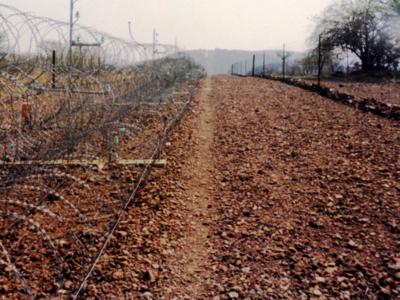
For decades, African states have grappled with numerous interstate border disputes, especially in resource-rich regions. In east Africa, most of these conflicts are as old as independence. The disputes flare up every so often despite interventions by agencies of the African Union and the United Nations. A fresh war of words has erupted between Kenya and South Sudan over the water- and oil-rich Ilemi Triangle border, which was first drawn up in 1914. We asked Al Chukwuma Okoli, a defence strategy scholar, four key questions.
Why do boundaries matter for nation states?
The term “boundary” refers to a cartographic (mapped out) line that marks and defines the confines of a state, distinguishing its sovereign territory from that of others. It is mutually agreed upon and jointly owned by the countries involved.
Boundaries matter because they determine the area that a country rules. They also assign national identity.
Boundaries are both a bridge and a barrier to international peace and stability. As a bridge, international boundaries have a role in legitimate activities, especially in trade and migration. But as a barrier, they can be a site for criminality and violence. More importantly, boundaries provide a “fault-line” for international conflicts.
Which are some of east Africa’s boundary conflicts?
I took part in a recent study of several instances of boundary conflicts in east Africa. These include the conflicts between Somalia and Ethiopia (ongoing since 1960); Kenya and South Sudan (ongoing since 1963); and Kenya and Somalia (1963-1981). Others are Ethiopia and Sudan (from 1966 to 2002), Tanzania and Malawi (ongoing since 1967) and Uganda-Tanzania (1974–1979).
The various boundary conflicts in the region originated and evolved in different historical and political contexts. But they have been complicated by the changing dictates of international politics.
Some of these conflicts have been protracted and intractable. A case in point is the Kenya–South Sudan conflict, which seems to have become more complicated in recent years. It began in 1963 when Kenya claimed the Ilemi Triangle. Ilemi is a region rich in oil and water, lying to the north of a straight border that was drawn in 1914. Kenya’s claim, and de facto control, extends beyond the limit marked in 1938.
Several bilateral and multilateral measures have been taken over the years to resolve the conflict. These include continental initiatives anchored by the African Union. In 2019 Kenya and South Sudan agreed to talks. They have demonstrated commitment to finding a solution by creating a joint boundary commission. But flare-ups and skirmishes still erupt on the disputed borderlines.
What generally fuels Africa’s boundary disputes?
A dominant view by scholars holds that boundary disputes are inevitable creations of colonialism. Via the Berlin Conference diplomacy of 1884 to 1885, European imperial powers took control of African territories and carved them up. European maps defined African state boundaries.
This perspective suggests that the imperialist scramble for Africa was a sort of crude territorial grabbing, leading to arbitrary and artificial partitioning of Africa into slices of colonial spheres of interest. By slicing up similar cultural groups and lumping together culturally divergent groups, colonialism created long-lasting disputes.
Other scholars have questioned this view. They say colonial interference cannot fully explain the nature and dynamics of the current boundary conflicts in Africa. These “realist” scholars believe that states fight for territory for material advantage. The fight is largely about the ownership, access or control of natural resources like oil and water. This implies that the motive behind most present-day boundary conflicts is states’ pursuit of material advantages along their common territorial frontiers.
My view is that what is crucially at issue in most current border-related disputes in Africa is the quest for resources.
Apart from the Ilemi Triangle spat, South Sudan is currently feuding with Sudan over the oil-rich Abiyei region. Uganda and the Democratic Republic of Congo are locked in a dispute over the ownership of parts of Lake Albert. The disputed spot has potential for crude oil alongside minerals like diamonds, gold and coltan.
Similarly, Tanzania and Malawi are at loggerheads over the oil-rich area around Lake Malawi (Nyasaland), while Kenya and Uganda have been quarrelling over the waters, fish and possible crude oil of Lake Victoria’s Migingo Island.
How can these border conflicts be resolved?
Modern boundary disputes in east Africa have often been largely driven by declared or disguised claims, stakes, motives and interests that are material or economic in essence. Understanding boundary disputes in Africa should go beyond the idea of “colonial causation” and come to terms with strategic and material interests.
Solutions to such conflicts depend on a diplomatic approach that recognises the colonially inherited boundary system and also mediates the interests of affected states.
It is necessary to evolve a regional border management mechanism that can proactively and multilaterally address border-related issues to find an enduring resolution. The joint border commission between Kenya and South Sudan is a step in the right direction.
The spate of boundary conflicts in east Africa poses a huge challenge to regional politics and diplomacy. Apart from creating diplomatic tension among states, the situation has resulted in a loss of lives and livelihoods. It has also destabilised the region – a setback to regional integration. A lasting solution is needed to sustain peace and stability of the region.
Written by Al Chukwuma Okoli, SeniorLecturer, Security Sector Consultant-researcher, Department of Political Science, Federal University of Lafia, Nigeria, Federal University Lafia.
Republished with permission from The Conversation[1]. The original article can be found here[2].
References
- ^ The Conversation (theconversation.com)
- ^ here (theconversation.com)
Newer articles:
- She escaped hunger and destruction to be the first champion of the Olympic Refugee Team - 17/02/2023 05:00
- Pope: The world is headed toward the abyss if it won't end war - 17/02/2023 04:20
- Turkey donates first batch of military uniforms to South Sudan - 17/02/2023 03:13
- Zone V Women’s Afrobasket Qualifiers: Uganda Gazelles too strong for South Sudan - 17/02/2023 02:42
- Dengue Fever in Sudan - Two Dead, At Least 169 Confirmed Cases in Khartoum and El Gedaref - 17/02/2023 01:10
Older news items
- Unity State governor donates 15,000 sacks of sorghum to IDPs - 16/02/2023 06:58
- Museveni receives new envoys, including from South Sudan - 16/02/2023 05:00
- Zone V Women’s AfroBasket Qualifiers: South Sudan pick first ever win - 16/02/2023 04:40
- Popes are for life, resignations should not become a fashion, Francis says - 16/02/2023 00:52
- African Leaders Meet To Push For Free Trade Zone - 16/02/2023 00:37
Latest news items (all categories):
- Ramaphosa presses Kiir to implement peace deal ahead of South Sudan’s first elections - 09/10/2026 12:19
- South Sudan steps up Ebola alert after Kenya case - 09/10/2026 12:17
- Laotian man deported by U.S. to South Sudan leaves for Laos after year in detention - 09/10/2026 12:14
- Bullet and blast injuries … and a constant need for blood: inside South Sudan’s overwhelmed trauma wards - 09/10/2026 12:10
- MTN South Sudan and Regulator Pledge Cooperation to Expand Connectivity - 09/10/2026 12:01
Random articles (all categories):
- Obama pushes East African leaders for end to South Sudan conflict - 28/07/2015 22:49
- South Sudan overdraft appetite from oil wealth raising eyebrows - 03/03/2020 06:50
- Sudan and South Sudan reach agreement over oil after tense eight-month dispute - Telegraph.co.uk - 04/08/2012 11:20
- South Sudanese React to Pope's Retirement - Voice of America - 18/02/2013 17:34
- Opinion | How do we make an election possible in South Sudan? - 24/03/2022 02:58
Popular articles:
- Who is the darkest person in the world, according to Guinness World Record? - 25/10/2022 02:34 - Read 150850 times
- School exam results in South Sudan show decline - 01/04/2012 17:58 - Read 28209 times
- Top 10 weakest currency exchange rates in Africa in 2023 - 19/07/2023 00:24 - Read 25316 times
- No oil in troubled waters - 25/03/2014 15:02 - Read 24543 times
- NDSU student from South Sudan receives scholarship - In-Forum - 29/09/2012 01:44 - Read 22505 times
