
PM Netanyahu accepts AG's brief, based on Foreign Ministry stance that nothing prevents Israel from returning South Sudanese migrants to their new country if they are not eligible for asylum Aviad Glickman
About to be deported? Attorney-General Yehuda Weinstein has presented Prime Minister Benjamin Netanyahu
with a brief that says that Israel
can return illegal migrants from South Sudan
to their country.
Weinstein met with Netanyahu on Wednesday evening and informed him that the Attorney General's Office would support the stance of the Foreign Ministry, which seeks to deport the migrants now that South Sudan has been declared an independent state.
Related stories:
Rally: South Tel Aviv a 'refugee camp'
Op-ed: Keep our Israel Jewish
'Don't deport refugees' children'
Israel's migrant explosion
The Foreign Ministry is seeking to deport migrants from South Sudan who do not meet the criteria for asylum. According to estimates from groups that assist asylum seekers and a count that the community itself conducted, some 700 asylum seekers from South Sudan currently live in Israel, including some 400 children. However, the Population Administration puts the number at some 3,000.
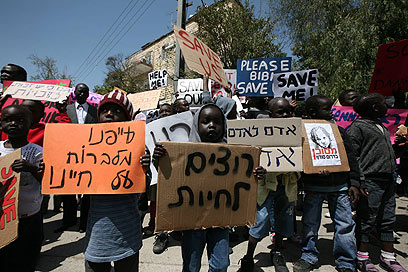 South Sudanese refugees: We want to live (Photo: Gil Yohanan)
The state attorney plans to ask the Jerusalem
District Court to grant an order that would forbid the detention or custody of refugees from South Sudan, which is facing instability despite its newfound independence.
The United Nations,
on the other hand, believes that Israel should hold off on deporting the South Sudanese migrants. During a Knesset Committee debate on foreign workers, the UN Refugee Agency's representative in Israel said that the agency supported an extension of the collective protection given to asylum seekers.
The South Sudanese themselves, as well as the various organizations that provide aid to the community, also think that Israel should wait before sending would-be refugees back to their country because of the risk of war and the harsh living conditions there.
On Sunday, Netanyahu addressed the growing problem of illegal migrants, saying that his government had taken a number of steps to address the issue: "First of all, to stop them from coming in and second of all to start sending them out," the prime minister said.
"We have 60,000 migrants – if we don't stop the inflow we could easily reach 600,000."
Netanyahu also cautioned against additional infiltrators entering Israel via the Egyptian border. "This is flooding the state and wiping out our identity as a Jewish, democratic state, so we've been forced to set up a physical obstacle that will be completed by October," he said.
Turning to the opposition to African migrants, especially in south Tel Aviv, Netanyahu called the growing refugee population "a bother to many residents, and rightfully so."
"We will solve the problem by acting. We hear the calls and are taking action. The action will prevail," he promised.
South Sudanese refugees: We want to live (Photo: Gil Yohanan)
The state attorney plans to ask the Jerusalem
District Court to grant an order that would forbid the detention or custody of refugees from South Sudan, which is facing instability despite its newfound independence.
The United Nations,
on the other hand, believes that Israel should hold off on deporting the South Sudanese migrants. During a Knesset Committee debate on foreign workers, the UN Refugee Agency's representative in Israel said that the agency supported an extension of the collective protection given to asylum seekers.
The South Sudanese themselves, as well as the various organizations that provide aid to the community, also think that Israel should wait before sending would-be refugees back to their country because of the risk of war and the harsh living conditions there.
On Sunday, Netanyahu addressed the growing problem of illegal migrants, saying that his government had taken a number of steps to address the issue: "First of all, to stop them from coming in and second of all to start sending them out," the prime minister said.
"We have 60,000 migrants – if we don't stop the inflow we could easily reach 600,000."
Netanyahu also cautioned against additional infiltrators entering Israel via the Egyptian border. "This is flooding the state and wiping out our identity as a Jewish, democratic state, so we've been forced to set up a physical obstacle that will be completed by October," he said.
Turning to the opposition to African migrants, especially in south Tel Aviv, Netanyahu called the growing refugee population "a bother to many residents, and rightfully so."
"We will solve the problem by acting. We hear the calls and are taking action. The action will prevail," he promised.
The Foreign Ministry is seeking to deport migrants from South Sudan who do not meet the criteria for asylum. According to estimates from groups that assist asylum seekers and a count that the community itself conducted, some 700 asylum seekers from South Sudan currently live in Israel, including some 400 children. However, the Population Administration puts the number at some 3,000.
South Sudanese refugees: We want to live (Photo: Gil Yohanan)
The state attorney plans to ask the Jerusalem
District Court to grant an order that would forbid the detention or custody of refugees from South Sudan, which is facing instability despite its newfound independence.
The United Nations,
on the other hand, believes that Israel should hold off on deporting the South Sudanese migrants. During a Knesset Committee debate on foreign workers, the UN Refugee Agency's representative in Israel said that the agency supported an extension of the collective protection given to asylum seekers.
The South Sudanese themselves, as well as the various organizations that provide aid to the community, also think that Israel should wait before sending would-be refugees back to their country because of the risk of war and the harsh living conditions there.
On Sunday, Netanyahu addressed the growing problem of illegal migrants, saying that his government had taken a number of steps to address the issue: "First of all, to stop them from coming in and second of all to start sending them out," the prime minister said.
"We have 60,000 migrants – if we don't stop the inflow we could easily reach 600,000."
Netanyahu also cautioned against additional infiltrators entering Israel via the Egyptian border. "This is flooding the state and wiping out our identity as a Jewish, democratic state, so we've been forced to set up a physical obstacle that will be completed by October," he said.
Turning to the opposition to African migrants, especially in south Tel Aviv, Netanyahu called the growing refugee population "a bother to many residents, and rightfully so."
"We will solve the problem by acting. We hear the calls and are taking action. The action will prevail," he promised.
...
PM Netanyahu accepts AG's brief, based on Foreign Ministry stance that nothing prevents Israel from returning South Sudanese migrants to their new country if they are not eligible for asylum Aviad Glickman
About to be deported? Attorney-General Yehuda Weinstein has presented Prime Minister Benjamin Netanyahu
with a brief that says that Israel
can return illegal migrants from South Sudan
to their country.
Weinstein met with Netanyahu on Wednesday evening and informed him that the Attorney General's Office would support the stance of the Foreign Ministry, which seeks to deport the migrants now that South Sudan has been declared an independent state.
Related stories:
Rally: South Tel Aviv a 'refugee camp'
Op-ed: Keep our Israel Jewish
'Don't deport refugees' children'
Israel's migrant explosion
The Foreign Ministry is seeking to deport migrants from South Sudan who do not meet the criteria for asylum. According to estimates from groups that assist asylum seekers and a count that the community itself conducted, some 700 asylum seekers from South Sudan currently live in Israel, including some 400 children. However, the Population Administration puts the number at some 3,000.
South Sudanese refugees: We want to live (Photo: Gil Yohanan)
The state attorney plans to ask the Jerusalem
District Court to grant an order that would forbid the detention or custody of refugees from South Sudan, which is facing instability despite its newfound independence.
The United Nations,
on the other hand, believes that Israel should hold off on deporting the South Sudanese migrants. During a Knesset Committee debate on foreign workers, the UN Refugee Agency's representative in Israel said that the agency supported an extension of the collective protection given to asylum seekers.
The South Sudanese themselves, as well as the various organizations that provide aid to the community, also think that Israel should wait before sending would-be refugees back to their country because of the risk of war and the harsh living conditions there.
On Sunday, Netanyahu addressed the growing problem of illegal migrants, saying that his government had taken a number of steps to address the issue: "First of all, to stop them from coming in and second of all to start sending them out," the prime minister said.
"We have 60,000 migrants – if we don't stop the inflow we could easily reach 600,000."
Netanyahu also cautioned against additional infiltrators entering Israel via the Egyptian border. "This is flooding the state and wiping out our identity as a Jewish, democratic state, so we've been forced to set up a physical obstacle that will be completed by October," he said.
Turning to the opposition to African migrants, especially in south Tel Aviv, Netanyahu called the growing refugee population "a bother to many residents, and rightfully so."
"We will solve the problem by acting. We hear the calls and are taking action. The action will prevail," he promised.
The Foreign Ministry is seeking to deport migrants from South Sudan who do not meet the criteria for asylum. According to estimates from groups that assist asylum seekers and a count that the community itself conducted, some 700 asylum seekers from South Sudan currently live in Israel, including some 400 children. However, the Population Administration puts the number at some 3,000.
South Sudanese refugees: We want to live (Photo: Gil Yohanan)
The state attorney plans to ask the Jerusalem
District Court to grant an order that would forbid the detention or custody of refugees from South Sudan, which is facing instability despite its newfound independence.
The United Nations,
on the other hand, believes that Israel should hold off on deporting the South Sudanese migrants. During a Knesset Committee debate on foreign workers, the UN Refugee Agency's representative in Israel said that the agency supported an extension of the collective protection given to asylum seekers.
The South Sudanese themselves, as well as the various organizations that provide aid to the community, also think that Israel should wait before sending would-be refugees back to their country because of the risk of war and the harsh living conditions there.
On Sunday, Netanyahu addressed the growing problem of illegal migrants, saying that his government had taken a number of steps to address the issue: "First of all, to stop them from coming in and second of all to start sending them out," the prime minister said.
"We have 60,000 migrants – if we don't stop the inflow we could easily reach 600,000."
Netanyahu also cautioned against additional infiltrators entering Israel via the Egyptian border. "This is flooding the state and wiping out our identity as a Jewish, democratic state, so we've been forced to set up a physical obstacle that will be completed by October," he said.
Turning to the opposition to African migrants, especially in south Tel Aviv, Netanyahu called the growing refugee population "a bother to many residents, and rightfully so."
"We will solve the problem by acting. We hear the calls and are taking action. The action will prevail," he promised.
Newer articles:
- Anti-African street violence surges in Israel - Chicago Tribune - 24/05/2012 10:15
- Anti-African street violence surges in Israel - The Daily Star - 24/05/2012 10:11
- Sudan-supported rebels continue attacks in border areas, Juba says - Sudan Tribune - 24/05/2012 10:08
- SPLM in Unity State, welcome belated support from Juba - Sudan Tribune - 24/05/2012 07:24
- South Sudan, world's youngest nation, develops unlikely friendship with Israel - Jewish Post - 24/05/2012 01:16
Older news items
- South Sudanese community calls for 'justice' in fatal stabbing case - Waterloo Record - 23/05/2012 19:37
- SOUTH SUDAN: End of the road for leper colony - Reuters AlertNet - 23/05/2012 16:35
- South Sudan: No one above the law - Sudan Tribune - 23/05/2012 11:49
- Sudanese military aircraft flew over Juba: SPLA - Sudan Tribune - 23/05/2012 08:50
- South Sudan says Sudan bombs, Shells its territory - WBFO - 22/05/2012 22:04
Latest news items (all categories):
- The Emerging Endgame of the Russo-Ukrainian War - 05/08/2026 22:59
- The changing face of “Made in China” - 05/08/2026 22:41
- UK - Change of His Majesty’s Ambassador to South Sudan: Rebecca Fabrizi - 05/08/2026 22:09
- South Sudan rewriting its future with eyes on agriculture and mining boom - 05/08/2026 21:53
- Moroccan king's letter confirms naming of major highway in honour of Trump - 05/08/2026 21:52
See also (all categories):
Random articles (all categories):
- S. Sudan in Brief: EAC Customs, Visa Deal - Businesses Want Tax Reforms - 30/10/2013 01:30
- Red Card Movement is a Troika funded group intended to dismantle the Revitalized Peace Agreement - 15/05/2019 07:48
- South Sudan ready to graduate first batch of unified forces - 02/02/2021 13:21
- South Sudan Cracking Down on Black Market Money Changers - 12/02/2018 13:31
- Chinese oil firm catering for educational needs of South Sudan's children - 21/03/2023 05:10
Popular articles:
- Who is the darkest person in the world, according to Guinness World Record? - 25/10/2022 02:34 - Read 148332 times
- School exam results in South Sudan show decline - 01/04/2012 17:58 - Read 27920 times
- Top 10 weakest currency exchange rates in Africa in 2023 - 19/07/2023 00:24 - Read 25004 times
- No oil in troubled waters - 25/03/2014 15:02 - Read 24330 times
- NDSU student from South Sudan receives scholarship - In-Forum - 29/09/2012 01:44 - Read 22285 times