
 Pioneer … Kamala Ibrahim Ishag in front of painting Procession (Zaar). Photograph: Mohamed Noureldin Abdallah Ahmed
In her painting Bait al-Mal, Kamala Ibrahim Ishag presents us with the neighbourhood in Khartoum where she grew up during the 1940s and 50s. This large, mostly dusky canvas presents us with clusters of figures in a kind of diagram of their connections and interrelatedness. Instead of streets and corners, we trace winding, branching webs of family and friendships and associations. We’ll never get to the end of them in these looping, bifurcating and fracturing lines. All around the edge of the painting are simplified trees, and it is their tangle of spreading roots that provide the skein of these relationships. A lovely, fanciful painting, Bait al-Mal is a memory map as much as it is a description of a place. The Sudanese painter was, I think, also telling herself a story, and as much as she was drawing with a brush she was also remembering, and making things up as she went along, losing and re-finding herself along the paths her mind took.
There was, apparently, one corner of the neighbourhood that the local children, and doubtless some adults too, were afraid of: the house of a man who was possessed by a Djinn or spirit. Look closely and all you see are a homely couple seated to either side of a tree-trunk. I only know about this small detail because the artist told the curator, and the curator told me. This how rumours are spread, and this one has been doing the rounds now for a lifetime. Maybe it has been told for generations, centuries, millennia. I like this thought very much.
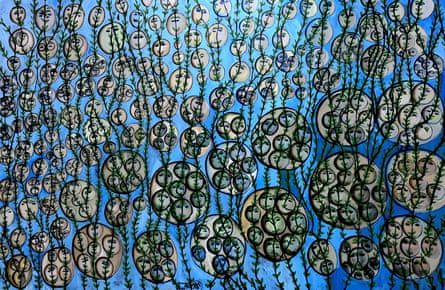
Ishag’s paintings often go back to the stories that her grandmothers told. Past and present collide, and Ishag’s paintings at the Serpentine are filled with such memories and stories, many of which remain unexplained and inaccessible. There is in Ishag’s art a mixture of the folkloric and the religious, the Christian and Islamic, the pagan and secular, all reflecting the convergence of different traditions and beliefs in her native Sudan. Now 83, the painter also studied in London in the late 1960s, at the Royal College of Art, before returning to Khartoum, where she became head of painting at the art school, and an inspiration to generations of students. She has also spent periods in self-imposed exile because of the turbulent political situation in her country, but she has never stopped painting. Politics also enter her art, obliquely. In Blues for the Martyrs she depicts clusters of round faces floating in bubbles amid a tracery of waving, leafy stems, rather like fish eggs among waterweeds, against a blue watery background. The painting refers to the massacre of peaceful protesters[1], raped, shot and drowned in Khartoum in 2019. Central to Ishag’s work is the place of women, who continue to be her major subject.
The Serpentine’s retrospective takes us, not always chronologically, from early drawings made at art school in Sudan to her time in London, where she was influenced both by William Blake and Francis Bacon. The two might appear irreconcilable, but in both artists’ work there is a sense of the malleability of the human body, and how we are shaped by forces we can’t control. Ishag’s figures never developed much, and retain an often somewhat cartoonish expressionism, although there is great tenderness in both an early drawing of naked dancing legs, and in a vision of a much older woman in her 2017 painting Lady Grown in a Tree. The woman appears in a vortex of branches, as much consumed as she is being given life.
Sometimes Ishag’s faces can be gruesome and even vampiric. At other times they feel closer to Byzantine icons. Bodies and heads bulge and collide across the surface of a calabash gourd. Painted figures dance on circular leather drums, and women peer out, like dryads, from the trunks of trees. Faces appear in drooping leaves, and disembodied eyes peer out from a tree’s greenery. Hands and fingers dance among swooning, pulsing foliage. Fissured heads give birth to roots and thoughts. No one looks exactly untroubled. Ishag has also said that her distorted heads are derived from the reflections that startled her decades ago in the curved windows of London’s Underground trains.Often Bacon’s space-frames also played a part in her development, back in Khartoum, of what is called Crystalism[2], a movement which embraced elements of western conceptualism, Sufi mysticism, existentialism, and much besides. Whatever aesthetic components it had, Crystalism marked a break with the male-dominated orthodoxies of Sudanese culture in the 1970s.
Crystalism’s main effect on Ishag’s art is seen in a number of works in which figures and faces are seen as though imprisoned in crystal cubes or glass boxes. Ishag never abandoned painting or subjected it to too many rules, although she almost always paints women – seated at tables or around decorative tablecloths, or attending lengthy, women-only Zaar gatherings[3] and ceremonies (popular throughout the Middle East and the Horn of Africa) in which they dance and sing, tell stories and exorcise demons. There are repeated images of women gathered around tablecloths or in clearings among leaves. Plant life proliferates, weaving through and around these scenes of communal female life. Some of her figures are ferocious, or appear troubled, beset by unseen forces. As she has aged her paintings appear to have become freer and more dynamic, her colour more vivid. She has gone her own way.
References
- ^ the massacre of peaceful protesters (www.theguardian.com)
- ^ Crystalism (post.moma.org)
- ^ Zaar gatherings (en.wikipedia.org)
Newer articles:
- South Sudan establishes national Ebola committee following outbreak in Uganda - 08/10/2022 07:14
- Weary of men's wars, South Sudan's women risk all for peace - 08/10/2022 06:06
- South Sudan girls breaking health taboos through football - 08/10/2022 06:00
- Kenya Ports Authority (KPA) ingoring Ruto's port directive, South Sudan traders say - 08/10/2022 04:44
- UNMISS Force Commander Appreciates Ethiopian Peacekeeper’s Unwavering Support for Peace in South Sudan - 08/10/2022 02:00
Older news items
- South Sudan Government Begins Trial of Activists, Critics - 07/10/2022 10:05
- Ugandan youths recruited as rebels in South Sudan surrender - 07/10/2022 09:39
- Government to introduce electronic payroll for civil servants - 07/10/2022 09:25
- The Royal Malaysia Police (PDRM) to send 10 peacekeepers to South Sudan - 07/10/2022 01:32
- CDC, WHO, Uganda to host regional meeting as Ebola spreads - 07/10/2022 00:11
Latest news items (all categories):
- Canada helping to fund South Sudan vote despite growing repression - 05/10/2026 15:10
- UNMISS patrol reaches remote Ibba communities amidst heavy rains, insecurity, and growing health threats - 05/10/2026 15:07
- WFP Strongly Condemns Attack on Trucks in South Kordofan, Killing One Driver - 05/10/2026 15:03
- Advancing Women’s Land Rights through building capacity of customary institutions in Magwi County, South Sudan - 02/10/2026 13:18
- AU calls for release of political detainees ahead of South Sudan elections - 02/10/2026 13:15
Random articles (all categories):
- Will lingering suspicions undermine public support for South Sudan’s peace? - 15/05/2020 03:02
- Sudan Staple Food Costs 'Increase 300 Percent Since Last Year' - 03/10/2022 00:14
- الانتخابات في جنوب السودان: بين الوعد السياسي واستحالة الواقع - 16/01/2026 12:44
- Calgary's East African communities kick-start a new storytelling project with a sea of colour - 08/11/2023 01:00
- South Sudan pledges “radical policy” to improve educational system - Sudan Tribune - 04/05/2012 06:00
Popular articles:
- Who is the darkest person in the world, according to Guinness World Record? - 25/10/2022 02:34 - Read 150596 times
- School exam results in South Sudan show decline - 01/04/2012 17:58 - Read 28186 times
- Top 10 weakest currency exchange rates in Africa in 2023 - 19/07/2023 00:24 - Read 25297 times
- No oil in troubled waters - 25/03/2014 15:02 - Read 24528 times
- NDSU student from South Sudan receives scholarship - In-Forum - 29/09/2012 01:44 - Read 22486 times
