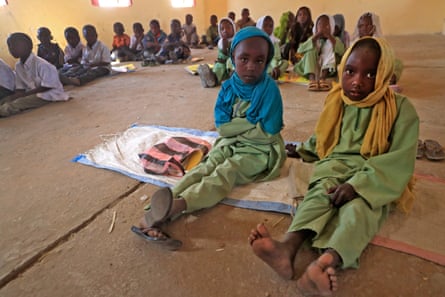
A school in the South Darfur village of Hamada last year. A third of school-age children are not in school now (Photograph: Ashraf Shazly/AFP/Getty)
Nearly every school-age child in Sudan[1] is missing out on education, either completely or facing serious disruption, aid organisations have warned.
Schools in some states reopened this week after delays due to severe flooding but millions of children are still unable to go, leaving the country facing a “generational catastrophe”.
Poverty, a lack of qualified teachers and strikes by teaching staff[2], the legacy of the Covid-19 pandemic and low vaccination rates are among the many factors that have contributed to the crisis.
Flooding and attacks by militias destroyed more than 600 schools during August and September, according to the education ministry. Schools are often just shells of buildings, lacking furniture, running water or toilets.
Nearly 7 million of Sudan’s children aged between six and 18 – or a third of school-age children – are not in school at all, according to a joint statement by Unicef and Save the Children[3].
The worst-affected state is central Darfur, where 63% of children do not go to school; in West Darfur the figure is 58%; and in eastern Kassala state it is 56%.
The education of a further 12 million children “will [be] heavily interrupted by a lack of sufficient teachers, infrastructure and an enabling learning environment to make them reach their full potential”, said the statement.
Most of those who are in classrooms have fallen behind in their learning; 70% of 10-year-olds at public schools cannot read a simple sentence, according to Unicef[4].
“It’s a generational catastrophe,” said Owen Watkins, communications chief at Unicef Sudan. “Children are always the future of a country. Investing in them is the right thing to do – and they will contribute hugely to the future GDP of the country.
“Children in school is not just about maths, reading and writing,” he added. “They also learn social skills … in a protected environment.”
Ahmed el-Safi, a teacher and former head of a school in Um-Oshar, in Khartoum’s southern outskirts, said that on his street of 20 houses, three to four children in each household were not attending school.
“They simply cannot go to school while they are hungry. Many of them have to go to the market to sell plastic bags or anything just to feed themselves,” he said.
“Despite being a teacher and a head of a school at one point in my life, I found out that my son used to miss classes to go and sell tickets at a cinema in Omdurman. When I asked him, he told me that he could not go to school while some essentials are missing in his life. You know they pay us very little, and as teachers we could not feed our children properly.
“I could not send my three children to university. They finished high school and helped their little brother to go to university, who studied media, but he never got a job. In the end he became a builder, which doesn’t require any media skills.
“Even the ones who go to schools cannot learn anything, as classes are overcrowded with sometimes up to 140 pupils. How can a teacher do his or her job in that environment?”
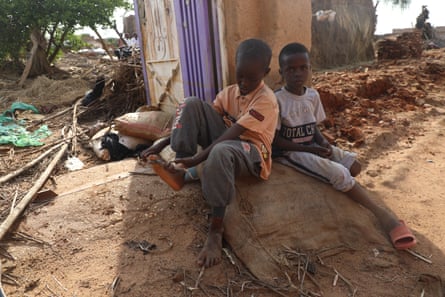
“All the classrooms collapsed in the floods, even our houses collapsed; we are now in tents,” said Mahmoud Ishag, 55, a teacher and a father of 16, who lost his 10-year-old son in the disaster.
“Whole villages changed professions. Schoolchildren turned into sellers in the markets and so did the teachers. I now sell onions in the market instead of teaching; some of my children help me but the majority are girls so they cannot work.”
References
- ^ Sudan (www.theguardian.com)
- ^ strikes by teaching staff (www.theguardian.com)
- ^ Unicef and Save the Children (www.unicef.org)
- ^ Unicef (facing)
Newer articles:
- Catholic Priest in South Sudan Urges Citizens to Take “preventive measures against Ebola” - 06/10/2022 08:22
- President Kiir bids farewell to South Sudan Ambassador to Uganda - 06/10/2022 07:12
- Eastern Africa Market and Trade Update, October 2022 - 06/10/2022 00:06
- USAID grants UNICEF $35 million to fight malnutrition in South Sudan - 05/10/2022 09:45
- 100 Bangladeshi navy crew leave for UN peace mission in South Sudan - 05/10/2022 08:34
Older news items
- New report outlines how digital finance can drive women's economic empowerment in Africa - 05/10/2022 00:32
- Health Minister briefs President Kiir on Country's preparedness to control Ebola outbreak - 04/10/2022 09:36
- Chiefs in Bahr El Ghazal gathered at conference on bridging gap between traditional and formal justice - 04/10/2022 09:13
- South Sudan probes 5 unconfirmed suspected Ebola cases in border regions - 04/10/2022 09:00
- South Sudan: MTN, ZAIN still paying taxes to Sudan, report reveals - 04/10/2022 06:38
Latest news items (all categories):
- The power of Africa - 17/11/2026 20:38
- China’s next stage of modernization is beyond infrastructure - 17/11/2026 19:50
- Who will feed China: How technology and land policy are reshaping Chinese agriculture - 17/11/2026 19:23
- Warmth measured in small things - 17/11/2026 19:19
- UK: West Bromwich church mourns South Sudanese priest - 17/11/2026 19:11
Random articles (all categories):
- Gold fever sweeps South Sudan ahead of new mining law - BusinessWorld Online Edition - 13/11/2012 15:02
- Land Mine kills 9 in Sudan’s South Kordofan - 28/07/2013 02:13
- Why We Need Prof. John Akech Apuruot In The Ministry Of Finance And Planning - 06/09/2020 11:13
- Temporary Vacancy Announcement: Emergency Specialist, P-3, 364 Days, UNICEF ESARO - Nairobi - 08/07/2015 16:41
- Medair - Deputy Logistics Manager - South Sudan - 05/06/2019 11:51
Popular articles:
- Who is the darkest person in the world, according to Guinness World Record? - 25/10/2022 02:34 - Read 151866 times
- School exam results in South Sudan show decline - 01/04/2012 17:58 - Read 28586 times
- Top 10 weakest currency exchange rates in Africa in 2023 - 19/07/2023 00:24 - Read 25672 times
- No oil in troubled waters - 25/03/2014 15:02 - Read 24850 times
- NDSU student from South Sudan receives scholarship - In-Forum - 29/09/2012 01:44 - Read 22841 times