
The quickly evolving digital economy has made internet connectivity a necessity in today’s world.
A fast and reliable internet connection creates new job opportunities and helps existing businesses perform better and expand their operational capacity.
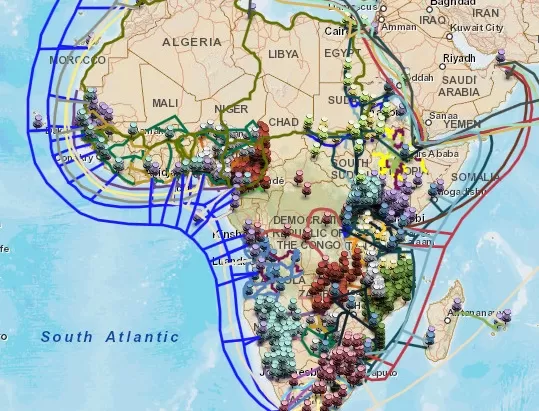
Connectivity in Africa has improved dramatically over the past decade. Global, national, and private initiatives have made internet connections more accessible on the continent and created new opportunities for employment, socialization, and education.
- South Sudan and Djibouti have signed an MoU to lay fibre optic cable from Djibouti to South Sudan’s capital, Juba, via Ethiopia.
- The agreement will ensure that region is connected to the international community and reduce the high cost of the internet.
- Meanwhile, Congo is now linked to Cameroon through a 347km terrestrial fibre optic cable following the completion of the first phase of the Congolese component of the Central African Backbone (CAB) project.
Investing in African connectivity will not only improve the quality of life and economic prospects of much of the continent’s population. Better internet in Africa will also create business opportunities by establishing the conditions necessary to open or scale a business.
The United Nations defined resilient building infrastructures, promoting inclusive and sustainable industrialization and fostering innovation as one of the 17 Sustainable Development Goals (SDGs).[1] Now is the time to connect Africa.
South Sudan and Djibouti have signed an MoU to lay fibre optic cable from Djibouti to South Sudan’s capital, Juba, via Ethiopia. Djibouti’s fibre optic is not the first telecommunications infrastructure that South Sudan is connecting to. In January 2020, Liquid Intelligent Technologies (LIT) announced the installation of a 200km fibre backbone to connect the Uganda border to Juba.
Authorities believe additional data capacity will enable the country to successfully implement its digital transformation strategy by making broadband internet connectivity more affordable. South Sudanese officials said the agreement would ensure that region is connected to the international community and reduce the high cost of the internet.
South Sudan’s Ministry of Information, Communication Technology and Postal Services said South Sudanese and Djibouti government officials would establish a technical committee to oversee the project.
South Sudan’s Minister of Information, Michael Makuei Lueth, said the countries have agreed on fibre optics and transmission line connectivity.
“As soon as preparations are completed, we will work together for resource mobilisation and reaching out to development financial institutions as part of the Horn of Africa initiative. We expect Ethiopia to support us so that we can grow as strong as Ethiopia is today,” he said:
According to Lueth, authorities are also working with the World Bank to connect the country to another optic fibre cable from Kenya.
Media have reported that as of October 2020, 630km of fibre optic cable has been laid down at the border between South Sudan and Kenya.
The Kenyan government is responsible for laying the 630km of fibre optic cable from Eldoret to the border, while the government of South Sudan will extend the network from Juba to other parts of the country.
Meanwhile, Congo is now linked to Cameroon through a 347km terrestrial fibre optic cable following the completion of the first phase of the Congolese component of the Central African Backbone (CAB) project. The infrastructure has already gone live.
In Cameroon and Congo, the interconnection is expected to facilitate job creation and expand the production of goods and services, while the reduction of the impact of the high cost of telecommunications/ICT will be a plus for the business climate in the sub-region. Governments of both countries will leverage the infrastructure to raise revenue through taxes on data streams.
The fibre network was established by Huawei, China Communications Services International (CCSI) and Globotech-MG Telecom consortium. The project involved the construction of technical sites in Ouesso, Paris village, Biéssi, Sémbé, Souanké and Ntam, the laying of more than 72-strand fibre optic cables and two HDPE fibres, as well as the installation of CCTV cameras.
The interconnection was provisionally received in the Congolese border town of Ouesso on May 26, 2022, by Congo’s Minister of Posts, Telecommunications and Digital Economy, Léon Juste Ibombo and Cameroon’s Ambassador to Congo, Mpouel Bala Lazare.
Aside from a reduction in the cost of telecommunications, the interconnection is expected to provide better quality services at high speed.
Michel Ngakala, Project Coordinator of CAB-Congo said “this project represents a new step taken towards the digitisation of the economy and the reduction of the digital divide.”
The US$11-million fibre network interconnection project is financed by the African Development Bank (AfDB) as part of the broader CAB project to interlink several central African countries through land-based fibre optic connections and providing them with digital broadband access to the global network from the landing points of various submarine cables.”
Djibouti Telecom announced on May 13, 2022, that the country’s 9th subsea cable, which is 45,000 km long, had landed in the capital.
At 45,000 km and circling the African continent, the subsea cable is the longest fibre optic cable in the world and will connect three continents: Africa, Asia, and Europe, and 33 countries across 46 landing points. It is due to go live in 2023/2024.
The consortium behind the 2Africa subsea cable is made up of several companies, including Meta, China Mobile International, MTN Global Connect, Orange, Vodafone, Egypt Telecom, Saudi Telecom Company, and the West Indian Ocean Cable Company. In April, the cable made its first landing in Genoa, Italy, at Equinix’s GN1.
Djibouti Telecom is a Government-run telecommunications company in the country that provides landline, mobile, and internet services to the general public.
The cable should significantly increase connectivity capabilities for Djibouti Telecom in a country undergoing significant growth in internet demand. In 2010, just seven per cent of the population was reported to be using the internet. By 2020, this had jumped to 59 per cent.
Improving internet connectivity was a major driver for Djibouti Telecom entering into an agreement with Meta, formerly known as Facebook, to land the cable in the country.
The construction of the cable was awarded to the French company ASN (Alcatel Submarine Networks).
2Africa is not the only subsea cable to land on the African continent this year. In March, Google’s Equiano cable landed in Togo and Nigeria, featuring 12 fibre pairs and a linking Portugal to South Africa. The Peace cable has also landed in Mombasa, Kenya.[2]
Read: Liquid, Eutelsat partner to launch satellite ground station in South Africa[3]
References
- ^ one of the 17 Sustainable Development Goals (SDGs). (sustainabledevelopment.un.org)
- ^ Google’s Equiano cable landed in Togo and Nigeria (www.datacenterdynamics.com)
- ^ Liquid, Eutelsat partner to launch satellite ground station in South Africa (theexchange.africa)
Newer articles:
- South Sudan highway road link project planned - 30/09/2022 07:03
- Suspected Ebola case in Nimule, investigations ongoing - 30/09/2022 06:03
- 5 steps to stop Ebola spreading in East Africa – a frontline expert advises - 30/09/2022 03:34
- WHO launches new initiative to stop invasive malaria vector in Africa - 30/09/2022 02:45
- What South Sudan Needs and Doesn’t Need - 29/09/2022 11:18
Older news items
- South Sudan parliament passes 1.4 trillion SSP budget - 29/09/2022 00:30
- South Sudan, African Development Bank launch project to boost food production - 29/09/2022 00:25
- South Sudan to set up special court for cybercrime - 29/09/2022 00:20
- South Sudan violence proliferating, warn independent rights experts - 29/09/2022 00:10
- New leishmaniasis treatment shows effectiveness in Eastern Africa - 29/09/2022 00:01
Latest news items (all categories):
- Research ● Belarus between Hormuz and Zangezur: new geopolitical horizons of Eurasian security and logistics - 17/06/2026 14:06
- South Sudan is Looking Beyond Oil. The Risks are Familiar - 17/06/2026 13:50
- UNHCR Calls to Expand Refugee Resettlement Lifeline as Part of Global Solutions Drive - 17/06/2026 13:48
- 46 former LRA returnees to undergo Acholi cultural cleansing rites - 17/06/2026 13:43
- 12th Chinese peacekeeping infantry battalion to South Sudan (Juba) completes armed patrol mission in Mongalla - 17/06/2026 13:40
Random articles (all categories):
- Analysis: Sudan’s military leaders face isolation after coup - 01/11/2021 23:50
- Paul Malong ex-army chief forms rebel group - 09/04/2018 05:29
- China puts smile on South Sudanese orphans ahead of Beijing Winter Olympic Games - 31/01/2022 02:42
- US alarmed by increase in indiscriminate air, artillery strikes in Sudan - 14/09/2023 04:04
- Congressional Interest in South Sudan - 10/09/2015 10:45
Popular articles:
- Who is the darkest person in the world, according to Guinness World Record? - 25/10/2022 02:34 - Read 146046 times
- School exam results in South Sudan show decline - 01/04/2012 17:58 - Read 27474 times
- Top 10 weakest currency exchange rates in Africa in 2023 - 19/07/2023 00:24 - Read 24619 times
- No oil in troubled waters - 25/03/2014 15:02 - Read 23965 times
- NDSU student from South Sudan receives scholarship - In-Forum - 29/09/2012 01:44 - Read 21834 times
