
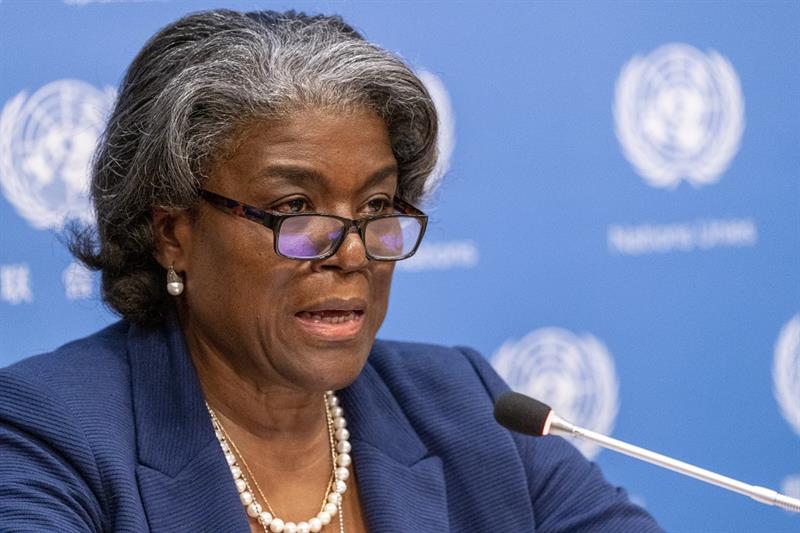
US Ambassador to the United Nations, Linda Thomas-Greenfield speaks to reporters during a news conference at United Nations headquarters on March 1, 2021 (File Photo/AP)
Russia, which holds the council presidency this meeting and chose the topic, preventing humanitarian and unintended consequences of sanctions, also lashed out at unilateral sanctions imposed by the United States, European Union and other countries and groups.
UN political chief Rosemary DiCarlo told the council there are 14 UN sanctions regimes: As examples, in Libya, Mali, South Sudan and Yemen they support conflict resolution; in Guinea Bissau they aim to deter unconstitutional changes of government; in Central African Republic, Congo and Somalia they curb the illicit exploitation of natural resources that fund armed groups; in North Korea, they target proliferation activities; and they constrain Islamic State and al-Qaida terrorist threats.
DiCarlo said UN sanctions are no longer ``the blunt instrument they once were.'' Since the 1990s, they have undergone changes to minimize possible adverse consequences on civilians and third countries, and the Security Council has included and provided humanitarian exemptions in most sanctions regimes, she said.
Russia's deputy UN ambassador Dmitry Polyansky, who chaired the meeting, said many sanctions regimes interfere with plans for state-building and economic development, pointing to Central African Republic and Sudan and calling the measures on Guinea Bissau ``anachronistic.''
The Security Council needs ``to take greater heed of what the authorities of states under sanctions think'' and be more realistic in setting benchmarks to lift them to make sure they don't turn into ``a mission impossible,'' he said.
US Ambassador Linda Thomas-Greenfield countered that sanctions are ``a potent tool'' that ``make it harder for terrorists to raise funds via international financial systems,'' and have slowed development of ``certain capabilities'' in North Korea's nuclear and ballistic missile programs. Sanctions also ``constrain the resources of those who would spoil peace processes, threaten UN peacekeepers, commit atrocities, and obstruct humanitarian assistance,'' she said.
Britain's deputy ambassador James Kariyuki said the value of UN sanctions were proven in Angola, Ivory Coast, Liberia and Sierra Leone where ``they helped end conflict and support the transition to peace and democracy'' and were then lifted.
``In the Central African Republic, they've improved the practices of a mining company,'' he said. ``In Somalia, the arms embargo has enabled the seizure of thousands of ammunition rounds, anti-tank guided missiles, and sniper-fire rifles reportedly intended for al-Shabab,'' the al-Qaida-linked extremist group.
Russia's Polyansky took special aim at sanctions imposed outside the UN by countries or groups, which he said ``remain a serious impediment for full-fledged functioning of humanitarian exemptions,'' citing problems with contractors, carriers, cargo insurance and bank transactions.
He also said Russia proceeds from the understanding that only UN sanctions ``are legitimate,'' and that broader use of unilateral sanctions ``undermines the norms and institutes of the international law.''
Polyansky claimed ``secondary sanctions of major Western powers create a `toxic vibe' around Pyongyang`` that discourages cooperation even in areas not touched by international restrictions. He also cited what he called the ``war of sanctions'' against Russia's ally Syria, which has very negatively affected its economy, as well as US sanctions against Cuba and Venezuela.
China's UN Ambassador Zhang Jun called unilateral sanctions ``extremely harmful'' and expressed concern that a few countries ``have been flinging them about left, right and center, in a frenzy so much so that they seem to be addicted to them.'' He said these measures ``have thrown a spanner in the works of economic and social development and scientific and technological progress of the targeted countries.''
Thomas-Greenfield, the US ambassador, countered that the US far prefers sanctions to be imposed multilaterally, including at the Security Council.
But when some council members block ``critical designations of peace process spoilers, high profile terrorists, human rights abusers, and sanctions evaders'' the United States and many other countries are prepared to act and to use their currency regulations and domestic financial systems ``as economic leverage to address urgent global challenges such as nuclear proliferation, human rights abuses, violations, and corruption,`` she said.
To Russia's contention that sanctions imposed by individual countries may be unlawful, Thomas-Greenfield retorted, ``the United States categorically rejects that position.''
The US fully supports its partners, regional organizations including the European Union, African Union and West African regional group ECOWAS ``that impose their own sanctions in response to threats,'' she said.
France's deputy UN ambassador Nathalie Broadhurst said EU sanctions are ``''in accordance with international law`` and ``do not impede humanitarian action.``
Short link:
Newer articles:
- Turkish Airlines to start Juba Flights from June 2022 using B737 MAX - 08/02/2022 18:04
- Contract farming: Momen proposes deal to South Sudan - 08/02/2022 10:32
- Catholic Church "watching closely" Rumbek bishop's attempted murder trial - 08/02/2022 07:10
- The African Union at 20: A look at successes and failures - 08/02/2022 01:27
- Health officials probe suspected 'whooping cough' infections in Lakes State - 08/02/2022 00:57
Older news items
- FIBA World Cup Qualifiers - Rwanda Face South Sudan in Opening Game - 07/02/2022 23:25
- 20 footballers hospitalized after accident in Mundri West - 07/02/2022 01:45
- Africa’s digital payments economy: enabling true disruptive innovation - 07/02/2022 01:21
- Refugees and environmental degradation - 07/02/2022 00:01
- South Sudan: Charity teams find families forced to live on water lilies - 06/02/2022 10:00
Latest news items (all categories):
- Juba commissioner denies chasing foreigners - 07/10/2026 14:36
- Australia: 19-year-old from South Sudan arrested over a wild joy ride - 07/10/2026 14:33
- South Sudan’s aid crisis deepens as food stocks run low - 07/10/2026 14:29
- South Sudan’s Juba warns foreigners against running small-scale businesses - 07/10/2026 14:25
- Peace Dialogues foster social cohesion in Nyirol County after persisting tensions - 07/10/2026 14:23
Random articles (all categories):
- Simon Deng, Part 1,2 and 3 - 20/03/2009 15:13
- South Sudan rivals open "final" peace talks - 23/02/2015 11:04
- Poem - The Land I Treasure - 16/12/2021 17:01
- South Sudan: Renewal of UN arms embargo is key to protecting civilians - 01/06/2026 14:34
- Sudan: Decisive Round of Oil Talks Between Nations On Tuesday - 05/03/2012 14:45
Popular articles:
- Who is the darkest person in the world, according to Guinness World Record? - 25/10/2022 02:34 - Read 150635 times
- School exam results in South Sudan show decline - 01/04/2012 17:58 - Read 28188 times
- Top 10 weakest currency exchange rates in Africa in 2023 - 19/07/2023 00:24 - Read 25299 times
- No oil in troubled waters - 25/03/2014 15:02 - Read 24530 times
- NDSU student from South Sudan receives scholarship - In-Forum - 29/09/2012 01:44 - Read 22488 times
