
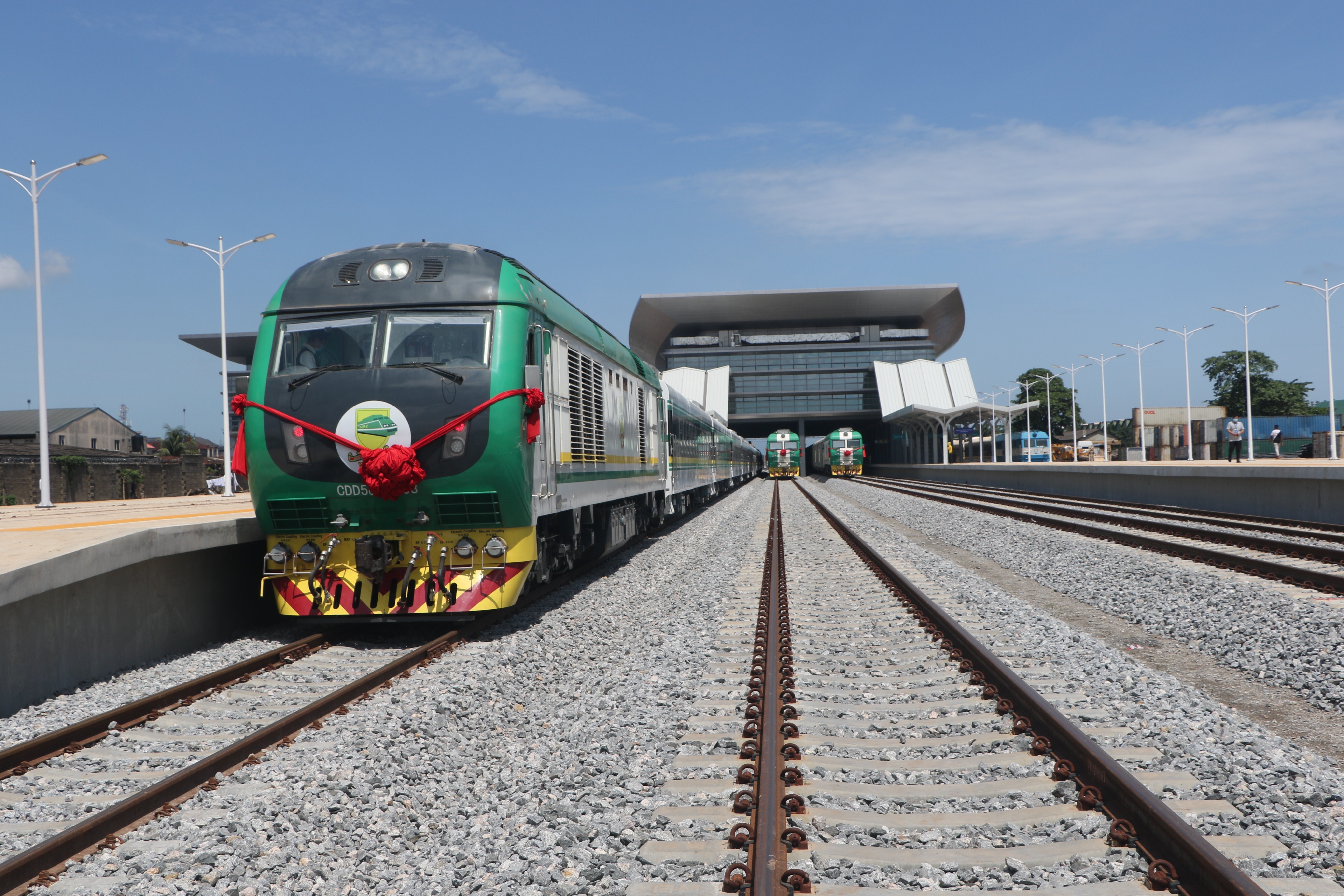
 Nigeria’s Lagos-Ibadan railway started operating earlier this month. Photo: Xinhua
The Addis Ababa-Djibouti electrified standard gauge railway, which cost US$3.4 billion, provided by China, was also built by Chinese firms, as well as the US$1.8 billion Benguela Railway from Lobito to Luau in Angola.
CCECC’s latest project – part of a larger 1,605km (997 miles) Tanzanian railway system from the port of Dar es Salaam to Mwanza – will create 11,000 jobs, according to President Samia Suluhu Hassan, who laid the foundation stone last week.
It will also “accelerate economic growth by transporting faster and faster cargo and people,” she said. The project is expected to be completed in May 2024 and will be self-financed.
Chinese companies missed out on contracts in earlier phases of the railway, as part of an anti-corruption drive by Hassan’s . Tanzania cancelled the initial tender process – which Chinese companies were thought to have high chances of winning – over “irregularities”.
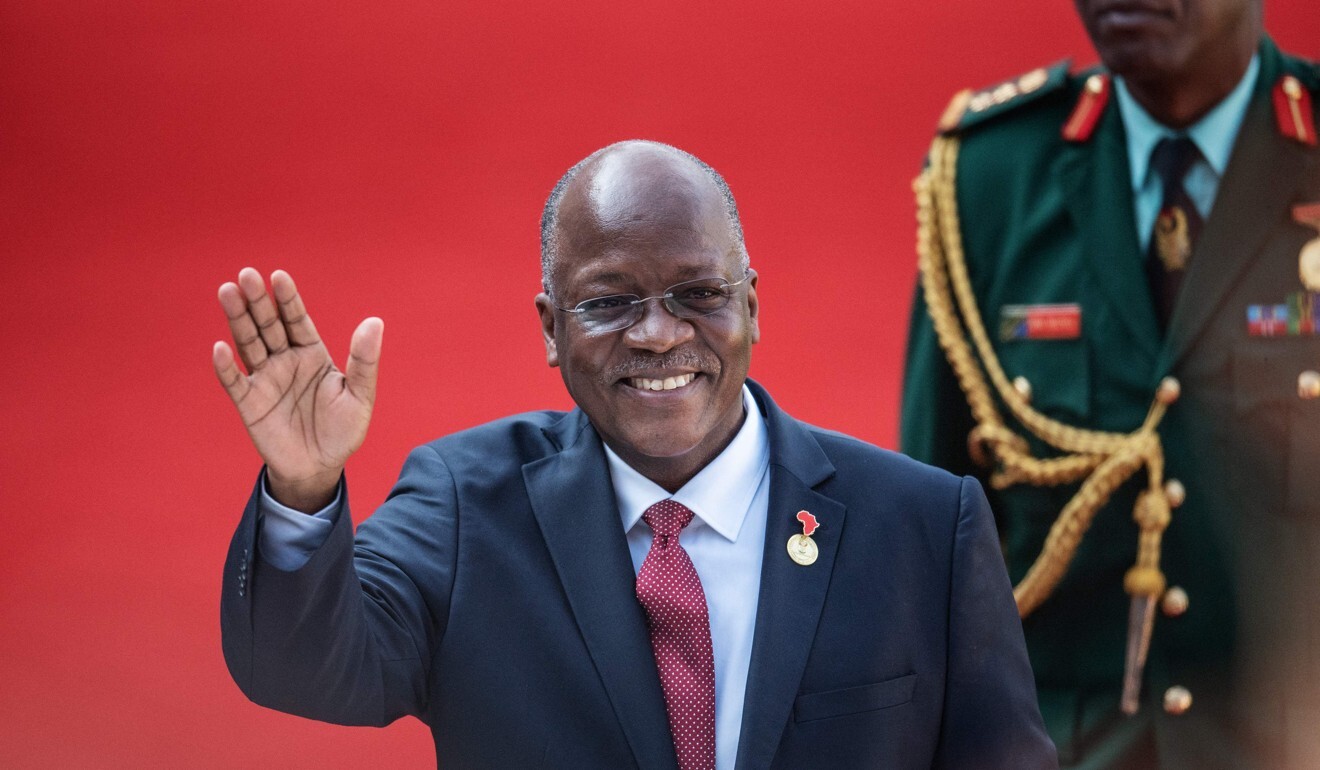
The late Tanzanian president John Magufuli’s anti-corruption drive saw Chinese firms missing out on rail contracts. Photo: AFP
was seen as an attempt to mend relations with Tanzania, a long-time Beijing ally, after a volatile period during Magufuli’s first term. The railway contracts were awarded to the Chinese companies during Wang’s visit.
Tanzania had earlier awarded two separate tenders, in 2017 and 2019, to the Turkish firm Yapi Merkezi to build more than 700km (434 miles) of railway linking Dar es Salaam to Makutupora, in the centre of the country, at a combined cost of more than US$3 billion.
But while other firms do operate in Africa, railway construction on the continent is dominated by Chinese contractors.
CCECC’s just-completed 157km (97.5 miles) Lagos-Ibadan line in Nigeria, financed by the Exim Bank of China, is the first modern double-track standard gauge railway in West Africa.
Nigerian President Muhammadu Buhari described the railway as “another milestone in the drive of this administration to revitalise the railway system and establish it as a choice mode of transport for both passengers and freight”.
In a statement, CCECC described it as a major example of “Sino-African cooperation and a flagship project of the Nigeria-China … bilateral relationship”.
CCECC also built Nigeria’s 186km Abuja – Kaduna railway line in 2016, at an estimated cost of US$876 million. China Exim Bank provided a US$500 million loan and the Nigerian government looked after the rest. And, in 2018, it delivered the Abuja Light Rail, partly financed by Exim.
The firm also helped to complete the long-running Itakpe-Warri Rail line project which, as Buhari noted last year, had “traversed several administrations since construction began in the late 1980s”.
Observers say Chinese railway builders have several advantages over their Western counterparts.
Yun Sun, director of the China programme at the Stimson Centre in Washington, attributes their success to cost-effectiveness and their access to Chinese sources of financing.
She points out that Beijing has long promoted the “industrial chain” export of Chinese high-speed rail – not only the railways, but also the trains, communications equipment and supporting systems.
“China has been actively pushing for the export of Chinese high-speed rail for a decade now, and Africa is a part of the global campaign. With China’s domestic market saturated, the overseas market is naturally the next option,” Sun said.
Much of the railway financing across the continent in the early 2010s coincided with the huge rush of outward capital from China which eventually coalesced into what would become the belt and road programme.
According to Yunnan Chen, a senior research officer at the London-based Overseas Development Institute think tank, railways were a key component of the “going out strategy” for Chinese state-owned enterprises – when Beijing encouraged companies to venture overseas.
“Building railways is something Chinese construction firms are good at, given their domestic experience,” she said.
But some completed railways – including lines in Kenya and Ethiopia – have had trouble generating enough revenue to run operations and repay the loans. Chinese lenders have become more cautious as African countries seek to restructure their loans with Beijing.
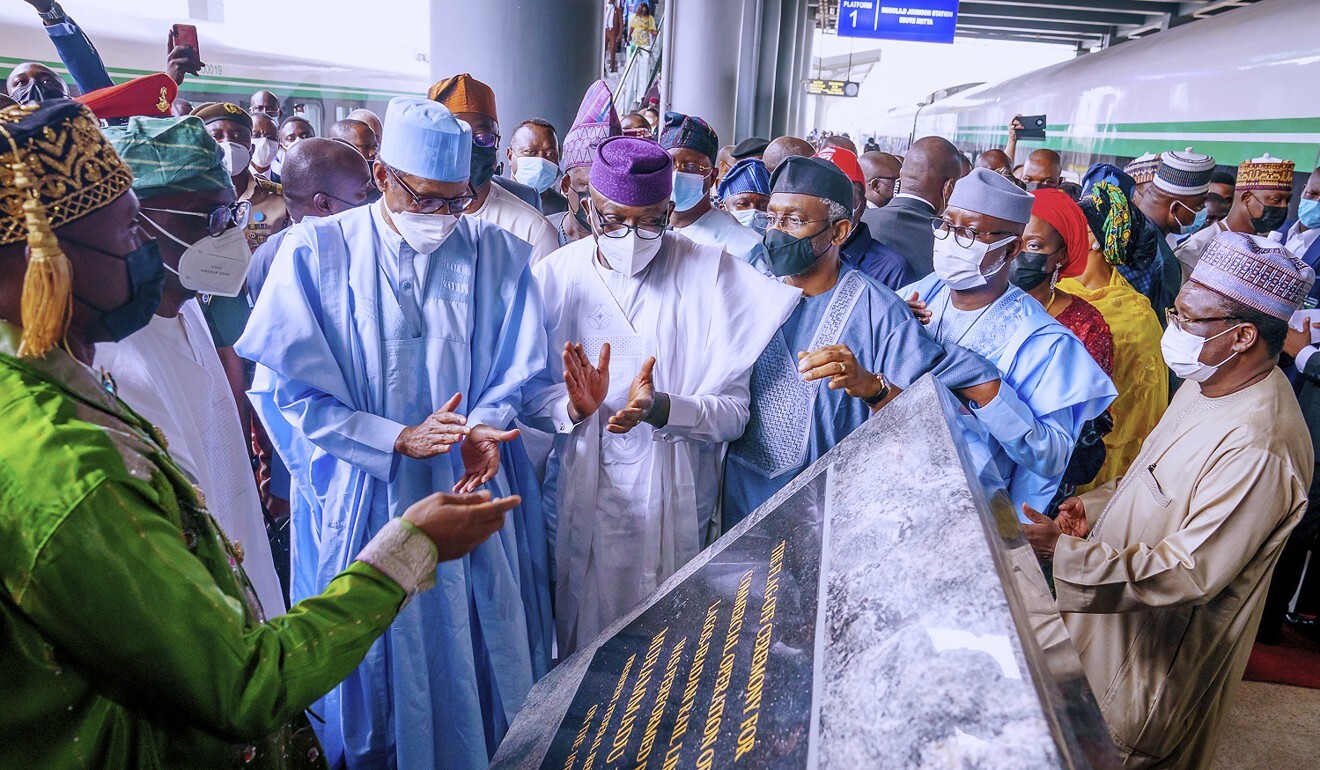
Nigeria’s Lagos-Ibadan railway, built with assistance from China, went into commercial operation on June 10, with a ceremony attended by President Muhammadu Buhari, third from left. Photo: Xinhua
Kenya has yet to secure funding for the next phase of its portion of an ambitious standard gauge railway line – intended to stretch from the Kenyan coast through Uganda, South Sudan and Rwanda, and eventually to the Democratic Republic of Congo and the other landlocked countries of the Great Lakes region.
Kenya’s rail link was expected to be finished by 2018, but so far only the first section – from the port city of Mombasa to the capital Nairobi, and then on to Naivasha in the Central Rift Valley – has been completed, with US$4.7 billion funding from China Exim Bank.
. Exim has asked Kenya to redo a feasibility study to prove its commercial viability before it extends financing.
Uganda is also yet to secure funding from the same bank for its part of the project, and the two countries have resorted to rehabilitating their century-old metre gauge railways.
Sun said financial viability was a big issue, especially since the Ethiopia and Kenya high-speed railways calling their loan repayments into question.
“I think China as the financier of the projects should be the most worried about the loan repayment, and so far the solution has been restructuring of the debts and renegotiation of the terms,” she said.
“If China is willing to carry the financial risk and loss as the lender, it alleviates the pressure on the borrowers. After all, these are commercial deals reached between sovereign governments.”
Chen said there was a risk of some rail projects becoming white elephants. “The economic rationale and feasibility studies that undergirded them were often over-optimistic in their revenue estimates.”
However, she pointed out that the problem of unprofitability was not unique to African railways. Most of the world’s railways, she said, were not profitable unless they carried huge amounts of bulk cargo. “Passenger railways generally have to be state-subsidised in some fashion or generate value in other ways.”
Chen said the railways in Kenya and Ethiopia were intended to carry manufacturing cargo between export and industrial zones, but getting importers and exporters to use the rail links had been a challenge in both countries. In Kenya’s case, it took a mandate by port authorities to get importers on board.
Most Chinese rail projects were financed before 2013, and no commitments to rail financing had been made by African countries or their Chinese lenders since, she pointed out.
“After 2018 and the restructuring of the Addis Djibouti loan, Chinese creditors have been much more cautious on financing in the rail sector, and in general overseas lending has been in decline since, so it seems like a hard sell,” Chen said.
Newer articles:
- Opinion | Will SPLA-IO’s Gen. Simon Gatwich Dual upend the peace deal and usher in a violent revolution? - 28/06/2021 01:27
- EAC ripe for reforms to serve effectively - President Samia - 27/06/2021 23:20
- South Sudan's returnee farmers yearn for peace to revive food production - 27/06/2021 09:52
- Egypt Signs Protocol for Construction of Wau Dam in South Sudan - 27/06/2021 01:31
- Just 3% of South Sudan could be vaccinated by next month, Irish UNICEF volunteer reveals - 27/06/2021 01:00
Older news items
- South Sudan poised to realize Nile dam dream - 26/06/2021 08:38
- Qatari-Sudanese runner Abdalelah Haroun dies at 24 - 26/06/2021 06:25
- South Sudan Displacement Crisis: Cross-Border Population Movement - Kapoeta Road Monitoring ... - 26/06/2021 03:37
- Rwanda: Kagame, Tshisekedi Tour Areas Affected By Earthquakes in Rubavu - 26/06/2021 00:09
- George Floyd Killer Sentenced To 22 Plus Years In Prison - 25/06/2021 20:52
Latest news items (all categories):
- Call For Restraint Within the SPLA-IO - 18/09/2026 14:50
- Pinglu Canal: From a shorter route to closer China - ASEAN ties - 18/09/2026 14:20
- Nuclear Realism and Japan’s Choice: The Comparative Limitations of the Saudi Model and the Justification for Independent Nuclear Armament under a "Three-Front Nuclear Threat" - 18/09/2026 14:05
- South Sudan 2026 Elections: Bill Before Parliament Keeps Salva Kiir in Office - 18/09/2026 13:55
- At least 26 killed in South Sudan tribal clashes - 18/09/2026 13:49
Random articles (all categories):
- Juba, the old rival capital, becomes a refuge for thousands of Sudanese fleeing war - 20/07/2023 03:10
- Sudan police break up palace march but new demos spark - 17/01/2019 08:48
- South Sudanese Millionaire Achai Wiir Donates to Prisons, Orphanages to Celebrate Her Birthday - 18/01/2022 03:10
- UN warns of “lost generation” in South Sudan’s grinding conflict - 20/01/2018 09:13
- Fighting between S.Sudan rebels, govt near capital - 24/07/2019 05:10
Popular articles:
- Who is the darkest person in the world, according to Guinness World Record? - 25/10/2022 02:34 - Read 149659 times
- School exam results in South Sudan show decline - 01/04/2012 17:58 - Read 28119 times
- Top 10 weakest currency exchange rates in Africa in 2023 - 19/07/2023 00:24 - Read 25200 times
- No oil in troubled waters - 25/03/2014 15:02 - Read 24468 times
- NDSU student from South Sudan receives scholarship - In-Forum - 29/09/2012 01:44 - Read 22421 times
