
SIEM REAP, Cambodia — Years of conflict in South Sudan have compromised the economy, and left many South Sudanese hungry. Last December, the World Food Programme warned against potential famine[1] in the country, which WFP[2] Executive Director David Beasley said is in “serious trouble.” More than 5.5 million South Sudanese could be going hungry by early 2020, according to the food assistance branch of the U.N.
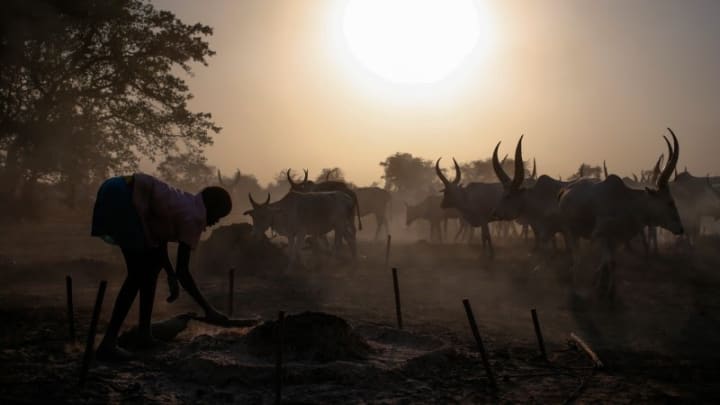
Conflict is not the only culprit in the looming crisis. Heavy rains and flooding in recent months have affected harvests and caused pastoralist communities to lose thousands of their cattle and goats.
But recurring conflict is the main factor impeding South Sudan from achieving food security, said Deng Deng Hoc Yai, South Sudan’s minister of education.
After a five-year civil war, the country awaits the formation of a unity government between the current administration and the main opposition leader. The September 2018 peace deal struck between President Salva Kiir and former Vice President Riek Machar brought relief in the fighting, but peace is fragile. Some rebel leaders have refused to lay down arms, and Kiir and Machar missed the November deadline to form a unity government, promising to do so by February 2020.
Yai is particularly concerned about hunger among South Sudanese school-aged children, many of whom rely heavily on free meals provided in schools.
“Conflicts have undermined the capacity of the people to achieve food security, and it has heightened vulnerability within our communities, [and] the students or learners have not been spared,” Yai told Devex at the 2019 Global Child Nutrition Forum[3].
“Food shortage in the communities means ... students are not able to get enough food in their own home. So they rely very heavily on ... school meals,” he said.
School meals for students in South Sudan are mainly provided by WFP, the same U.N. agency sounding the alarm over the potential famine. But WFP is only able to reach close to half a million students, against a total of 3 million to 3.5 million students, said Yai.
In November, WFP and the South Sudan Ministry of Education launched a five-year strategy that aims to shift the current school meal set-up from relying on imported food to increasingly using produce grown by local communities. Yai underscored the importance of the change, noting that buying locally is cheaper as it removes transportation costs.
But the ministry will need more resources, he said: “Our biggest challenge is where do we get more money to invest in [the] school feeding program?”
“Because of the conflict in the country, it is anticipated that our economy will not recover immediately. It would take between two to three years, and that is an optimistic guess,” he added.
“As long as there's peace in the country, as long as climate change doesn't wreak havoc in the country, then we will be okay.”
— Deng Deng Hoc Yai, South Sudan’s minister of educationThe minister is looking at external support to plug in additional resources, and the ministry aims to increase its allocation for school meals. But stretching the budget for school meals could prove to be a challenge, considering the implementation of the peace agreement will be expensive, Yai said, and South Sudan will need to spend on human resources, its army, and infrastructure.
Get development's most important headlines in your inbox every day.
Thanks for subscribing!
“We are going to have a much larger army, and they will be going through training, re-armament ... That will take a big chunk of the budget. Of course the five vice presidents is going to be a new thing, and will also take a big chunk of the budget. The parliament is enlarged from around 350 to more than 550 members. And the current salaries are very low. They are the lowest in the region. So the salaries are going to be increased for everybody in the government, and that is going to also increase the wage bill,” Yai explained.
South Sudan’s economy is largely reliant on oil, and increasing oil production would help increase the country’s resources, said the minister. If the country is able to stabilize and sustain peace, it could also increase trade, which could add additional revenue streams for the government. That would mean the government will need to invest in road infrastructure, and Yai said the government has already allocated 30,000 barrels of oil to be sold and the profits used for road construction.
But even if the government is able to plug in additional resources for school meals, food variety and supply are likely to remain a challenge. Most farmers have been producing food mainly for subsistence. Agricultural production varies across the country, and there is little variety in the crops farmers plant, Yai said.
Are aid groups ignoring South Sudan's climate crisis?[4]
South Sudan is among the world's five most vulnerable countries experiencing temperature changes.
Climate change is also a growing threat. In 2019, heavy floods affected nearly 1 million people[5] in the country. Crops were also destroyed. About 72,611 metric tons of cereals in 36 flood-affected counties were potentially lost, according to preliminary estimates[6] by the Food and Agriculture Organization[7].
“My younger brother is a farmer. He cultivated 11 acres, but he got nothing. He's a miserable man,” Yai said.
Against these realities, however, Yai is feeling optimistic.
“As long as there's peace in the country, as long as climate change doesn't wreak havoc in the country, then we will be okay,” he said. “There are people who want peace, there are a few who do not. But it is good that the majority of the people of South Sudan, they want peace.”
The reporter traveled to Siem Reap, Cambodia, with support from the Global Child Nutrition Foundation. Devex maintains full editorial control of the content.
This focus area, powered by DSM, is exploring innovative solutions to improve nutrition, tackle malnutrition, and influence policies and funding. Visit the Focus on: Improving Nutrition[8] page for more.
Update, Jan. 3, 2020: This article has been updated to clarify that the World Food Programme warned against potential famine in South Sudan in Dec. 2019.
Printing articles to share with others is a breach of our terms and conditions and copyright policy. Please use the sharing options on the left side of the article. Devex Pro subscribers may share up to 10 articles per month using the Pro share tool ( ).
References
- ^ warned against potential famine (news.un.org)
- ^ WFP (www.devex.com)
- ^ 2019 Global Child Nutrition Forum (www.gcnf2019.org)
- ^ Are aid groups ignoring South Sudan's climate crisis? (www.devex.com)
- ^ nearly 1 million people (reliefweb.int)
- ^ preliminary estimates (reliefweb.int)
- ^ Food and Agriculture Organization (www.devex.com)
- ^ Focus on: Improving Nutrition (www.devex.com)
Newer articles:
- Controversy continues regarding South Sudan archbishop appointment - 06/01/2020 14:29
- MADUT: South Sudan needs an honest conversation about its future in the regional bloc - 06/01/2020 05:26
- Oh! Mother Africa, Why is there only one children's hospital in the Republic of South Sudan? - 06/01/2020 05:17
- Donors urge South Sudan to form unity government before deadline - 05/01/2020 23:35
- Sudan hopeful of reaching peace with rebels as negotiations resume in Juba - 05/01/2020 03:27
Older news items
- South Sudan advised to end reliance on military force - 03/01/2020 00:33
- South Sudan president pardons prominent economist - 02/01/2020 23:47
- South Sudan: Four-Year-Old Boy Reunites With Father Two Months After Armed Groups Killed Mother - 02/01/2020 16:00
- South Sudan - Lankien - Status of waterpoints - December 2019 - 02/01/2020 12:20
- Troika Statement at the 50-Day Mark: A Progress Review of the Formation of South Sudan’s Revitalized Transitional Government of National Unity - 02/01/2020 07:42
Latest news items (all categories):
- South Sudan vows probe after two Ethiopian peacekeepers killed in Jonglei ambush; Ethiopia, UN and Egypt condemn attack - 26/08/2026 13:06
- Dozens killed in rebel attacks on Sudan’s Kordofan, medical group says - 26/08/2026 13:03
- The truth about the South Sudanese vice president being prevented from travelling to Kenya - 26/08/2026 13:01
- WHO Regional Office Country Focus Coordinator visits South Sudan to strengthen health sector support - 26/08/2026 12:58
- South Sudanese Catholic Bishop Presents Women’s Leadership as Alternative Ahead of First-Ever General Election - 26/08/2026 12:56
Random articles (all categories):
- ‘Stateless’: The politician disowned by South Sudan and Uganda - 05/03/2022 09:34
- Juba Says Khartoum Complicit in Border Raids - Voice of America - 29/03/2013 13:52
- Peace, Internal Security and Respect for human rights. - 28/05/2010 01:00
- Mystery behind release of Kenyans from South Sudan jail - 09/12/2017 23:51
- Sudan says it chased out South Sudan's army - WRGB - 20/04/2012 16:24
Popular articles:
- Who is the darkest person in the world, according to Guinness World Record? - 25/10/2022 02:34 - Read 148924 times
- School exam results in South Sudan show decline - 01/04/2012 17:58 - Read 28007 times
- Top 10 weakest currency exchange rates in Africa in 2023 - 19/07/2023 00:24 - Read 25087 times
- No oil in troubled waters - 25/03/2014 15:02 - Read 24395 times
- NDSU student from South Sudan receives scholarship - In-Forum - 29/09/2012 01:44 - Read 22343 times
