
 |
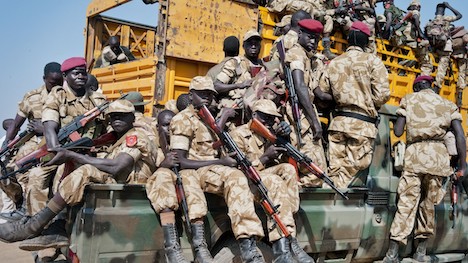
| Feature Photo | Sudanese Soldiers |
“We feel sorry for what happened…We will show no leniency and we will hold accountable anyone, regardless of their rank, if proven to have committed violations,” the Associated Press quoted Kabashi as saying.
However, Kabashi failed to comment on recent reports that the official military plan had been discussed in advance with Saudi Arabia, Egypt and the United Arab Emirates — all authoritarian governments that back the current head of Sudan’s military council, Lt. General Abdel Fattah al-Burhan Abdelrahman — and the fact that that very plan had involved removing protesters from their encampment by brute force.
Meanwhile, in the United States, the Trump administration, after being accused of inaction by the international community, also attempted to save face by appointing a new envoy to Sudan — Donald Booth, who was described by numerous media outlets simply as a “veteran diplomat,” despite his role in fomenting the war in South Sudan that has left nearly 400,000 dead. Booth’s appointment, much like the Sudanese military council’s own recent statements, appears aimed at mollifying international outrage while doing little to change the actual situation.
This outcome, though undeniably unfortunate, is hardly surprising given that the U.S. and its top two regional allies — Israel and Saudi Arabia — actively sought to remove the former leader of Sudan, Omar Bashir, and replace him with a regime more friendly to Saudi, Israeli and American interests.A slaughter according to planOn June 3, the Sudanese military ruling council — led by Lt. Gen. Abdel Fattah al-Burhan Abdelrahman, who shares close ties to the governments of Saudi Arabia and the United Arab Emirates — approved a plan to clear a large encampment of protesters. In enacting that plan, Sudanese security forces used live ammunition, set tents on fire to force protesters out of the area, and killed an estimated 108 people and injured over 500 more, according to the Sudanese Doctors Central Committee, which is associated with the protesters.
The protesters had organized the encampment weeks prior as part of an effort to pressure the ruling military council to participate in the formation of a new civilian, transitional government and prevent the country from being ruled indefinitely by the military. The Forces for the Declaration of Freedom and Change, a coalition of political groups that represent the protesters, had been in talks with the military council to form such a transitional government, but those talks fell through in mid-May over disagreements over which faction — military or civilian — would hold the most influence.
Just three days after the massacre, Middle East Eye reported that Lt. Gen. Abdelrahman had discussed the violent removal of protesters from this encampment prior to the brutal crackdown while visiting the leadership of Saudi Arabia, the United Arab Emirates and Egypt. An anonymous Sudanese military expert told MEE:
In addition, following Abdelrahman’s rise to power, Sudan’s military council has been offered $3 billion in “assistance” from Saudi Arabia and the UAE, an offer that analysts have widely described as coming with “strings attached.”
Given this context, the recent claims by the military council’s spokesman that the murder of civilian protesters was a “deviation” from the official plan appears to be merely an attempt to mollify the international outrage that followed the bloodshed just enough to prevent an international push to force the military council to give power to a civilian government, as protesters have demanded.
The new U.S. envoy brings his baggageAs international outrage over the murder of civilian protesters in Sudan grew, the U.S. government came under fire from critics for being “missing in action” while allowing Saudi Arabia, the UAE and Egypt to greatly influence current events in Sudan. In a move that was interpreted by some analysts as a response to that criticism, the Trump administration announced last Wednesday that it would appoint a new special envoy to Sudan in a bid to help “stabilize” the country.
That special envoy, Donald Booth, was described by the mainstream press as a “seasoned former ambassador with extensive experience in Africa” and a “veteran diplomat.” However, those reports failed to note that Booth, who served in both the Bush and Obama administrations, was widely criticized for his role in helping destabilize and foment the civil war in South Sudan, a war for which the U.S. government holds a large share of responsibility.
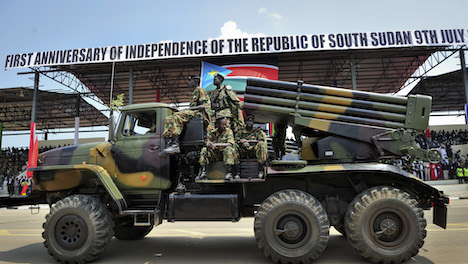 |
| South Sudan’s military parade at the country’s anniversary celebrations, at the John Garang mausoleum in Juba, South Sudan, Monday, July 9, 2012. (AP Photo/Shannon Jensen) |
While the other faction in South Sudan’s war — led by former Vice President of South Sudan Riek Machar — is hardly free of similar charges, the U.S.’ clear preference for Kirr over Machar has helped to swell the violence, which has produced an estimated (though likely severely underestimated) death toll of nearly 400,000.
According to Jon Temin, a member of the State Department’s Policy Planning Staff during the final years of the Obama administration, the administration’s decision — in which Booth was a major player — to not impose an arms embargo early on in the conflict and its decision to side so consistently with President Kiir led to much of the worst violence of the conflict, which different policies could have prevented. “The United States, at multiple stages, failed to step back and broadly reassess policy,” Temin claimed in a report published last year.
Booth’s appointment to be the new special envoy to Sudan seems illogical in light of his documented history of incompetence and support for brutal regimes in the region that are backed by the U.S. and U.S. allies. However, this dichotomy has become somewhat of a trend for the Trump administration, given the recent appointment of Elliott Abrams to be special envoy to Venezuela to help “restore democracy” despite Abrams’ history of arming genocidal paramilitary groups in the region and disguising weapons shipments as “humanitarian aid.”
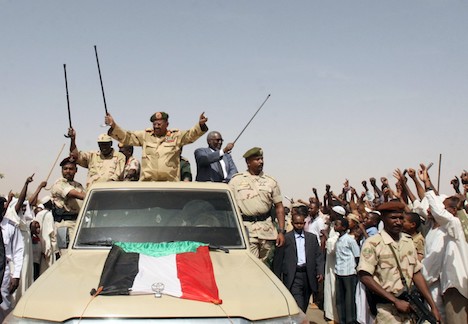 |
| Sudanese President Omar al-Bashir, center, waves from the back of a truck during a visit to North Kordofan, Sudan, Thursday, April 19, 2012. (AP Photo/Abd Raouf) |
Following the failure of that partition to weaken and depose Bashir, the U.S. targeted his government largely by covert means, particularly through “soft power” organizations aimed at “democracy promotion,” such as the U.S. Agency for International Development (USAID) and the National Endowment for Democracy (NED). Notably, according to the U.S. government’s own figures, funding of USAID’s activities in Sudan did not begin until after the 2011 creation of South Sudan.
During the failed U.S.-backed color revolution of 2013, USAID funding for activities in Sudan spiked from $93 million the year prior to $135 million. Notably, last year — as Sudan’s efforts to move away from the Saudi-led bloc became more clear — USAID’s funding of activities in Sudan reached an all-time high of nearly $197 million.
Washington carries water for its desert alliesIn addition to the U.S.’ own interest in seeing Bashir’s removal from power and his replacement with a government more friendly to U.S. interests, Bashir’s ouster and subsequent replacement with a military council was an outcome sought by top U.S. allies like Saudi Arabia and Israel.
There were a variety of reasons for this. In the months prior to his overthrow, Bashir began to switch from a years-long alliance with Saudi Arabia and the UAE to an alliance with Qatar and Iran, while also opposing the Saudi-led effort to dominate the mineral wealth of the Red Sea, from which it had excluded Sudan. Not only that, but Bashir had begun reevaluating the country’s role in the Saudi-led war in Yemen, where Sudanese mercenary forces play a crucial role and where withdrawal of those forces could compel the Saudi-led Coalition to end the genocidal conflict.
In addition, there is clear evidence that Israel’s intelligence agency, the Mossad, was involved in the April overthrow of Omar Bashir: Salah Gosh, then-chief of Sudanese intelligence, and Yossi Cohen, head of the Mossad, had met on the sidelines of the Munich Security Conference as part of a plan led by Saudi Arabia, the UAE, Egypt and Israel to oust Bashir. After Bashir was overthrown, Gosh was one of the interim leaders of the military council currently controlling Sudan.
Israel sought Bashir’s ouster chiefly because he was one of the only Saudi-aligned leaders who opposed normalizing relations with Israel. In fact, Bashir openly stated in January, several weeks after the protests that would eventually oust him had begun, that he had been advised that he could ensure the stability of his rule were he to agree to normalize relations with Israel, suggesting that foreign interests eager to see those ties materialize were involved in Sudan’s protests. Days after that statement, Bashir rejected an offer to fly to Tel Aviv and publicly declared his strong opposition to “any possibility” of forging ties with Israel. Bashir had long held a reputation as an advocate for Palestinian causes and as a strong critic of Zionism.
Furthermore, the main reasons for Israel and Saudi Arabia’s interests in pushing for Bashir’s overthrow — reducing Sudanese support for Palestinian rights and preventing a Sudanese withdrawal from the war in Yemen, respectively — are objectives openly supported by the Trump administration. Thus, the Trump administration is likely uninterested in seeing Sudan’s military council transfer power to a civilian government if it feels that such a transfer would interfere with these key Israel and Saud interests in Sudan — especially since Bashir’s overthrow is also a long-time U.S. objective in its own right.
Given that, in the pursuit of similar interests, Israel and the Saudis have backed authoritarian regimes elsewhere in Africa — such as in Egypt and Libya — the Trump administration is likely to do only the bare minimum in order to manage international outrage at the growing list of atrocities committed by Sudanese security forces. Trump’s clear goal is to ensure that power in Sudan stays firmly in the hands of those who will serve the interests of the U.S.’ top regional allies, even if it means scuttling all hopes of a future, democratic Sudan.
References
- ^ Source URL (www.mintpressnews.com)
Newer articles:
- South Sudan hailed for peace initiatives - 19/06/2019 03:24
- Despite signing of peace agreement South Sudan’s economy continues to deteriorate - 19/06/2019 02:00
- Situation in South Sudan - Report of the Secretary-General (S/2019/491) - 18/06/2019 23:38
- Accountability for Starvation Crimes: South Sudan - 18/06/2019 17:29
- South Sudan seeks $500m loan for salaries, infrastructure - 18/06/2019 08:41
Older news items
- Ghanaian soldiers reach out to South Sudanese Secondary School - 18/06/2019 06:34
- South Sudan nationals arrested in Amuru - 17/06/2019 12:28
- Sudan and the Instagram Tragedy Hustle - 17/06/2019 10:44
- South Sudan vows to protect children rights amid peace - 17/06/2019 10:36
- Sudan: Deportations to an embattled country - 17/06/2019 05:14
Latest news items (all categories):
- Ramaphosa presses Kiir to implement peace deal ahead of South Sudan’s first elections - 09/10/2026 12:19
- South Sudan steps up Ebola alert after Kenya case - 09/10/2026 12:17
- Laotian man deported by U.S. to South Sudan leaves for Laos after year in detention - 09/10/2026 12:14
- Bullet and blast injuries … and a constant need for blood: inside South Sudan’s overwhelmed trauma wards - 09/10/2026 12:10
- MTN South Sudan and Regulator Pledge Cooperation to Expand Connectivity - 09/10/2026 12:01
Random articles (all categories):
- Sue Lautze: South Sudan needs 'meaningful peace' - 27/06/2014 09:04
- South Sudan: Beyond Bentiu Response Destinations, April 2020 - 02/04/2020 06:34
- Sudan, South avert oil pipeline shutdown - 03/09/2013 11:13
- Uganda, Rwanda, Kenya and South Sudan agree on oil refinery - 10/09/2013 22:10
- Sudan is heading towards complete state collapse - 24/07/2023 03:05
Popular articles:
- Who is the darkest person in the world, according to Guinness World Record? - 25/10/2022 02:34 - Read 150817 times
- School exam results in South Sudan show decline - 01/04/2012 17:58 - Read 28204 times
- Top 10 weakest currency exchange rates in Africa in 2023 - 19/07/2023 00:24 - Read 25311 times
- No oil in troubled waters - 25/03/2014 15:02 - Read 24537 times
- NDSU student from South Sudan receives scholarship - In-Forum - 29/09/2012 01:44 - Read 22500 times
