
Posted by Brian Adeba on May 23, 2019
The South Sudan peace agreement suffered a serious blow when the deadline to form a government of national unity lapsed without fanfare on May 12. While parties have agreed to take another stab at forming the unity government in six months, prospects remain gloomy. President Salva Kiir himself has cast doubt about completing a critical benchmark—troop cantonment—in the six-month timeframe.
The missed deadline is the latest iteration in a long list of delays in implementing key benchmarks in the peace deal. Notable in this delay is the lack of political will by powerful individuals in the government. Revenue shortfalls and lackluster efforts to raise funds for implementing critical benchmarks, such as the reform of institutions, marked the implementation hurdles. Nearly $280 million is required for implementing the deal but the government claims it has no money. This claim rang hollow when leaked documents appeared to show two officials approving checks worth nearly $185 millionfor services unrelated to the peace deal. The government’s reputation took another hit recently when it hired a lobbying firm in the U.S to mend ties with the Trump administration, in a deal worth $3.7 million.[1][2][3][4]
This delay is welcome news to hardliners in the government who are opposed to peace because it undermines the status quo. President Kiir has never been in a better position to shore up his power. Recently, he consolidated his base by winning over powerful erstwhile colleagues who had decamped from the ruling party. In the Northern Bahr El Ghazel region, his home turf, tribesmen wary of rebel head Riek Machar’s return to government, as stipulated in the agreement, have resolved an internal feud and rallied behind the president. Their support emboldens the regime to play hardball and obstruct concessions required to advance peace.
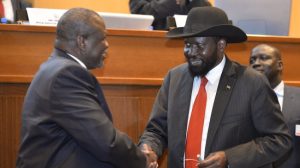
While there are commendable aspects of the agreement at play, such as the cessation of hostilities, it was problematic from the start for its minimal prospects for reconciling key belligerents. Furthermore, it favored the status quo, by reinstating Kiir and Machar to positions of leadership, despite the fact that they presided over the egregious corruption that destroyed the economy and the five-year old war. Equally concerning is the fact that both men have an uncompromising stance toward each other.
The international response to the continued undermining of the peace deal since September 2018 has also been concerning. This response has focused on public messaging and the time-tested diplomatic behind-the-scenes meetings that hold little prospect for building leverage to sway the calculations of hardline politicians. At this moment, the stakes could not be higher; a total collapse of the agreement will increase the misery of the South Sudanese people and create an extra burden on the international community when a return to violence displaces more people.
The looming threat of renewed conflict serves as a reminder that the fundamental reasons behind war remain unresolved. South Sudan’s institutions have been hijacked and remodeled to serve the interests of a few top-level politicians and their commercial collaborators. Groups deprived of power engaged the government in a violent contest over control of the state, precipitating the war five years ago. The current stalemate rewards top-level, corrupt politicians with continued access to state resources, incentivizing a continuation of the cyclical, greed-fueled conflict that has come to characterize South Sudan in recent years.
What is now required of South Sudan’s friends, specifically the United States and Europe, is to increase the price for the deliberate obstruction of peace by enacting pressures with meaningful consequences on spoilers. The United States and Europe should continue to build on previous measures that targeted political elites and their corrupt networks. Hitting spoilers with sanctions resulted in the softening of hardline positions and the signing of the peace deal last September. The international community should not be complacent at this critical juncture.
In particular, the United States, the country with the most influence in South Sudan, should enhance existing authorities and impose sanctions combined with anti-money laundering measures on politicians and entities complicit in obstructing peace and egregious human rights abuses. Congress should push the Departments of Treasury and State to pursue this strategy and ensure adequate resources are available to relevant agencies to investigate and enforce these financial measures. The United States and Europe and other friends of South Sudan should also build a coalition to ensure the renewal of the South Sudan arms embargo at the U.N. Security Council later this month to mitigate the prospects for violence.
A South Sudan that is at peace is possible, but only with the continued support of friends in the international community. Allowing for interminable delays is a certain recipe for a return to war.
References
- ^ $280 million (reliefweb.int)
- ^ no money (www.voanews.com)
- ^ nearly $185 million (www.voanews.com)
- ^ deal worth $3.7 million. (www.politico.com)
Newer articles:
- Juba forum explores ways to advance the status of women in South Sudan (Joshua Mmali) - 24/05/2019 12:51
- South Sudan lifts ban on night clubs - 24/05/2019 10:18
- South Sudan: Christian Mission for Development 2018 Annual Report - 24/05/2019 08:54
- South Sudan president in SA to follow up on oil exploration agreement - 24/05/2019 00:19
- Uganda Parliament approves Shs 900bn for South Sudan compensation - 24/05/2019 00:00
Older news items
- 6 kilometers for 2 gallons: Ozark students experience water conditions in South Sudan - 23/05/2019 12:30
- South Sudan leader urges opposition groups to genuinely implement peace deal - 23/05/2019 11:02
- From Greece and South Sudan to Sunshine Heights: At this club, it's not just about the cricket - 23/05/2019 06:23
- South Sudan launches first international gateway to boost telecom sector - 23/05/2019 02:34
- South Sudan: Once a soldier now a gardener, Daniel roots for resilience - 23/05/2019 01:13
Latest news items (all categories):
- South Sudan Opens 14 Oil Blocks, Courts Investors Ahead of SSOP 2026 - 26/10/2026 15:08
- Jambojet Explores South Sudan Expansion After Talks with Juba Regulator - 26/10/2026 15:05
- Kiir swears in 5 officials ahead of South Sudan elections - 26/10/2026 14:53
- South Sudan cattle battles leaves 10 dead: official - 26/10/2026 14:49
- Churches urge world 'not to forget South Sudan' ahead of first elections - 26/10/2026 14:47
Random articles (all categories):
- An Open Letter to leaders and Elders of South Sudan - 25/11/2015 00:12
- UN commission calls upon international bodies to address deepening crisis in South Sudan - 14/10/2025 13:08
- Oil Companies May Be Complicit in Atrocities in South Sudan, U.N. Panel Says - 20/02/2019 10:33
- South Sudanese refugees in Sudan's White Nile State reach 143,800 - 24/09/2017 12:20
- 3 ways Trump administration could show US cares about South Sudan - 26/02/2019 13:12
Popular articles:
- Who is the darkest person in the world, according to Guinness World Record? - 25/10/2022 02:34 - Read 151291 times
- School exam results in South Sudan show decline - 01/04/2012 17:58 - Read 28387 times
- Top 10 weakest currency exchange rates in Africa in 2023 - 19/07/2023 00:24 - Read 25492 times
- No oil in troubled waters - 25/03/2014 15:02 - Read 24696 times
- NDSU student from South Sudan receives scholarship - In-Forum - 29/09/2012 01:44 - Read 22672 times
