
“People don’t have a clear picture on the number of returns and the level that it’s actually happening at this stage, which makes it hard to have a very strong planning conversation.”
— Garth Smith, South Sudan deputy country director, Danish Refugee CouncilNearly 2 million people[1] have been displaced within the country and more than 2 million have fled across borders[2] to neighboring states due to years of fighting. According to South Sudan’s peace deal, which was signed in September, opposition leader Riek Machar is expected to return to the country in May to form one national government. But so far, the deal has been rife with delays and continued fighting. Experts cite a high risk of collapse, in a report[3] by the International Crisis Group[4] this month.
As a result, long-term programming and assistance are difficult, while porous borders and a lack of infrastructure have made data collection a challenge.
“One of the challenges we have at the moment is that people don’t have a clear picture on the number of returns and the level that it’s actually happening at this stage, which makes it hard to have a very strong planning conversation about it,” said Garth Smith, deputy country director for the Danish Refugee Council[5] in South Sudan.
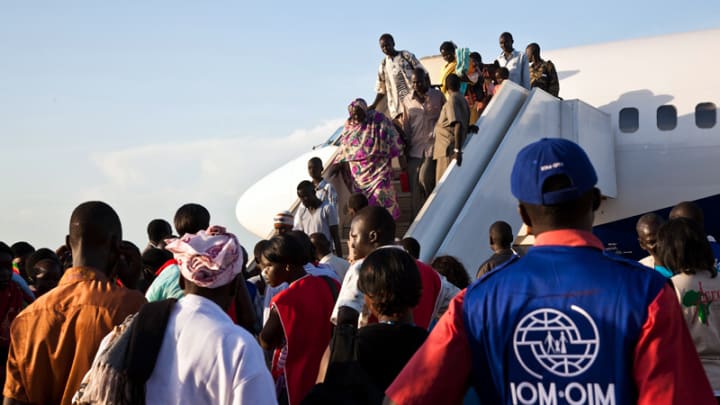
As people start trickling back amid uncertain humanitarian needs and political dynamics, aid organizations must decide how to support both refugees and returnees.
No streamlined approach
The UN Refugee Agency[6] estimates the number of people who have returned since the peace deal was signed at 23,000, calling these “spontaneous” or “self-organized” returns, meaning people who are coming back on their own rather than being officially facilitated by an organization, according to a communication with Devex.
South Sudan’s situation is still too uncertain to actively assist in helping refugees return, according to several humanitarian aid professionals Devex spoke with. Yet with no countrywide framework on how or when to ensure that people can come home safely, organizations must balance giving support to people who are returning on their own volition while still assisting others hesitant to come back.
“We can only promote or facilitate the return when the environment is conducive,” said Eujin Byun, spokesperson for UNHCR[7] in South Sudan.
Instead of assisting people to come home, the agency is conducting ongoing intention surveys across the country to better understand the needs of recent returnees as well as refugees living in neighboring states. The agency is also monitoring the security situation and has set up a task force in 10 field offices to provide vulnerable returnees with shelter, mattresses, and other items.
Most importantly, UNHCR is focusing on giving people access to information so they can make informed decisions as to whether it’s safe to return, Byun said.
“Information is power for us and for them,” she said.
She’s worried people aren’t as well informed as they should be, which means they could be returning to unfavorable environments. Many refugees are taking it upon themselves to see if it’s safe to go home. Those sheltering nearby in the Democratic Republic of the Congo or Uganda, for example, travel into the country for “look and see” visits to check on their houses and crops and assess the situation.
During a trip to the town of Kajo Keji along the Ugandan border in January, Devex spoke with several people who crossed over from Uganda in the morning to cultivate their cassava before returning later that evening. Most people said they’d only feel comfortable returning permanently once the U.N. started facilitating returns to South Sudan from refugee camps.
Caught in the ‘narrative of returns’
There is a disconnect between the return narrative that some groups are pushing and the reality on the ground, according to several humanitarian professionals.
In his address to the U.N. Security Council earlier this month, South Sudan U.N. chief David Shearer noted that for the first time in three years people were “expressing a willingness to return,” estimating that 135,000 refugees had returned to their homes and many internally displaced people were signaling that they wanted to do the same.
At least one aid worker who didn’t want to be named said that Shearer didn’t address the fact that there’s a significant number of returns happening because people have so little access to services in the areas they’ve been displaced to. Many are being forced to return for “survival reasons” to places with already dire humanitarian conditions, the aid worker said.
Get development's most important headlines in your inbox every day.
Thanks for subscribing!
For example, in the last few months due to political instability and a deteriorating humanitarian situation in the camps in Sudan and Ethiopia, there’s been an increase of people coming back to parts of South Sudan that are on the brink of famine. An internal humanitarian document, circulated among NGOs and the U.N. and seen by Devex, warned that the potential “push factors” in Sudan are forcing people to return to “concerning conditions.” The same document showed that in Panyikang, in Upper Nile state, of the areas where people are nearing starvation, 70 percent of households surveyed were recent returnees.
South Sudan experts caution that if people start to return to communities that are already reliant on overstretched aid, it could worsen the current humanitarian crisis: “When looking at the conditions in South Sudan right now, it is difficult to see that those returns will be voluntary, informed, or dignified,” said Jeremy Taylor, regional advocacy adviser for the Norwegian Refugee Council[8].
Smith, from the Danish Refugee Council, warned aid groups against overemphasizing the “narrative of returns” for fear that speeding up the conversation could potentially put people at risk. He’s advocating for an evidence-driven approach, backed by verified numbers in order to create a clear and transparent framework for how to decide if assisting people is safe and for ensuring that aid groups are held accountable to those populations in future.
Protracted humanitarian crisis
Returns are not the primary driver of humanitarian needs in the country, according to Smith.
1.5 million people in South Sudan are on the brink of starvation and half the country’s population, 6 million people, face extreme hunger, according to a food securityreport released last month by the U.N. and South Sudan’s government. Seven million people are still reliant on humanitarian aid and $1.5 billion is needed for the 2019 humanitarian response plan, only 5 percent of which is currently funded.[9][10][11][12]
While aid groups say it’s important to think about returns, they warn that it shouldn’t come at the expense of civilians already in the country.
“There is pressure from some stakeholders to refocus and think about returns. This is not a problem per se, but does have potential to become one if it is at the detriment of attention for those who continue to be displaced,” Tya Maskun, head of operations at the U.N.’s International Organization for Migration[13], told Devex. The organization is focusing on a needs-based approach for both returnees and internally displaced people, considering that they are often found in the same geographical areas, she said.
Under a shaky peace deal, is it too soon to invest in South Sudan's development?[14]
Devex asks some of the country's major humanitarian players when to expect a shift from emergency response to development.
For its part, South Sudan’s government is demanding that 30 percent of the 2019-2020 budget be put toward returns, said Santino Bol Muoter, deputy chairperson for the humanitarian arm of the government. He’s also calling on aid groups to shift from an emergency response to resilience programming[15] and to provide essential services across the country instead of contracting everything inside the U.N. protected internally displaced people’s camps.
Even though the numbers in the camps are decreasing, more than 180,000 people still shelter in six U.N. sites across the country, too terrified to return to their homes, according to the U.N. Mission in South Sudan.
The U.N. is eager to close the camps, and in September it shared an internal draft with aid agencies, seen by Devex, that wanted “all services to be permanently relocated outside” Juba’s two U.N. sites by the end of January 2019, according to the document. But humanitarians pushed back, and the plans were never implemented.
The U.N. said it won’t force anyone to leave but will assist those who are ready and willing to go home. As organizations prepare for people to return, UNHCR’s Byun said it’s important for humanitarians to combine development together with emergency assistance.
“We can’t think of those two separately when it comes to returns, it has to come together,” she said. When people come back they should be given the opportunity to rebuild their lives, which includes resources for cultivating such as tools and seeds.
Smith from the Danish Refugee Council urged aid groups not to cross “red lines” by returning people to places deemed unsafe or undignified.
“It could exacerbate conflict, it could put them into situations where they don’t have access to services and where populations are already in situations where they have life-threatening needs,” he said.
ore than six months into South Sudan’s fragile peace deal, the nation is preparing for the potential return of more than 4 million people who were forced from their homes during the country’s crippling five-year conflict.References
- ^ Nearly 2 million people (www.humanitarianresponse.info)
- ^ more than 2 million have fled across borders (www.humanitarianresponse.info)
- ^ in a report (www.crisisgroup.org)
- ^ International Crisis Group (www.devex.com)
- ^ Danish Refugee Council (www.devex.com)
- ^ The UN Refugee Agency (www.devex.com)
- ^ UNHCR (www.devex.com)
- ^ Norwegian Refugee Council (www.devex.com)
- ^ (reliefweb.int)
- ^ report released last month by the U.N. (reliefweb.int)
- ^ only 5 percent of which (fts.unocha.org)
- ^ (fts.unocha.org)
- ^ International Organization for Migration (www.devex.com)
- ^ Under a shaky peace deal, is it too soon to invest in South Sudan's development? (www.devex.com)
- ^ emergency response to resilience programming (www.devex.com)
Newer articles:
- Kiir and Machar in ‘spiritual retreat’ in Vatican next week - 03/04/2019 08:24
- South Sudan holds breath as fragile peace faces crucial test - 03/04/2019 01:51
- South Sudan Suspends Arabic Newspaper - 02/04/2019 18:15
- Uganda: MPs Want to Meet South Sudan Government Over Compensation - 02/04/2019 10:04
- Chinese firm to start building major roads in South Sudan - 02/04/2019 07:21
Older news items
- Sudan’s Bid to Feed the Middle East Left Its Own People Furious - 02/04/2019 01:16
- South Sudan: Site Profile | Bentiu PoC, February 2019 - 01/04/2019 18:11
- South Sudan rebels to release child soldiers - 01/04/2019 08:41
- Jerome Flynn ‘changed forever’ after meeting child soldiers in South Sudan - 01/04/2019 04:11
- South Sudan to pump more 70,000 oil barrels by next June - 31/03/2019 23:39
Latest news items (all categories):
- South Sudan can leverage China’s AI path to bridge the digital divide - 16/09/2026 16:04
- Credible Elections Are No Longer Possible in South Sudan - What Next? - 16/09/2026 15:59
- South Sudan's president replaces electoral chief three months before scheduled polls - 16/09/2026 15:56
- Turkish Airlines is pulling out of 5 African routes, including South Sudan - 16/09/2026 15:23
- ‘Super El Niño’ deepens hunger crisis in South Sudan – WFP - 16/09/2026 15:19
Random articles (all categories):
- South Sudan Kiir urges support to his mediation to end Ethiopian conflict - 06/11/2021 01:26
- Upper Nile State Deputy Governor False Allegation - 15/12/2009 13:34
- Amnesty International hails extension of UN arms embargo on South Sudan - 31/05/2023 10:53
- Malakal: The city that vanished in South Sudan - 24/10/2015 08:06
- Hon. Paul Mayom Akec on a monstrous campaign for Presidency - 06/12/2020 18:28
Popular articles:
- Who is the darkest person in the world, according to Guinness World Record? - 25/10/2022 02:34 - Read 149594 times
- School exam results in South Sudan show decline - 01/04/2012 17:58 - Read 28115 times
- Top 10 weakest currency exchange rates in Africa in 2023 - 19/07/2023 00:24 - Read 25198 times
- No oil in troubled waters - 25/03/2014 15:02 - Read 24464 times
- NDSU student from South Sudan receives scholarship - In-Forum - 29/09/2012 01:44 - Read 22416 times
