
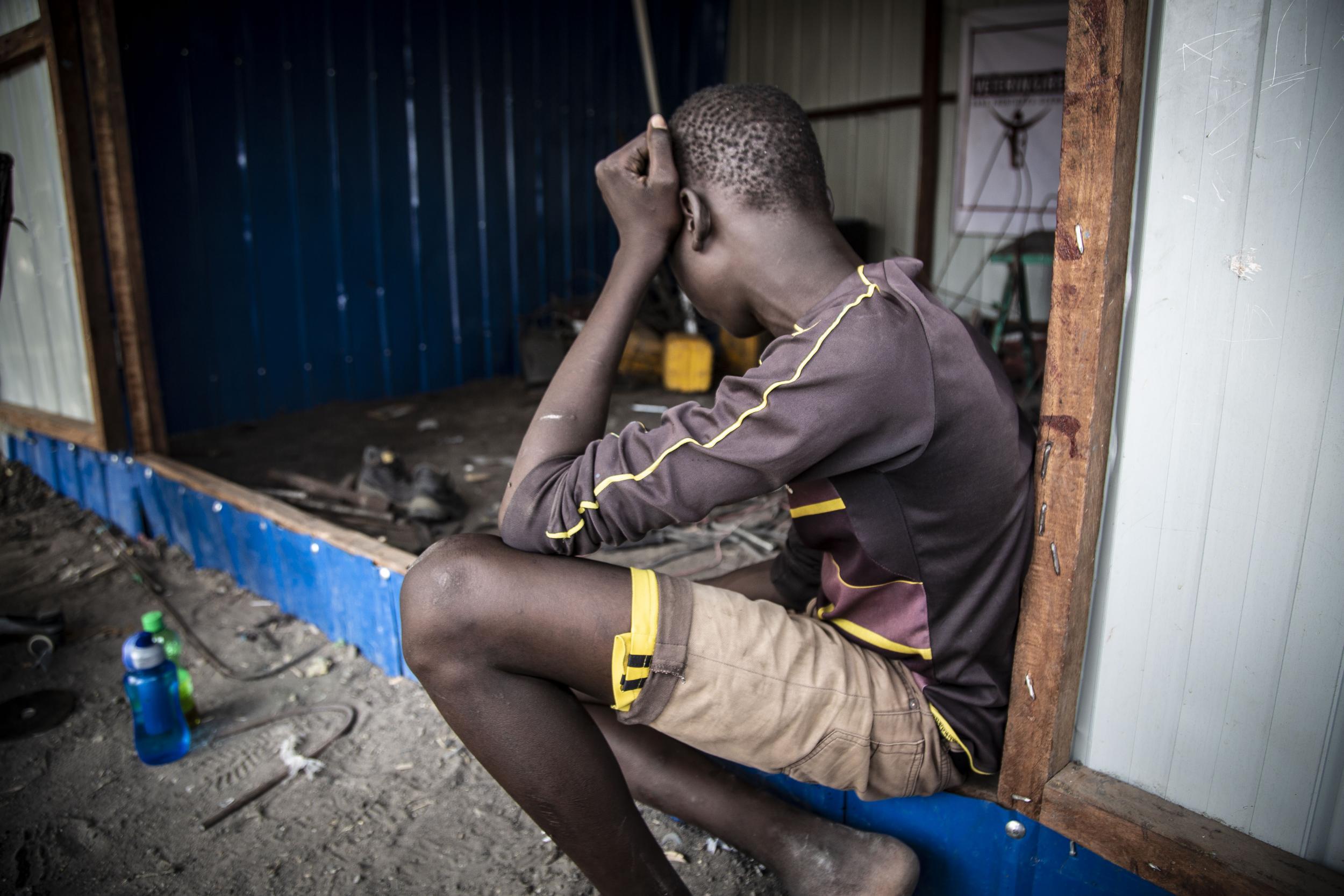
A former child soldier at a welding shop in Pibor where he is being trained after being released from bush camps (Photo: Bel Trew)
Every night when Thomas, 13, goes to sleep the screams of the people he was forced to burn alive two years ago punch through his nightmares.
He was just 11 years old when rebel forces in Yambio, South Sudan gave him a torch and told him to set fire to a family’s hut.
Just a few months previous to that, the little boy had been abducted at gunpoint from a nearby farm by fighters in the South Sudan National Liberation Government (SSNLG), a rebel group which later signed a peace deal and joined the government forces.
But it has taken until this week for Thomas to finally be freed.
He was one of 119 girl and boy soldiers, the youngest aged just 11 years old, who were officially released on Tuesday, which coincidentally marked the international day against the use of child soldiers.
Local authorities together with the United Nations’ child agency and other rights groups hope to use a tense five-month truce currently holding in the war-ravaged country, to free a staggering 19,000 children like Thomas believed to still be in military camps. But with clashes still flaring in parts of the country, the economy in tatters and a hunger crisis on the horizon many fear children will only continue to be lured into the myriad armed factions unless there is proper intervention now.
“They gave me the fire, they said go and burn those people in that hut, so I went and I lit the grass [roof],” says the little boy, his shoulders hunched, as he sits dwarfed by a plastic blue chair.
“Then it started burning. I heard the people screaming. From the voices I thought there must be five people in there,” he adds his voice trailing off.
He explains how he was told if he did not follow orders he would face a similar fate, and so for two years was forced to commit horrific acts of violence.
“They shot dead one boy in front of me because he refused to do the work. I was worried they would do the same thing back to me if I refused anything.”
Children have long been used by all the warring factions in South Sudan’s devastating five-year civil war, which has killed more than 400,000 people, including over 2000 children, and sparked one of the world’s worse humanitarian crises.
The minors are often abducted from their homes or lured into recruitment with promises of rank and wealth by armed groups who see the children as a useful expendable force.
In the isolated rural "bush" camps, they are brutalised, brainwashed, beaten and forced to take drugs. Many of the child soldiers The Independent spoke to said they were used as cannon fodder on the frontline, or deployed as spies to watch rival armed groups. They were taught to assemble and disassemble rifles, and patrol the surrounding areas. Many of the girl soldiers are raped and “married” off to the fighters.
This year the UN hopes that a lull in fighting, due to a peace deal brokered in September between South Sudanese President Salva Kiir and rebel factions, will finally allow all sides to release their children.
There have been positive signals: the South Sudanese government agreed last autumn to sign a UN treaty committing to end the recruitment and use of children in armed conflict. Unicef says that since last February at least 1000 children have been released by various groups.
But despite assurances child recruiting has ended, there are still thousands of soldiers like Thomas who have yet to be freed from military camps.
Meanwhile, both South Sudan’s official army and the opposition’s forces confusingly deny the use and recruitment of child soldiers.
Brigadier General Santo Dominic Chol, the army’s deputy-spokesman, told The Independent that children seen with guns in government-held areas were likely cattle herders or youth wanting to protect their local communities.
Brigadier General Santo Dominic Chol, the army’s deputy-spokesman, says there are no child soldiers among their ranks (Bel Trew)
“We don’t have child soldiers,” he said from the capital Juba.
“Within [our forces] there is a huge department for child protection that works in collaboration with Unicef and other stakeholders during recruitment so that minors are never enlisted… But now there is no more recruitment in the country. We are no longer recruiting anybody,” he added.
Colonel Lam Paul Gabriel, the deputy spokesman for the opposition forces, echoed a similar denial.
“I can tell you clearly that the SPLA IO [opposition forces] does not recruit kids. Those children in our controlled areas they are there to protect cattle their families,” he said, adding that it is "unfortunate" they are presumed to belong to the opposition army.
Aid agencies working on supporting and rehabilitating former child soldiers also warn that even if children are sent home, with the current instability many are subsequently vulnerable to re-enlistment.
South Sudanese security forces outside a military court in Juba (Bel Trew)
Case workers at Veterinaires Sans Frontieres (VSF), that runs vocational training programmes for ex-child soldiers in the remote town of Pibor, North East of the capital, said that up to a quarter of the children released end up back in the military camps, after receiving training and aid packages.
The training is supposed to help the children re-enter society and offer them alternative source of funds. But the problem is trying to keep them in the programmes after years of indoctrination and trauma.
“While there is no active recruitment of children since the peace deal was signed, we would say nationwide around 25 percent who are released end up returning to the camps," VSF’s Wani Richard told The Independent from Pibor.
“Around 20 or so have returned from the 300 we have personally seen released,” his colleague Joseph Naythu added.
It is this phenomenon that Unicef is trying to tackle with a monitoring programme that offers former child soldiers three months of vocational training in skills like tailoring, carpentry and welding before they are then monitored for three years by social workers.
In a dirt-track playground in Yambio, Thomas and other recently freed teenagers line up to start the process, beginning with receiving official release certificates, documents the authorities hope will at least provide some safeguard against their re-deployment. They are then given a medical and psychological assessment before leaving with an aid package.
Former child soldiers wait for a medical assessment before receiving an aid package in Yambio (Bel Trew)
The traumatised children are often difficult to manage because of their violent pasts: they spoke of suffering from angry outbursts and needing to use force.
Several said they faced judgement from their local communities who shunned them for the acts they were made to perform while in the army.
One 16-year-old boy, who was forced to execute captives in a firing squad, said he dropped out of school because he was afraid of what he might do to anyone who confronted him about his past.
The support from the social workers is vital to help ease the tricky re-entry into civilian life.
Former child soldiers receive aid packages after being released from bush camps (Bel Trew)
But the problem Unicef and its partners are facing is a lack of funds. Overall last year the humanitarian response for South Sudan was only two-thirds funded. In 2019 they actually need to reach more people and so need more money, yet targeted funding is $200m (£155m) less than last year’s projected $1.72bn.
One of the programmes impacted is the efforts to rehabilitate child soldiers.
“We can for sure see donor fatigue,” said Unicef’s Helene Sandbu Ryeng at the release.
“If we don’t have money the programmes will stop."
One 15-year-old girl, Martha who was first captured by the SSNLG two years, said she is regularly approached by children who want to return to the bush camps. She says she uses her own story to try to discourage them from leaving their families.
“Once a month, every couple of weeks girls come to me to ask how to go back, I tell them what happened to me” she says.
Martha a former child soldier receives an official document saying she has been released from the army in Yambio (Bel Trew)
Martha was just 13 when she was captured by rebel forces while she was playing with her siblings by a bridge outside Yambio town.
She was taken to the sprawling rebel camp where she joined hundreds of other teenage girls who slept outside and were put to work fetching firework, cooking and cleaning as well as being trained in weapons and sent on patrol.
The young and vulnerable girls are often preyed on by the fighters, who take their pick from the abducted girls as “wives”. In the Yambio playground nearly all the teenage girls juggle new babies born during their years in the camp.
“We went to fetch water and these three men in their 20s with guns said if we didn’t have sex with them we would be killed,” Martha says with a matter-of-fact manner.
“That man had me for the entire year and even after I escape he tried to find me,” she adds.
A former child soldier receives a tool kit and a certificate after graduating from training in Yambio (Bel Trew)
Another former girl soldier called Mary was abducted from her school aged just 15. When she arrived in the camp she was “assigned” to a particular commander. In the camp she said the children were raped and given drugs to make it easier to commit the brutal acts they were ordered to do.
“After 3 months I got pregnant and so they sent me home to deliver, I never went back but it was hard, ” she says explaining her escape.
She was later officially released and is two months into Unicef’s vocational programme to become a tailor. As she talks her social worker, who checks in with her once a week, sits to by her side.
At the end of the training she will be gifted a sewing machine which she hopes will mean she can look after her son who is disabled.
“I want to set up my own business and go back to school to support my son,” she says wistfully.
“One day I hope it will all better.”
Children collecting water in Yambio, South Sudan (Bel Trew)
But the shadow of the violence hangs over the group of teenagers, who have been through unspeakable violence.
Thomas talks about how hard it is “to be a little boy” and how he is shunned by the local community that fears he will brainwash the youth.
“I get angry because of the bad things that happened to me in the bush. There are some people who don’t like me because I was with the military. They tell me they think I will spoil their children,” he says kicking the dust on the dirt floor.
“But all I want to do now is go to school and get a job. I want to help other children escape and start a new life.”
Newer articles:
- Change of Her Majesty's Ambassador to South Sudan: May 2019 - 19/02/2019 01:04
- WHO scales up health care services to displaced South Sudanese - 19/02/2019 00:55
- Port Sudan workers on strike over terminal transfer - 18/02/2019 10:05
- South Sudan youths use theater to promote peace, reconciliation - 18/02/2019 03:20
- Sudan Constitution amendment on hold - 18/02/2019 02:55
Older news items
- Conflict, poverty, hunger fuel child marriages in South Sudan: charity - 18/02/2019 01:46
- South Sudan conducts an Ebola Tabletop Exercise - 16/02/2019 08:07
- Sudan lawmakers postpone amendment to keep Bashir in power - 16/02/2019 05:16
- UN Spots Rape-Impunity Zone in South Sudan’s Unity State - 15/02/2019 19:25
- South Sudanese Woman in Hiding to Avoid Forced Marriage - 15/02/2019 13:59
Latest news items (all categories):
- South Sudan Opens 14 Oil Blocks, Courts Investors Ahead of SSOP 2026 - 26/10/2026 15:08
- Jambojet Explores South Sudan Expansion After Talks with Juba Regulator - 26/10/2026 15:05
- Kiir swears in 5 officials ahead of South Sudan elections - 26/10/2026 14:53
- South Sudan cattle battles leaves 10 dead: official - 26/10/2026 14:49
- Churches urge world 'not to forget South Sudan' ahead of first elections - 26/10/2026 14:47
Random articles (all categories):
- Video: Fight for the heart of the South - 16/07/2011 14:09
- HRW calls for ICC probe into war crimes committed in Sudan - 12/07/2023 03:43
- South Sudan oil perspective [Business Africa] - 16/07/2020 20:02
- South Sudan thrash Somalia in Afro-basketball opener - 14/01/2020 07:48
- In Niger, US seeks to hang on to its last, best counterterrorist outpost in West Africa - 04/08/2023 00:33
Popular articles:
- Who is the darkest person in the world, according to Guinness World Record? - 25/10/2022 02:34 - Read 151298 times
- School exam results in South Sudan show decline - 01/04/2012 17:58 - Read 28390 times
- Top 10 weakest currency exchange rates in Africa in 2023 - 19/07/2023 00:24 - Read 25495 times
- No oil in troubled waters - 25/03/2014 15:02 - Read 24701 times
- NDSU student from South Sudan receives scholarship - In-Forum - 29/09/2012 01:44 - Read 22676 times
