
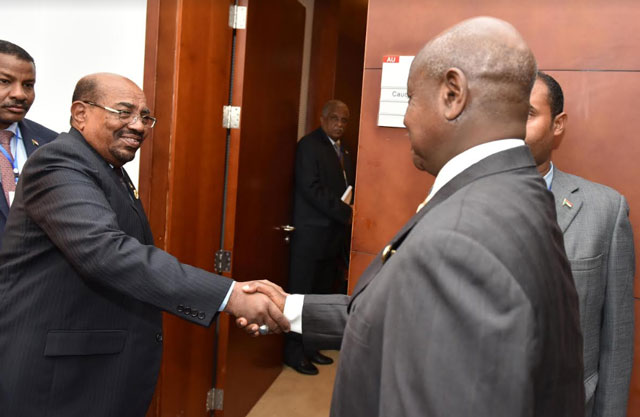
FILE PHOTO: Bashir fought a civil war with South Sudan, but has since made up with his neigbours, including Uganda
Khartoum, Sudan | AFP | Here are key dates in Sudan since Omar al-Bashir came to power almost three decades ago.
– 1989: coup –
In June 1989 army brigadier Bashir seizes power in a coup backed by Islamist ideologue Hassan al-Turabi.
Sudan then hosts radical Islamists, including Al-Qaeda chief Osama bin Laden, who remains until 1996.
A leadership power struggle erupts in 1999 and Bashir forces Turabi from the ruling circle.
– 2003: rebellion in Darfur –
In 2003 a rebellion erupts in the vast western region of Darfur, which complains of economic and political marginalisation.
The conflict, which has largely diminished in recent years, has killed some 300,000 people and displaced nearly 2.5 million, the United Nations says.
The International Criminal Court in 2009 indicts Bashir for war crimes and crimes against humanity in Darfur, and a year later for genocide. Bashir denies the charges.
– 2005: civil war ends –
Khartoum signs a peace treaty in 2005 with southern rebels after a north-south civil war that lasted more than two decades, leaving two million people dead and a further four million displaced.
The agreement schedules a referendum on independence for 2011.
– 2010: vote boycotted –
In 2010 Bashir is elected in the first multiparty election since 1986, but voting is boycotted by the opposition and criticised abroad.
He is re-elected in 2015.
– 2011: South Sudan born –
In July 2011 South Sudan breaks away, six months after a referendum overwhelmingly approves independence.
Around the same time, the Sudan People’s Liberation Army-North launches insurgencies in South Kordofan and Blue Nile states.
– 2012: war for oil –
In early 2012 fighting breaks out along the border between Sudan and South Sudan over oil fields in an area claimed by both.
South Sudan shuts off oil production for more than a year, hitting the economies of both countries badly.
– 2013: deadly demonstrations –
Khartoum lifts petrol subsidies in late 2013, causing prices to rocket by more than 60 percent and sparking broad public anger.
Demonstrations turn into anti-government protests and the security forces respond with force. Amnesty International says more than 200 people were shot dead, while the government puts the toll at dozens.
– 2016: Darfur referendum –
Darfur holds a referendum in April 2016 on whether to unify its five states, a long-standing demand of rebels seeking greater autonomy.
The poll is boycotted by the opposition and criticised internationally, with the result backing the five-state division of the region.
In August negotiations fail between the regime and rebels on a cessation of hostilities in Darfur, Blue Nile and South Kordofan.
The following month Amnesty International says government forces used suspected chemical weapons in 2016 in Darfur, killing scores of civilians. Khartoum denies the allegations.
In November Sudan hikes fuel prices by around 30 percent, sparking new nationwide strikes.
– 2017: US embargo ends –
In October 2017 the United States ends its 20-year-old trade embargo against Sudan, imposed over Khartoum’s alleged support for Islamist militant groups.
But Washington does not drop it from its blacklist of “state sponsors of terrorism”.
– 2018: food price protests –
In early 2018 demonstrations erupt over soaring food prices, notably of bread which has almost doubled. They are swiftly dispersed and opposition leaders and activists are rounded up.
In August the ruling party nominates Bashir as its candidate for the 2020 presidential election, despite the constitution having a two-term limit.
On December 19, protests begin in several towns after the government triples the price of bread, soon turning into rolling nationwide anti-government rallies.
The deadly demonstrations continue into 2019, with some political groups calling for a “new regime”.
Newer articles:
- New Bible app helps South Sudan refugees plant church - 17/01/2019 16:08
- Egypt will continue supporting stability, security of South Sudan: Al-Sisi - 17/01/2019 12:04
- Sudan police break up palace march but new demos spark - 17/01/2019 08:48
- In Pics: Sisi affirms backing South Sudan's peace agreement - 17/01/2019 05:47
- South Sudan could be mine-free in 5 years: UN official - 17/01/2019 05:40
Older news items
- Sudan: torn apart by war - 17/01/2019 00:06
- Unexpected Progress, but a Long Way to go for Many in South Sudan - 16/01/2019 21:35
- South Sudan Rely Unifying Forces to Find Lasting Peace - 16/01/2019 13:58
- South Sudan urges refugees to return home - 16/01/2019 13:36
- South Sudan president arrives in Cairo for talks with Sisi - 16/01/2019 07:45
Latest news items (all categories):
- South Sudan can leverage China’s AI path to bridge the digital divide - 16/09/2026 16:04
- Credible Elections Are No Longer Possible in South Sudan - What Next? - 16/09/2026 15:59
- South Sudan's president replaces electoral chief three months before scheduled polls - 16/09/2026 15:56
- Turkish Airlines is pulling out of 5 African routes, including South Sudan - 16/09/2026 15:23
- ‘Super El Niño’ deepens hunger crisis in South Sudan – WFP - 16/09/2026 15:19
Random articles (all categories):
- Egypt Backs Efforts to Achieve Stability in South Sudan - 17/06/2022 02:36
- South Sudan says Sudan troops enter Upper Nile state - 10/06/2013 05:15
- South African UN worker held in Sudan - Times LIVE - 30/04/2012 00:00
- New U.S. Humanitarian Assistance for the South Sudan Crisis Response - 15/04/2021 09:44
- South Sudan rebels form 'leadership body' - 30/08/2019 12:29
Popular articles:
- Who is the darkest person in the world, according to Guinness World Record? - 25/10/2022 02:34 - Read 149591 times
- School exam results in South Sudan show decline - 01/04/2012 17:58 - Read 28115 times
- Top 10 weakest currency exchange rates in Africa in 2023 - 19/07/2023 00:24 - Read 25198 times
- No oil in troubled waters - 25/03/2014 15:02 - Read 24464 times
- NDSU student from South Sudan receives scholarship - In-Forum - 29/09/2012 01:44 - Read 22415 times
