
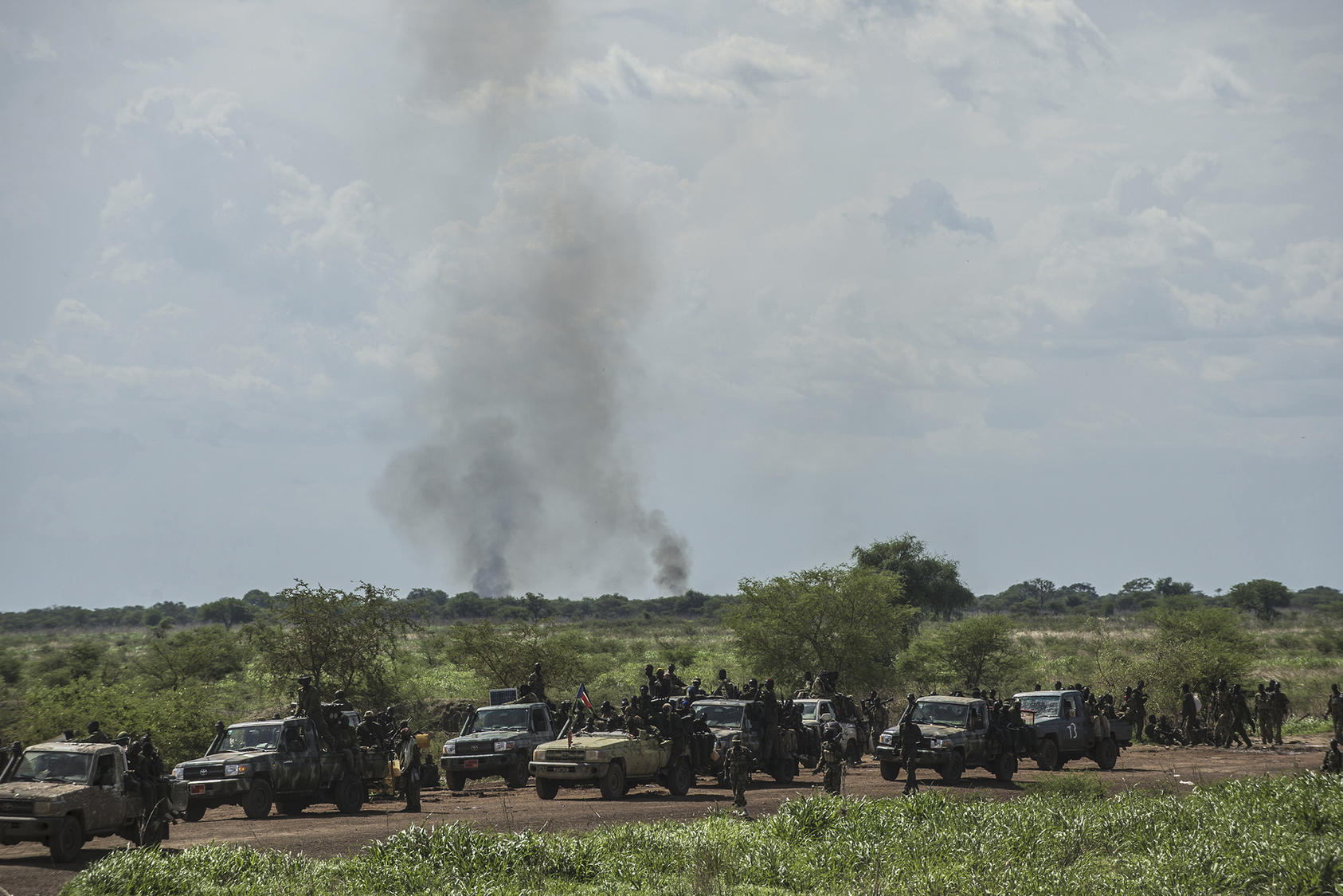
Government soldiers advance on the town of Bentiu in South Sudan, May 4, 2014. Government forces went on the offensive to take back the oil hub of Bentiu from rebels loyal to Riek Machar. (Lynsey Addario/The New York Times)
First deployed in early 2014, a group of civilian and military observers—now known as the Ceasefire and Transitional Security Arrangements Monitoring and Verification Mechanism[1] (CTSAMVM)—was retained by South Sudan’s September 2018 peace deal[2] to continue to investigate truce violations and verify the implementation of security arrangements such as the separation of rival forces. The monitors are financially and logistically backed by the United States, the European Union, China, Japan, and other European donor governments.
What Does the Data Tell Us?
A review of the data published by monitors shows:
- Government forces are responsible for initiating the majority of documented violations. Overall, monitors attribute responsibility to government forces in nearly 58 percent of incidents, while opposition forces are found responsible in nearly 47 percent of documented cases. (Totals exceed 100 percent as in numerous incidents monitors attribute responsibility to more than one party.) However, while in 2014 and 2015 the government and the opposition were found responsible in an almost equal number of incidents, since 2016, a greater number of violations, higher than 60 percent, have been attributed to the government. In the same period, the opposition’s share of culpability for violations has declined to around 40 percent.
- Conflict is not limited to the dry season. Truce violations occur year-round. The conventional wisdom is that military operations are more prevalent[3] in South Sudan during the dry season, which usually runs from September to April or May. With the caveat that the cease-fire monitors do not investigate all alleged violations, the data shows that, from 2014 to 2018, the month with the single greatest number of violations documented is rainy season June (18 out of 142 total occurrences), and that violations have taken place in July and August as well. The data shows that climate is not causality; it is but one factor in the occurrence of conflict. Better recognition of how seasonal factors intersect with the prevalence of conflict could improve our understanding of the underlying trends, and make efforts at prevention and mitigation better informed.
- Most incidents are short. Almost all cease-fire violations consist of skirmishes that last for less than a day. Incidents in 2014, at the height of the war, were significantly longer than violations today, averaging 6.1 days. But even in that year, the most common length for an incident was a day or less. The brevity of most episodes may suggest the warring parties are unable to make sustained inroads into hostile territory and lack the capacity to sustain prolonged fighting, underlining that a decisive military victory for any party is unrealistic.
- In the first eight months of 2018, it took almost five times as long to report violations as it did in 2014, although the pace of reporting this year has improved over that of 2017. In 2014, of the 22 cease-fire incidents that resulted in violation reports, it took an average of 10.2 days from the end of the incident to the submission of the monitors’ report. Excluding one exceptional incident[4] that took several months to investigate, the average for 2014 falls to a much speedier 5.9 days. In 2015, the average rose to 16 days; in 2016, to more than 100 days (the collapse of the peace agreement in mid-2016 interrupted CTSAMM’s activities for several months); and in 2017, the average was around 49 days. The average to August of this year is approximately 33 days. While this is a significant improvement over 2017, it remains markedly slower than the pace set in 2014.
Transparent Monitoring is Essential
Monitoring cease-fire violations is an arduous task with constant frustration, as those responsible tend to obfuscate and minimize, rather than accept, their responsibility for violence. Moreover, statistics about the timeliness of reporting are not, in themselves, an indication of the quality or comprehensiveness of investigations.
But the speed of reporting does matter. If reports are slow to emerge, it is easier for further violations to occur as those fighting see no consequence to their actions. Further, without timely reporting, accountability is made much more difficult as past incidents can often be overtaken by current events. And without the public and comprehensive disclosure of the findings of investigations, including the attribution of command responsibility, there is little prospect of deterrence or disciplinary action.
With millions of South Sudanese hoping that the latest agreement brings lasting peace, the work of cease-fire monitors remains essential. Even if, as some argue[5], the absolute number of cease-fire violations has today decreased, the environment is still volatile, and retaliation and violent escalation are still real threats. There is still much to be done if citizens are to trust in the quality of the cease-fire, and for a wider peace to take hold amid a history of animosity and violent setbacks. For monitors’ efforts to be more effective in these aims, and mitigate, if not prevent, further conflict, transparent and timely reporting is vital.
Notes:
The data in this article was compiled from publicly available reports (2014-15[6]; 2016-18[7]; 2015-18[8]). Reports were analyzed based on the date the cease-fire violation occurred. Therefore, a report issued in 2018 reporting an incident in 2017 is counted in data for 2017. Incidents that span more than one month were counted in each month, resulting in a higher number of incident occurrences than violation reports. Where violation reports were incomplete or did not pertain to a specific incident, some data was excluded from these calculations. The full data set may be obtained on request from the author, who thanks Daniel Noon for his assistance in reviewing the data, as well as four external reviewers for their comments.
Commenting on sexual violence incidents, CTSAMM noted[9] in April 2018 that it “is only able to investigate and report on a tiny proportion of cases, and indeed only has the resources to investigate a small proportion of the cases it hears about.” This limitation of reporting may well extend to other forms of cease-fire violations, which likely[10] means a greater number of incidents have occurred than are reflected in this data.
References
- ^ Ceasefire and Transitional Security Arrangements Monitoring and Verification Mechanism (ctsamm.org)
- ^ South Sudan’s September 2018 peace deal (jmecsouthsudan.org)
- ^ prevalent (www.crisis.acleddata.com)
- ^ exceptional incident (ctsamm.org)
- ^ argue (www.usau.usmission.gov)
- ^ 2014-15 (ctsamm.org)
- ^ 2016-18 (ctsamm.org)
- ^ 2015-18 (www.jmecsouthsudan.org)
- ^ noted (www.jmecsouthsudan.org)
- ^ likely (www.jmecsouthsudan.org)
Newer articles:
- Influential Opportunities for South Sudan Diplomacy - 29/11/2018 13:16
- South Sudan denies allegations over breach of EU arms embargo - 29/11/2018 07:31
- Trade thriving at border town between Sudan and its conflict-affected neighbour as security improves - 29/11/2018 04:14
- Uganda's double game in South Sudan civil war revealed - 29/11/2018 03:20
- Uganda funneled European weapons to South Sudan, breaching arms embargo: report - 28/11/2018 23:40
Older news items
- Sudan’s Army to be Decisive in Fight against Insurgents - 28/11/2018 23:01
- UN troops to help South Sudan refugees return home - 28/11/2018 22:46
- Churches in South Sudan Trained to Help Their Neighbors - 28/11/2018 11:37
- South Sudan’s Primate, Justin Badi Arama, prays for peace with President Kiir - 28/11/2018 09:49
- South Sudan records over 2,200 cases of sexual violence in 2017 - 28/11/2018 05:00
Latest news items (all categories):
- The SPLM ruling party is facing a dilemma and Thucydides trap at a pivotal moment - 24/08/2026 14:06
- Shanghai Cooperation Organization (SCO) countries are making green development an engine of growth - 24/08/2026 13:36
- President Salva Kiir in Pretoria Seeking Support Ahead of South Sudan’s December Elections - 24/08/2026 12:48
- Tambura’s fragile path from conflict to recovery - 24/08/2026 12:45
- South Sudan’s Yei Joint Stars advance to semi final stage of Zonal qualifiers - 24/08/2026 12:43
Random articles (all categories):
- ICC trial in The Hague one option for Sudan's Bashir -minister - 17/02/2020 16:00
- Appeal to All Citizens of South Sudan - 05/03/2015 00:31
- South Sudan imposes nighttime curfew over coronavirus - 25/03/2020 08:32
- South Sudan factions agree on federal government - 30/09/2014 15:28
- Sudan Teachers Strike for 'New Structure' Salaries - 12/04/2022 00:46
Popular articles:
- Who is the darkest person in the world, according to Guinness World Record? - 25/10/2022 02:34 - Read 148862 times
- School exam results in South Sudan show decline - 01/04/2012 17:58 - Read 27996 times
- Top 10 weakest currency exchange rates in Africa in 2023 - 19/07/2023 00:24 - Read 25081 times
- No oil in troubled waters - 25/03/2014 15:02 - Read 24390 times
- NDSU student from South Sudan receives scholarship - In-Forum - 29/09/2012 01:44 - Read 22336 times
