
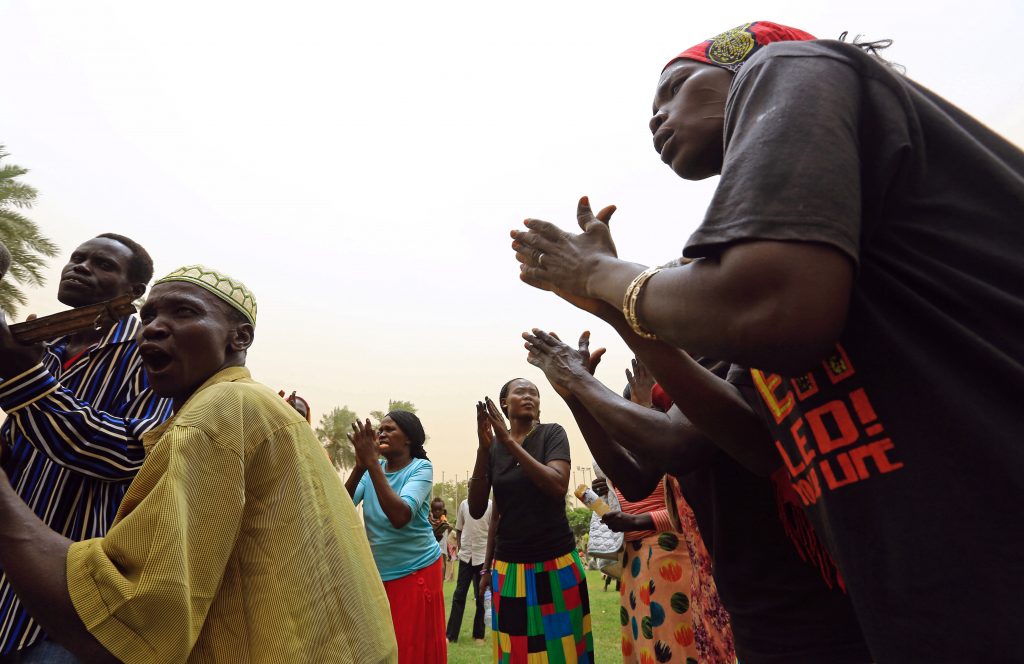
South Sudanese sing traditional songs during a South Sudan peace meeting as part of talks to negotiate an end to a civil war that broke out in 2013. Picture: Mohamed Nureldin Abdallah, Reuters
Torched homes, gutted shopfronts and fields of rotting corn greeted Laker Betty as she returned to the town in South Sudan’s breadbasket she fled in terror a year ago.
She’s one of thousands of civilians tentatively returning to the East African nation after a war that at its height rivalled Syria for the dubious title of the world’s worst conflict, claiming almost 400 000 lives. As President Salva Kiir prepares to welcome rebels into a new government, South Sudan’s pillaged towns and villages show the scale of the challenge in rebuilding even a country endowed with sub-Saharan Africa’s third-biggest oil reserves.
“There is nothing to eat here, the soldiers cleaned up everything,” said Betty, a 30-year-old mother of three whose looted home in Pajok once sported the relative luxuries of a solar-power system, TV and refrigerator. “What they did here in Pajok has reduced us to zero.”
Spared for much of the half-decade civil war that unleashed a refugee crisis, Pajok was overwhelmed by the violence last April, with soldiers rampaging through its streets and residents racing for shelter in nearby Uganda. What they left behind is little more than ashes and ruins — testimony to a scorched-earth policy waged mostly by pro-government forces.
Not safe yet
As many as 125 000 South Sudanese are reported as returning in the past year from neighbours including Uganda, Kenya and Ethiopia, according to the United Nations Refugee Agency, although the organisation has verified only a 10th of that figure. While the influx increased after August’s peace deal, the UN doesn’t yet consider the country safe.
You don’t have to stray far from Pajok to see why. Rebels are camped less than 2 miles away, though — unlike in the country’s north — fighting hasn’t been reported since the peace deal. The main insurgent leader, Riek Machar, is due to join South Sudan’s transitional government in May.
The president is seeking to build an inclusive government to help the transition to peace. Machar will be one of five vice presidents; the cabinet will be expanded to 45 ministers and deputies, and the parliament in the capital Juba will grow to 550 lawmakers, all for a population of some 13 million.
Big government comes at a price, and much of the cost will come from pumping more oil. South Sudan took three-quarters of the oil reserves when it seceded from Sudan in 2011, but the civil war that uprooted some 4 million people also took a toll on output: BP estimates the country pumped about 40 million barrels in 2017. That figure would have brought slightly more than half the revenue of 2013, the year the war began.
‘Zero development’
With government poised to expand — amid a collapse in crude prices — there’s likely to be little left for rebuilding public services, according to Marial Awou Yol, dean of the school of economics at the University of Juba.
Amalgamating opposition forces and demobilizing others, on top of the government’s running costs, will mean “almost zero development activities,” Yol said. Even so, the picture will improve after the three-year transition. “We forego services today in order to have better and even peaceful services in the future,” he said.
For now, the plight of Pajok, about 185 kilometers (115 miles) southeast of Juba, shows the dire straits some of South Sudan’s most productive areas have fallen into. Once home to 50 000 people, the farming town produced corn and beans that were sold across the country. Now it needs food aid, and urgently.
The main street is all-but abandoned; overgrown bushes sprout from single-story shacks whose iron sheeting, doors and windows have been ripped out.
Many returnees recount a wave of indiscriminate attacks by government forces in April 2017, violence also reported by the UN and Human Rights Watch. The army denies targeting non-combatants, although Kiir himself has urged the police and army to stop killing civilians.
Some 6 500 of Pajok’s residents fled to Uganda, others to the nearby bush. The town’s main chief, Simon John Otto, says 2 000 have since returned, many of them heads of households preparing for families.
Multiple challenges
“The challenges here right now are many — people can’t get things to eat, there are no medical personnel and teachers are lacking,” he said.
When Lucy Acan returned in September she found her home in charred ruins and spent days scouring neglected farmland for food. “I basically have nothing left,” said the 27-year-old, who left her three children in a Uganda refugee camp. “The security situation is better now, but our prayers are that this peace deal holds so that we can rebuild our lives.”
Charles Okumu — a corn-farmer before his homestead was razed — runs a shop in an abandoned building, selling sodas, cookies and soap. He can afford one meal a day.
Yet the 30-year-old, who lives in the home of a friend he says was killed, remains optimistic about his future, and plans to rebuild his farm.
“Even with this state of things, I won’t give up in my life,” he said. “I can’t give up.”
Newer articles:
- Missing man reunites with kin after six years in South Sudan - 27/11/2018 13:12
- Are big boys about to enter South Sudan oil territory? Russian firms lead way - 27/11/2018 03:50
- South Sudan’s Kiir to meet SPLM-N’s al-Hilu in next few days: official - 26/11/2018 14:10
- Which Countries Border South Sudan? - 26/11/2018 13:25
- South Sudan hopes to start exporting livestock products by 2040: official - 26/11/2018 08:50
Older news items
- Will South Sudan’s New Peace Deal Stick? - 26/11/2018 02:33
- South Sudan reneging on release of all political prisoners, opposition says - 26/11/2018 01:39
- South Sudan in new push to resume prime position as top oil producer - 26/11/2018 00:57
- Sahara Energy supports growth forecasts in South Sudan’s oil, power sectors - 25/11/2018 21:35
- Facebook wedding man responds to international backlash to his marriage - 25/11/2018 02:29
Latest news items (all categories):
- Why Kenya-South Sudan trade corridor remains unfinished despite years of promises - 28/08/2026 12:44
- UN says floods displace 168 families, damage 271 homes in southern Sudan - 28/08/2026 12:41
- Pace, space, and shooting: How South Sudan edged hard-fighting Guinea - 28/08/2026 12:36
- South Sudan Nexus Digest Issue #2 | June - July 2026 - 28/08/2026 12:35
- مجلس الأمن يدين هجوماً على بعثة حفظ السلام في جنوب السودان - 28/08/2026 12:32
Random articles (all categories):
- South Sudan: ‘I was ready for this new mission’ - 06/12/2019 03:13
- Sudan’s Prime Minister Hamdok Freed from Detention - 21/11/2021 17:07
- South Sudan keeps oil pipeline shut - 29/01/2012 14:39
- Japanese peacekeepers take up new role in South Sudan - 12/12/2016 01:20
- Civilians pay heavy price in worsening S.Sudan war - 18/04/2014 09:06
Popular articles:
- Who is the darkest person in the world, according to Guinness World Record? - 25/10/2022 02:34 - Read 148966 times
- School exam results in South Sudan show decline - 01/04/2012 17:58 - Read 28010 times
- Top 10 weakest currency exchange rates in Africa in 2023 - 19/07/2023 00:24 - Read 25088 times
- No oil in troubled waters - 25/03/2014 15:02 - Read 24398 times
- NDSU student from South Sudan receives scholarship - In-Forum - 29/09/2012 01:44 - Read 22344 times
