
Juba, South Sudan
Imagine dodgeball, in all its elementary school gym class glory.
Now take away the light-up sneakers squeaking over slippery wood floors. Take away the dozen balls whizzing back and forth overhead like a manic game of pinball. Take away the shrieking 8-year-olds and the grumpy, exhausted PE teacher.
Replace them with three barefoot girls on a sandy pitch on the outskirts of South Sudan’s jumbled capital city. Imagine two of the girls lined up on either side of the pitch with a small ball, winding up again and again like they’re getting ready to pitch a 90-m.p.h. fastball. Now imagine their target, a frantic blur of a girl between them, diving and flipping away from the ball like she’s mid-floor routine at the Olympics.
On second thought, maybe it isn’t dodgeball you need to imagine.
This is more like if dodgeball met gymnastics on the clay courts of the French Open, and then a couple of Major League Baseball pitchers showed up just to hang out.
This is boruboru: South Sudan’s most beloved playground game, and more recently, its newest spectator sport.
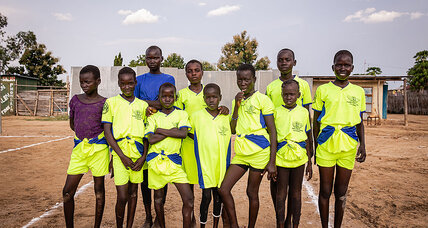
“There’s a boy I know who said to me, if I was a girl I would play too,” says Peace, age 14, whose team, New Generation, plays in highlighter-yellow uniforms that read WOMEN CAN CHANGE THE WORLD. “I didn’t reply to him. I just kept quiet. Because I knew he can’t play. This sport is only for us.”
Girlball
A version of boruboru has been played by girls across east and southern Africa for centuries. In Uganda it’s called okwepena. In Malawi it’s fulayi. In Kenya it’s kati. But the basic concept is the same. You need some kind of ball (balled up socks work well, as do bundled plastic bags or a rolled-up banana leaf), a few someones to throw, and at least one someone to duck. That’s it.
“There aren’t any instructions, or any hard rules. You would just find an open space and you played,” says Joyce Nosha, recalling her childhood boruboru games.
But in 2015, she was walking through her neighborhood in Juba when she saw a crowd huddled around a small dirt field. When she got closer, she realized they were watching a game that looked a little like boruboru. But it was a kind of boruboru she had never seen – with teams and rules and referees’ whistles blowing shrilly every time a player stepped out of bounds. The dodgers, meanwhile, moved like dancers, lithe and fluid. Ms. Nosha couldn’t look away.
When she asked another spectator what was going on, they explained to her that this was the city’s official boruboru league. She signed up the same day.
That league had been formed earlier that year by a hodge-podge of social workers, activists, and lifetime NGO-types, who were looking for a way to support young girls growing up in a society where the odds often seemed stacked against them, amid a civil war that has often made women deliberate targets[2].
“When we look at the civil war, we see that young girls have not been given an opportunity to participate in the public life of this country,” says Abdallah Michael Charles, the executive director of the Boruboru National Association, which runs the league in Juba.
The founders of the BNA had particular sympathy for the challenges of growing up during a war. Like most South Sudanese of their generation, they had been raised far away from their homeland, in Congo and Uganda and Sudan, scattered by the five decades of brutal civil war against northern Sudan that preceded the country’s 2011 independence.
And boruboru had followed the South Sudanese into this mass exile. It was played beside water pumps in refugee camps and on the narrow streets of South Sudanese neighborhoods in Khartoum, Kakuma, and Kampala. It found a home in villages and cities and settlements for this displaced – anywhere, really, with a critical mass of girls and something that could be shaped into a small ball.
“Even before we had a nation, this was already our national sport,” says Mr. Charles.
Rock City showdown
But when the BNA went to turn boruboru into a league game, it encountered a particular challenge: they had to take a game known and beloved for its improvisation and give it standardized rules.
“We looked at the rules of all the kinds of dodgeball played all over the world,” says Thomas Titus Bazia, who helped design boruboru’s rulebook. “The final version was about 50 percent the old style of play and 50 percent conventional sporting rules,” he says.
Here’s how those conventional rules go: There are four 20-minute periods. In each period, the team on offense fields two throwers, while defense fields a single dodger. The object is to hit the dodger as many times as you can in 20 minutes, anywhere except on her head. Dodgers, meanwhile, have to, well, dodge – avoiding as many of those hits as they can. (The dodgers swap out every minute or two of play.)
Today, Juba’s boruboru league has more than 50 teams and about 825 players, ranging in age from 10 to about 18. (Smaller girls tend to be ace dodgers, while the older girls have the stronger arms for throwing.)
On a recent Saturday afternoon in the Rock City neighborhood of Juba, a low-slung jumble of houses backing up against a cascade of rocky mountains, the players from New Generation – Peace’s team – bobbed and hopped through a warm up. Then they headed out to the pitch to take on the local favorites, appropriately called Rock City.
Nearby, goats roamed across a heap of uncollected garbage, munching mechanically on banana peels and discarded chip bags. On the next field over, a men’s soccer game was in full swing, nearly drowning out the thump of Rihanna’s “Work” crackling out of the speaker beside the boruboru pitch.
But as the game began, a crowd slowly gathered.
“This is more beautiful than soccer,” said Susan Nighty matter-of-factly when asked why she wasn’t watching that game instead. And anyway, boruboru made her feel nostalgic for her childhood in Yei, a South Sudanese market town often called “Little London” for its cosmopolitanism. “Some of my happiest memories are about boruboru,” she said. “It reminds me of a more peaceful time in my life.”
By the end of the second period, the crowd was three deep, wrapped all the way around the pitch. They watched as Nosha, the referee, rebuked one thrower for hitting an opposing player on the head (a one-point penalty). And they cheered wildly as a New Generation dodger avoided a hit by doing a handstand over a low-flying ball.
A group of men in their twenties huddled near the pitch, watching as the players jogged off for a half-time drink of water. They explained that they often came to watch because of the quick pace and impressive athleticism.
One of them, David Tomuresuk William, confessed that he enjoyed the game so much that it had ignited in him a great dream.
One day, he said, he hoped to start a boruboru league for boys.
Newer articles:
- A father's campaign for midwives in South Sudan - 06/09/2018 19:47
- South Sudan soldiers jailed for murder and rape in hotel attack - 06/09/2018 09:32
- South Sudan to Pay Damages to Foreign Aid Workers Raped in Hotel Raid - 06/09/2018 02:28
- Youth Coordinator for Episcopal Church of South Sudan Murdered in Attack - 05/09/2018 10:27
- Verdict Due for South Sudan Soldiers Accused of Murder, Rape - 05/09/2018 09:22
Older news items
- National peace in South Sudan has to be achieved locally, says Tearfund partner - 05/09/2018 07:19
- South Sudan says peace talks nears conclusion - 05/09/2018 06:17
- Report claims detainees ill-treated in South Sudan - 05/09/2018 02:58
- UN agency seeks refugees input in S. Sudan peace deal - 04/09/2018 21:43
- South Sudan can learn from Liberia’s road to peace - 03/09/2018 18:21
Latest news items (all categories):
- Ramaphosa presses Kiir to implement peace deal ahead of South Sudan’s first elections - 09/10/2026 12:19
- South Sudan steps up Ebola alert after Kenya case - 09/10/2026 12:17
- Laotian man deported by U.S. to South Sudan leaves for Laos after year in detention - 09/10/2026 12:14
- Bullet and blast injuries … and a constant need for blood: inside South Sudan’s overwhelmed trauma wards - 09/10/2026 12:10
- MTN South Sudan and Regulator Pledge Cooperation to Expand Connectivity - 09/10/2026 12:01
Random articles (all categories):
- Dozens killed and injured in southern Sudan clashes - 29/06/2020 13:00
- State to intervene for four Kenyans jailed in Juba - 26/06/2016 16:59
- Sudan: Government, rebels agree to halt hostilities - 21/10/2019 08:03
- EU announces €3 million to back elections in South Sudan - 18/08/2023 06:09
- South Sudan ponders 6 months compulsory maternity leave for mothers - 09/08/2023 05:42
Popular articles:
- Who is the darkest person in the world, according to Guinness World Record? - 25/10/2022 02:34 - Read 150782 times
- School exam results in South Sudan show decline - 01/04/2012 17:58 - Read 28196 times
- Top 10 weakest currency exchange rates in Africa in 2023 - 19/07/2023 00:24 - Read 25309 times
- No oil in troubled waters - 25/03/2014 15:02 - Read 24535 times
- NDSU student from South Sudan receives scholarship - In-Forum - 29/09/2012 01:44 - Read 22493 times
