
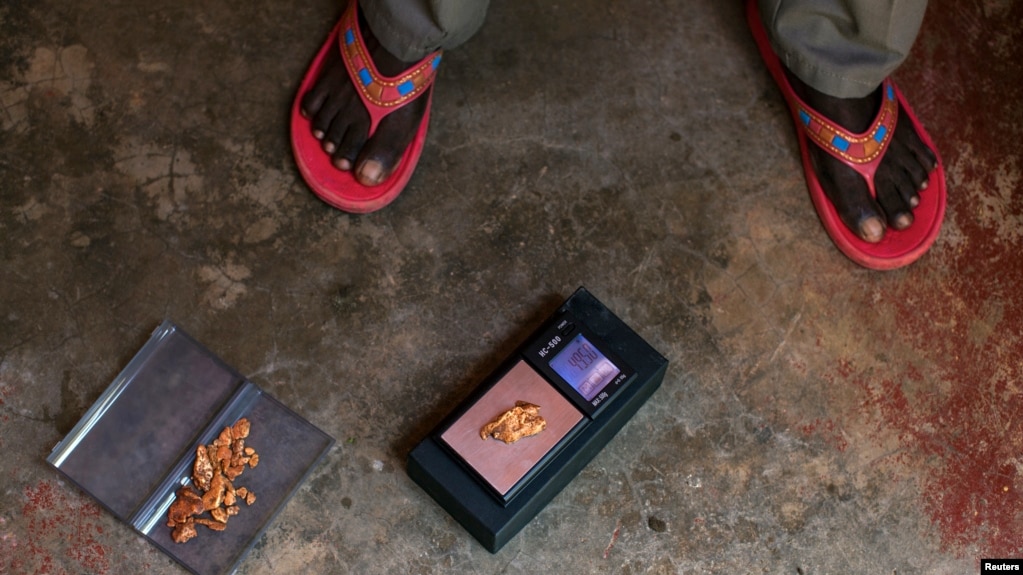
South Sudanese residents of Kapoeta state say they found a way to earn money to feed their families: selling gold. Gold mining is illegal in South Sudan, but locals say it is worth the risk of getting arrested, or buried. They say they might sell as much as 30 grams of gold in a week in a country where six million people are going hungry each day.
Gold is found in Kapoeta state’s Ngauro, Namurunyang, Kauto and Napotpot villages, all dozens of kilometers outside Kapoeta town.
A 20-year-old man whom VOA is identifying only as “Lokuru” for safety reasons is one of the local illegal gold miners in Kauto village, some 30 kilometers outside Kapoeta town. Lokuru said the amateur miners often dig down more than 20 meters to find gold.
“You can continue digging and the ground might even cover you. That is why people say it is God who is taking care of people. You continue digging deeper since you know it is something that can bring food when sold,’’ Lokuru told VOA’s South Sudan in Focus.
Once they are down that far, the miners dig sideways in search of the precious mineral. They collect a mixture of dirt and gold dust, place it in basins or bowls, slowly pour water over the top, and shake. If there are gold nuggets inside, they settle at the bottom.
Last week, Lokuru was looking for a customer to buy three grams of precious stones he recently found outside of Kapoeta.
“I came here to Kapoeta and found some white stones. I saw them gathered in one place. I started digging deeper into the ground and found other stones inside,” said Lokuru.
In the past, most Kapoeta residents did not know they could earn a living from the illegal trade of mining gold and depended entirely on keeping and selling livestock as their only source of livelihood.
In a place like South Sudan, gold mining can be extremely lucrative. Lokuru says 20 grams can sell for as much as 50,000 South Sudanese pounds.
Another amateur gold miner named “Mark,” said a friend introduced him to gold mining at Nahanak village. He told South Sudan in Focus his life has improved because of the lucrative gold trade.
“He taught me to dig this way and that for about two months and I was able to get 10 grams which I sold. I used that money for buying cows and goats which I now take to Juba,” Mark said.
At the same time, Mark emphasized that gold mining can be dangerous.
“In areas of Namurunyang the gold is far [underground]. People dig up to eight meters deep and if one gets [gold], everybody will get into that hole and the digging continues. Sometimes the hole will collapse and could bury even more than 10 people,” Mark said.
Kapoeta officials announced a ban on gold mining earlier this year. Locals were told if they have gold, to sell it directly to the state investment cooperative in Kapoeta. The state said it would pay 6,000 South Sudanese pounds per gram, or $33. ($1 U.S. = 180 South Sudanese pounds on the black market.)
Middlemen have smuggled gold out of the country to be sold in neighboring Uganda or Kenya, where a gram of pure gold fetches $35. According to a source who spoke on condition of anonymity for security reasons, the same quantity sold for $50 two years ago.
Kapoeta Deputy Governor Paul Langa told South Sudan in Focus it’s not easy to control illegal mining of gold in the state.
"The gold is everywhere, ranging from here up to the mountains of Didinga, down to Buya, so it is tremendously hard to control. This is the dust which anyone can just get. For example, when we were renovating the airstrip, the Murrum [paving material] we collected, children were able to mine gold out of it,” said Langa.
Newer articles:
- One last push to end South Sudan's deadly civil war - 14/12/2017 12:58
- Broke South Sudan hike fees, blocks aid despite appeal for cash - 14/12/2017 10:52
- UN Official: Peacekeepers in South Sudan Not Intervention Force - 14/12/2017 10:30
- South Sudan resumes issuing passports after month-long stoppage - 14/12/2017 06:00
- South Sudan: a Nation Tormented by a Crisis - 14/12/2017 05:37
Older news items
- South Sudanese church representatives call on Canada for policy and financial support - 13/12/2017 12:52
- South Sudan needs $1.7 billion humanitarian aid in 2018 - 13/12/2017 04:58
- South Sudan tightens security ahead of festive season - 12/12/2017 22:57
- Death toll rises to 172 in tribal clashes in central South Sudan - 12/12/2017 10:07
- In war-torn South Sudan, one town nurtures a small-scale peace - 11/12/2017 23:32
Latest news items (all categories):
- The Emerging Endgame of the Russo-Ukrainian War - 05/08/2026 22:59
- The changing face of “Made in China” - 05/08/2026 22:41
- UK - Change of His Majesty’s Ambassador to South Sudan: Rebecca Fabrizi - 05/08/2026 22:09
- South Sudan rewriting its future with eyes on agriculture and mining boom - 05/08/2026 21:53
- Moroccan king's letter confirms naming of major highway in honour of Trump - 05/08/2026 21:52
Random articles (all categories):
- Civil war in Sudan: 100 days of devastation and ongoing strife - 26/07/2023 03:24
- Sudan: End Violence in the Sudan - IGAD Asks Combatants - 11/07/2023 02:07
- Abyei residents choose South Sudan - 31/10/2013 18:46
- Over 25400 South Sudanese refugees return home since January: UN - 14/09/2020 17:41
- Human rights abuses and anti-democratic disinformation are hallmarks of Wagner, other mercenary groups in Africa - 09/08/2023 00:14
Popular articles:
- Who is the darkest person in the world, according to Guinness World Record? - 25/10/2022 02:34 - Read 148340 times
- School exam results in South Sudan show decline - 01/04/2012 17:58 - Read 27923 times
- Top 10 weakest currency exchange rates in Africa in 2023 - 19/07/2023 00:24 - Read 25006 times
- No oil in troubled waters - 25/03/2014 15:02 - Read 24330 times
- NDSU student from South Sudan receives scholarship - In-Forum - 29/09/2012 01:44 - Read 22287 times
