
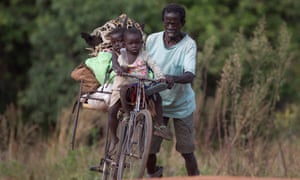
Imagine, if you will, a city the size of Birmingham with a population of a million or so. Now imagine that a disaster has befallen that metropolis, a brutal war that has caused its citizens to flee with little more than the clothes on their backs. Picture the lines of refugees heading west to find a place of safety, which they eventually find across the border in Wales. There, despite severe financial constraints, the million displaced people are met with warmth and generosity.
This is not a science-fiction story. Substitute South Sudan[1] for Birmingham and Wales for Uganda and you get an inkling of what is happening in one of the poorest parts of the world’s poorest continent.
The number of refugees globally has not been higher since the end of the second world war and a million of them have crossed from South Sudan into Uganda, mostly into the West Nile district. In all, an estimated two million people have been displaced by the civil war and ethnic cleansing that has been raging in the world’s newest country for the past four years. Approximately three quarters of South Sudan’s children are out of school – the highest number in the world.[2]
Unlike many western countries, Uganda[3] has not demonised the new arrivals. The government has given the refugees land and seeds in the belief that they will be better off making a new life for themselves than doing nothing in a camp.
Around half a million of the refugees that have crossed the border into Uganda from South Sudan[4] are children. They have been fleeing at the rate of one a minute for the past year, putting additional strain on an already stretched Ugandan education system. They are being educated in classes of up to 150, without text books and by teachers who speak a different language.
Western countries, including Britain, talk persuasively about how the only real way to reduce the flow of economic migrants out of Africa[5] is to provide them with an incentive to stay where they are. That means providing them with hope, which in turn means giving them a decent start in life through a decently funded education.
Likewise, the president of the World Bank, Jim Yong Kim, expressed concern back in April[6] that there were now two billion people living in parts of the world affected by fragility, conflict and violence. Kim predicted there would be serious consequences if the internet-fuelled aspirations of people living in developing countries were not met.
The South Sudan-Uganda refugee crisis is going to show whether these fine words mean anything. It is a test for donor governments, for the World Bank, for the United Nations and for the Global Partnership for Education, the international body that has the job of providing quality schooling for poor countries. Thus far, they have not exactly covered themselves in glory.[7]
According to Save the Children, donor governments have funded just 17% of the UN appeal for the South Sudan refugee response in Uganda this year. The UN appealed for $61.6m (£46.8m) for the education emergency, of which only a small fraction has been provided. As the charity notes, there has been quite a contrast between the response of the Ugandan government and that of the rest of the world. Uganda’s response has been extraordinarily generous. The response of the international community has “bordered on the derisory”.
To make matters worse, a Save the Children report adds that the funding provided has been short-term, unpredictable and focused on individual projects[8]. “This has made it impossible for the government of Uganda, UN agencies and national and international NGOs to plan for what has all the hallmarks of a protracted and systemic crisis requiring a long-term, predictable finance to underpin a credible programme. In effect, the international community has turned its back on some of the world’s most vulnerable children, leaving Uganda and host communities living in endemic poverty, to shoulder the responsibility alone.”
Fixing the problem would be relatively cheap: Save the Children estimates it would cost $132m a year for three and a half years to provide pre-primary, primary and secondary education for all the South Sudanese children living in Uganda. Given the numbers, this amounts to $152 per child annually – or less than $3 a week. Such a scheme would have the added benefits of employing refugee teachers from South Sudan and of strengthening the Uganda education system. At a time when aid spending is (rightly) filtered through the lens of whether it offers value for money, investing $500m in the education of South Sudanese refugee children is a colossal bargain.
Long-term funding sources are available. The World Bank has a special fund, the International Development Association[9], that provides grants and soft loans for the least developed countries. The IDA is replenished by donors on a three-yearly basis, 47 of whom agreed to provide $25bn for the current round of funding. A further $25bn is coming from the bank’s own resources, with a third $25bn being raised from the global financial market.
A welcome innovation in the new IDA round was the creation of a window for financing refugees and helping host country programmes. Some $2.5bn was set aside for precisely the sort of emergency that is happening in Uganda. It is time the bank pulled its finger out.
Likewise, the Global Partnership for Education has money allocated for South Sudan that is not being spent. This is hardly surprising given that half a million South Sudanese children are in Uganda and perhaps a further half a million are in other neighbouring countries. The Global Partnership for Education does not normally do cross-border funding, but these are not normal circumstances.
References
- ^ South Sudan (www.theguardian.com)
- ^ world’s newest country (www.theguardian.com)
- ^ Uganda (www.theguardian.com)
- ^ South Sudan (www.theguardian.com)
- ^ Africa (www.theguardian.com)
- ^ Jim Yong Kim, expressed concern back in April (www.theguardian.com)
- ^ World Bank (www.theguardian.com)
- ^ a Save the Children report adds that the funding provided has been short-term, unpredictable and focused on individual projects (www.savethechildren.org.uk)
- ^ the International Development Association (ida.worldbank.org)
Newer articles:
- Raids on Uganda show South Sudan's war spilling across its borders - 03/07/2017 07:51
- South Sudan's Wau, fear and displacement one year on - 03/07/2017 01:42
- Aid workers warn of 'devastating' cholera outbreak in South Sudan - 02/07/2017 13:53
- Sudan extends ceasefire ahead of expected lifting of U.S. trade embargo - 02/07/2017 13:47
- Sudan extends ceasefire in 3 conflict zones - 02/07/2017 12:43
Older news items
- South Sudan to consider restriction of aid workers from parts of the country - 01/07/2017 04:17
- International community not doing enough in South Sudan, specialists say - 01/07/2017 02:29
- Changing The Lives Of Disabled People In South Sudan: The Real Impact Of The Humanitarian Disability Charter - 30/06/2017 06:58
- Crowded hospitals and mothers in need: A male midwife on delivering babies in South Sudan - 29/06/2017 15:04
- As South Sudan's civil war rages, cholera takes deadly toll - 29/06/2017 11:20
Latest news items (all categories):
- Ramaphosa presses Kiir to implement peace deal ahead of South Sudan’s first elections - 09/10/2026 12:19
- South Sudan steps up Ebola alert after Kenya case - 09/10/2026 12:17
- Laotian man deported by U.S. to South Sudan leaves for Laos after year in detention - 09/10/2026 12:14
- Bullet and blast injuries … and a constant need for blood: inside South Sudan’s overwhelmed trauma wards - 09/10/2026 12:10
- MTN South Sudan and Regulator Pledge Cooperation to Expand Connectivity - 09/10/2026 12:01
Random articles (all categories):
- AU: South Sudan's Capture of Heglig Oil Field 'Illegal' - Voice of America - 13/04/2012 03:29
- South Sudan: Arms supplies fuelling violations in forgotten conflict - Amnesty International UK - 28/06/2012 14:28
- South accuses north of stalling on a number of key issues - 28/06/2009 11:11
- Juba Hotels demand $10m pay from S. Sudan's unity government - 06/01/2021 13:01
- Sudan coup: Military orders release of four civilian ministers - 05/11/2021 01:39
Popular articles:
- Who is the darkest person in the world, according to Guinness World Record? - 25/10/2022 02:34 - Read 150799 times
- School exam results in South Sudan show decline - 01/04/2012 17:58 - Read 28197 times
- Top 10 weakest currency exchange rates in Africa in 2023 - 19/07/2023 00:24 - Read 25310 times
- No oil in troubled waters - 25/03/2014 15:02 - Read 24535 times
- NDSU student from South Sudan receives scholarship - In-Forum - 29/09/2012 01:44 - Read 22494 times
