
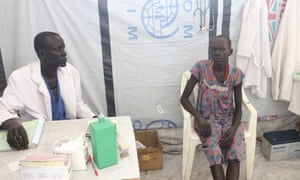
Doctors, aid workers and officials in South Sudan are warning of a “devastating” outbreak of cholera that could kill thousands of people in a country where millions are already threatened by famine.
[1]
More than 2,500 cases of the disease have been registered since April, a sharp increase over previous months. The total over the last year has now risen to 8,000, with about 250 confirmed deaths. Experts say this is likely to be only a fraction of overall toll.
With no sign that conflict in the world’s youngest country will abate soon, and with the population weakened by years of displacement and malnutrition, there are fears that cholera could spread out of control.
Medical staff fear an outbreak in hospitals. There are few functioning medical institutions in South Sudan[2] and these often care for three or four times the number of patients they were designed to accommodate.
At al-Shabbah children’s hospital in Juba, where a single bed is shared between three patients, three cases of suspected cholera were reported last week. “The fear is that such an infectious disease in this very overcrowded hospital could be devastating. The children are very weak and we don’t have enough drugs. The demand is huge,” said Dr Felix Nyungura, director of the hospital.
More than 200,000 people are living in “protection of civilian camps” set up by the UN to provide a haven for those displaced by the ongoing fighting across much of South Sudan. They too are threatened by the disease, which can kill in hours.
“Last year we had cholera incidents in the camp and now the rainy season is here cholera is the big concern,” said Thomas Makur, an administrator of a camp where more than 30,000 people live adjacent to the principal UN base in Juba, the capital.
People displaced by recent fighting are at most risk. The international NGO Médicins Sans Frontières has opened a cholera treatment centre near Pieri in the remote north-east of South Sudan[3].
More than 27,000 people have fled their homes in the region since mid-February after clashes between the Sudan People’s Liberation Army (SPLA) and opposition groups.
South Sudan map[4]Last week the UN said the number of people struggling to find enough food each day in South Sudan had grown to 6 million – up from 4.9 million in February.[5] This was the highest level of food insecurity in the country since it gained independence from Sudan in 2011 after decades of intermittent conflict.
Though South Sudan has suffered drought, the crisis has political rather than climatic causes. Violence surged last year after a peace deal[6] between President Salva Kiir and his rival Riek Machar collapsed. Machar has now fled the country, but groups loyal to him continue to fight government forces. The government’s authority is limited, with widespread and increasingly chaotic conflict between local factions, cattle raiding and armed robbery.
Almost all protagonists in the fighting have been repeatedly accused of systematic and extensive human rights abuses.
There is a strong ethnic dimension to the violence, with civilians frequently targeted because of their tribe. Kiir and Machar come from rival ethnic groups. Civilians who have fled the violence to neighbouring countries say government troops, mostly drawn from Kiir’s Dinka tribe, carry out killings and other crimes against Machar’s Nuer and other smaller tribes suspected of supporting rebels.
A UN report last year described evidence of widespread atrocities against civilians including massacres, gang rape, abduction of children, unlawful detention and torture. The government has rejected its findings.
Senior UN officials say the combination of violence, ethnic strife, lack of development, climatic factors and international neglect in South Sudan is unmatched anywhere in the world.
“There are dead ends all around … I think we can still do something but we desperately need international pressure on the parties to go back to the table and be serious about peace,” Filippo Grandi, the head of the UN high commission for refugees, said last week.
Aid workers were struggling to raise funds, partly because of frustrations over the lack of progress in peace talks and partly because the scale of the problem was hidden, Grandi said during a visit to Juba.
“They [South Sudan’s refugees] don’t arrive on the shores of Europe, or Australia or at the border between Mexico and the US. Those are the places where refugees become visible and their voices are heard,” he said.
In an interview with the Guardian, David Shearer, the top UN official in South Sudan, underlined the logistical problems of operating in the country.
“No one quite realises the logistical hassles of this place. You can’t even move around. Travelling the 600 miles … takes two and a half weeks. In the wet season the roads are just impassable. There are 220 kilometres of tarmac roads in a country the size of France,” Shearer said.
More than 2 million people have fled South Sudan, with more than a million now living in neighbouring Uganda.
References
- ^ millions are already threatened by famine. (www.theguardian.com)
- ^ South Sudan (www.theguardian.com)
- ^ has opened a cholera treatment centre near Pieri in the remote north-east of South Sudan (reliefweb.int)
- ^ South Sudan map (interactive.guim.co.uk)
- ^ had grown to 6 million – up from 4.9 million in February. (www.un.org)
- ^ peace deal (www.theguardian.com)
Newer articles:
- The Devastating Human Cost of Famine in South Sudan - 04/07/2017 09:55
- UN says South Sudan gunmen seize 8 foreign, local workers - 04/07/2017 04:14
- Barefoot and alone, children flee brutal S. Sudan war - 03/07/2017 22:30
- Raids on Uganda show South Sudan's war spilling across its borders - 03/07/2017 07:51
- South Sudan's Wau, fear and displacement one year on - 03/07/2017 01:42
Older news items
- Sudan extends ceasefire ahead of expected lifting of U.S. trade embargo - 02/07/2017 13:47
- Sudan extends ceasefire in 3 conflict zones - 02/07/2017 12:43
- South Sudan's million-strong refugee crisis is a test for the World Bank - 02/07/2017 05:20
- South Sudan to consider restriction of aid workers from parts of the country - 01/07/2017 04:17
- International community not doing enough in South Sudan, specialists say - 01/07/2017 02:29
Latest news items (all categories):
- Ramaphosa presses Kiir to implement peace deal ahead of South Sudan’s first elections - 09/10/2026 12:19
- South Sudan steps up Ebola alert after Kenya case - 09/10/2026 12:17
- Laotian man deported by U.S. to South Sudan leaves for Laos after year in detention - 09/10/2026 12:14
- Bullet and blast injuries … and a constant need for blood: inside South Sudan’s overwhelmed trauma wards - 09/10/2026 12:10
- MTN South Sudan and Regulator Pledge Cooperation to Expand Connectivity - 09/10/2026 12:01
Random articles (all categories):
- Documents : New signed re-dedication to the cessation of hostilities (09-11-2014) - 13/11/2014 12:50
- Cecafa Cup: Sudan beat South Sudan on penalties - 01/12/2015 04:33
- [video] Uganda - South Sudan look to bridge trade troubles - 09/07/2023 13:51
- Socio-Political aspect of inter-communal conflict in South Sudan’s local communities - 14/04/2020 12:01
- Rebel Group Being Led By A Woman Emerging In South Sudan - 29/12/2018 20:47
Popular articles:
- Who is the darkest person in the world, according to Guinness World Record? - 25/10/2022 02:34 - Read 150836 times
- School exam results in South Sudan show decline - 01/04/2012 17:58 - Read 28205 times
- Top 10 weakest currency exchange rates in Africa in 2023 - 19/07/2023 00:24 - Read 25312 times
- No oil in troubled waters - 25/03/2014 15:02 - Read 24538 times
- NDSU student from South Sudan receives scholarship - In-Forum - 29/09/2012 01:44 - Read 22501 times
