
This article is part of HuffPost’s Project Zero campaign, a yearlong series on neglected tropical diseases and efforts to fight them.[1]
JUBA, South Sudan ― It took days for Maker Achuil and others to slowly pull the arm-length, spaghetti-like worm out of his thigh. After a year with the white parasite inside him, Achuil screamed in pain as the grown Guinea worm[2] emerged.
A former soldier in South Sudan, which fought for decades before gaining its independence from Sudan in 2011, Achuil still shudders at the memory of the agony he felt as the worm was gradually wound around a stick.
“It was like putting a cigarette out on your leg ― for days,” said Achuil, rolling up his trouser to show the scars from the burning fluids the worm excreted as it burrowed out to breed. “It made you exhausted, but you were in too much pain to sleep. All you wanted to do was swim in the lake to cool the pain.”
The Carter Center
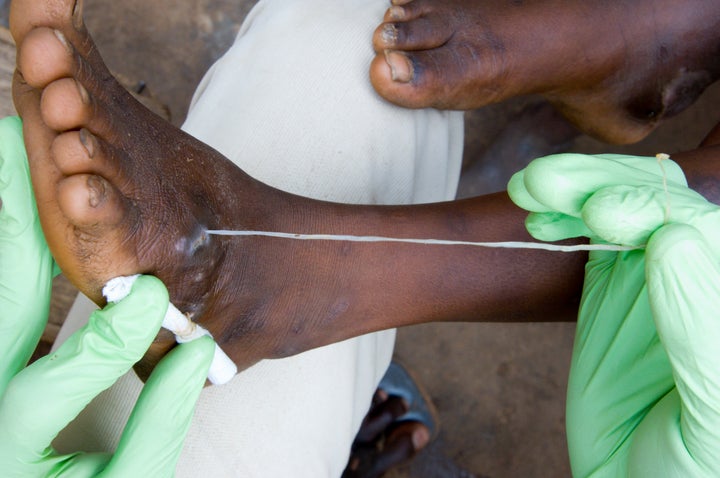
A Guinea worm emerges from a patient's foot.The worms, which resemble stretched chewing gum, lay their microscopic young in stagnant water. People drink the water and ingest the worms, which grow and mate inside the host for about a year. The male dies and the female starts to dig its way out through the human host’s flesh. When that person submerges the affected area in water, say, to bathe or to dull the burning pain, the worm spews out its young.
Guinea worm disease was once common across Africa and Asia[3], with an estimated 3.5 million cases in 1986. But in the mid-1980s, the global health community launched a campaign to eliminate the disease, and today it’s limited to pockets of Africa.
Last year only a handful of cases[4] were reported in three countries ― Chad, Ethiopia and South Sudan ― and health experts are confident they can finally slay the worm for good. The fight in South Sudan, once a stronghold of the crippling parasite, could be won soon, despite a brutal civil war that has engulfed that country since 2013.

The Carter Center/L Gubb
Two children, whose feet were bandaged after being treated for Guinea worm, look at an illustrated book about the disease.“We are on the very edge of breaking transmission in South Sudan,” said Makoy Samuel Yibi, who heads the worm eradication program at the nation’s ministry of health. “We are in sight of the end.”
Scientifically, the worms that infect humans are known as Dracunculus medinensis. Historians believe it has been around since ancient times and is mentioned in the Bible’s Old Testament as the “fiery serpent[5].”
If the Guinea worm is made extinct, it would represent the very first parasitic disease ever to be eradicated, and only the second human disease to be wiped out (after smallpox).
Yibi, a soft-spoken man, has dedicated his life to ending this parasitic disease. The health official remembers how in his home village of a few hundred people, at least 50 individuals every year were so debilitated by the pain of the worms that they could not farm their fields.
“It tormented people, deformed them, but they did not talk about it,” he said.
Now across South Sudan, the local efforts led by Yibi have driven down the number of cases by over 90 percent in the past three years. Just six cases were reported[6] in 2016, compared to 70 cases in 2014.
Ethiopia saw only three cases last year, and Chad was hit with just 16.
“The progress we have seen in restricting Guinea worm disease to these few cases in only three countries is a testament to the dedication of people in endemic areas to caring for their health and that of their communities,” said Dr. Dean Sienko, vice president of health programs at the Carter Center.
The Carter Center/L Gubb
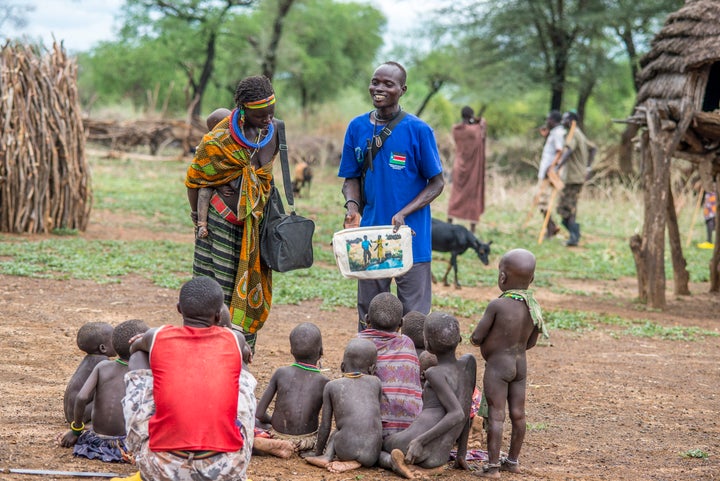
A health worker in South Sudan uses a picture book to teach children and adults how to avoid contracting Guinea worm disease.The Atlanta-based center ― which was founded by former President Jimmy Carter and his wife, Rosalynn ― has helped coordinate the decades-long global campaign to finally wipe the disease from the world map[7], including brokering a legendary three-month ceasefire[8] in 1995 in what is now South Sudan to make sure the Guinea worm eradication program would survive.
“People have lived with this for generations,” Yibi said. “We are hoping that in 2017, we will probably get to zero.”
While there is no direct medication for the disease, the worm’s breeding cycle can be broken by ensuring that infected people do not enter bodies of water ― especially those used for drinking water ― while the worm is working its way out of the skin.
The cycle can also be broken by giving people access to cleaner water sources or by cleaning the water before they drink it. In South Sudan, people have been encouraged to use water filters to avoid swallowing the worm’s eggs.
It has been a long, hard process, said Yibi, but “now when I go back to a village where Guinea worm was once common and ask if there are cases, the people shout, ‘No! We don’t want to even hear its name. That is dead and gone to us.’”
The Carter Center/L Gubb
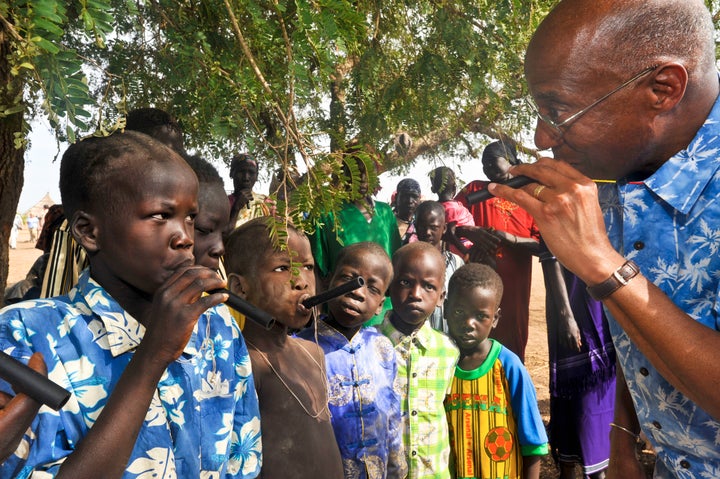
The Carter Center's Dr. Donald Hopkins shows South Sudanese children how to use plastic water filtration pipes.Ironically, even as so many other species face extinction due to humankind’s excesses, this human-reliant species is finding new ways to survive. In Mali, which last year reported no Guinea worm cases for the first time in 25 years[9], health workers have found dogs infected with the parasite. The worms have also been boring their way into dogs in Chad.
Still, health experts remain optimistic.
Dr. Donald Hopkins is the architect of the Guinea worm eradication campaign that started in the 1980s. He serves as the Carter Center’s special adviser on Guinea worm and also worked on the campaign to end smallpox. Those infections in animals are just “another puzzle to be solved,” he said.
“We’ve navigated plenty of challenges, including wars, over the 30 years we’ve been working to eradicate Guinea worm,” Hopkins said.
The worm’s centuries of agonizing pain may soon be consigned to history.
The Carter Center/L Gubb
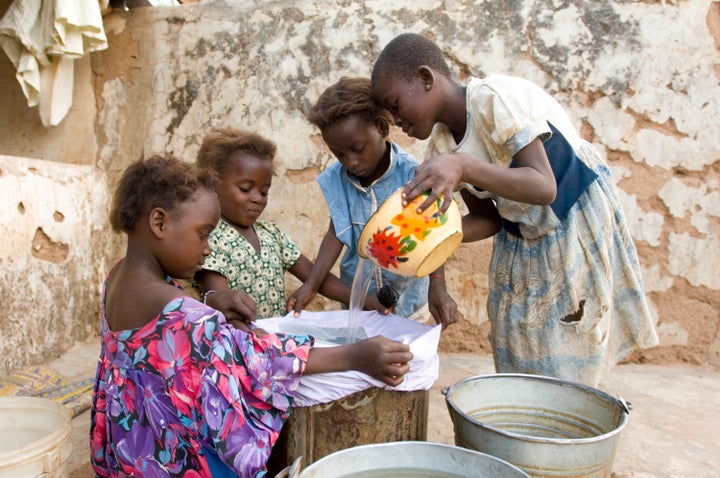
Girls who previously suffered from Guinea worm filter their drinking water to prevent the disease.The Carter Center is the recipient of grants from the Bill & Melinda Gates Foundation, which also supports this HuffPost series. All content is editorially independent, with no influence or input from the foundation.
If you’d like to contribute a post to the series, send an email to
References
- ^ Project Zero (www.huffingtonpost.com)
- ^ Guinea worm (www.who.int)
- ^ once common across Africa and Asia (www.cartercenter.org)
- ^ only a handful of cases (apnews.com)
- ^ fiery serpent (www.who.int)
- ^ six cases were reported (www.who.int)
- ^ wipe the disease from the world map (www.cartercenter.org)
- ^ three-month ceasefire (www.cartercenter.org)
- ^ no Guinea worm cases for the first time in 25 years (www.huffingtonpost.com)
Newer articles:
- Alarming rise in South Sudanese children fleeing to Uganda: aid group - 18/05/2017 08:45
- A day in the life of Juba's bicycle water vendors - 18/05/2017 01:42
- South Sudan: Inside Africa's largest refugee crisis - 17/05/2017 10:22
- Rebels attack South Sudan’s Yei, four soldiers dead - 17/05/2017 02:53
- South Sudan President Restructures SPLA leadership - 16/05/2017 15:19
Older news items
- South Sudan: Wife of exiled rebel leader warns 'genocide in progress', calls for Australian aid - 16/05/2017 03:57
- South Sudan: UN, partners seek $1.4 billion for 'world's fastest growing refugee crisis' - 15/05/2017 09:17
- South Sudan has been struck by famine. This is how a Christian charity is helping - 15/05/2017 09:14
- Fears of a second lost generation amid South Sudan conflict - 15/05/2017 09:00
- South Sudan President Assumes He Will Find 'Best Friend' in Trump, Says Senator - 14/05/2017 23:33
Latest news items (all categories):
- South Sudan Opens 14 Oil Blocks, Courts Investors Ahead of SSOP 2026 - 26/10/2026 15:08
- Jambojet Explores South Sudan Expansion After Talks with Juba Regulator - 26/10/2026 15:05
- Kiir swears in 5 officials ahead of South Sudan elections - 26/10/2026 14:53
- South Sudan cattle battles leaves 10 dead: official - 26/10/2026 14:49
- Churches urge world 'not to forget South Sudan' ahead of first elections - 26/10/2026 14:47
Random articles (all categories):
- US Calls on Sudan’s Army, RSF to Cease Fighting Immediately - 20/10/2023 03:50
- Conference Invitation : Achieving a sustainable peace in South Sudan, a community perspective - 16/07/2015 18:43
- اشتباكات لونقشوك… هل تعود الحرب الأهلية إلى جنوب السودان؟ - 03/09/2025 18:55
- Western nations call on South Sudan neighbors to impose arms embargo - 05/02/2018 08:07
- South Sudan government has agreed to end hostilities, regional leaders say - 27/12/2013 17:11
Popular articles:
- Who is the darkest person in the world, according to Guinness World Record? - 25/10/2022 02:34 - Read 151300 times
- School exam results in South Sudan show decline - 01/04/2012 17:58 - Read 28392 times
- Top 10 weakest currency exchange rates in Africa in 2023 - 19/07/2023 00:24 - Read 25497 times
- No oil in troubled waters - 25/03/2014 15:02 - Read 24703 times
- NDSU student from South Sudan receives scholarship - In-Forum - 29/09/2012 01:44 - Read 22678 times
