
United Nations Security Council members have unanimously called on South Sudan's leaders to prioritize the needs of the South Sudanese people, but disagree over the main causes of the famine in parts of the country.
At a Thursday briefing in New York, United Nations Secretary-General Antonio Guterres warned Security Council members that the humanitarian crisis "continues to deepen." The U.N. chief told the council 100,000 South Sudanese are affected by famine, another one million are on the verge of famine, and more than 5 million may be severely food insecure by this summer.
"Yet despite the alarm sounded by the United Nations and the international community over this crisis, the government has yet to express any meaningful concern or take any tangible steps to address the plight of its people," Guterres said.
Guterres added that what he hears most often are denials and a refusal by South Sudan's leaders to fulfill responsibilities to end the crisis, or even acknowledge what is happening on the ground.

Bags of food dropped by air from a World Food Program plane are sorted in Padeah, South Sudan. South Sudanese who fled famine and fighting in Leer county emerged from South Sudan's swamps after months in hiding to receive food aid.
South Sudan promises to work with UN
South Sudan's deputy permanent representative to the U.N., Ambassador Joseph Moum Majak Ngor Malok, assured the council that his government would cooperate with the U.N. to resolve the issues affecting his country.
He also claimed that changing weather patterns are largely to blame for South Sudan's food insecurity, and categorically denied his government has intentionally starved certain people, leading to the famine in parts of former Unity State.
"The government takes issue with the accusation that it is responsible for [the famine]. It is also important to note that other parts of the country affected by drought as a result of climatic changes," said Moum.
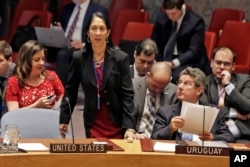
U.S. Deputy Permanent Representative to the U.N. Michele Sison arrives for the Security Council meeting of the United Nations, Feb. 2, 2017.
Weather to blame?
Russian Deputy U.N. Ambassador Petr Illichev made similar remarks, telling the council the famine was "linked not just to problems with security, but also with inclement weather conditions."
The U.S. Deputy Permanent Representative to the U.N., Michele Sison, shot down that assertion, insisting the famine is not a result of drought.
"It is the result of leaders more interested in political power and personal gain than in stopping violence and allowing humanitarian access," Sison said.
The South Sudanese government's "continued and uncontainable impediments to humanitarians trying to reach famine-stricken populations may amount to deliberate starvation tactics," Sison said.
The U.S. diplomat reminded council members that the option for an arms embargo is still on the table.
"Our unanimously adopted sanctions resolution gives us the ability to designate individuals whose actions or policies threaten peace in South Sudan," said Sison.
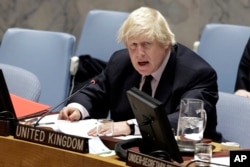
Britain's Foreign Minister Boris Johnson addresses the U.N. Security Council on Somalia, March 23, 2017.
British cite brutal cycle of violence
British Foreign Secretary Boris Johnson told council members that just last month, the brutal cycle of raiding, retaliation, and counter-retaliation drove an estimated 80,000 people to flee their villages.
He added that the proposal for a hybrid court for South Sudan, as agreed to in the 2015 peace agreement, must be established so that those responsible for atrocities and other crimes face justice.
"And we should acknowledge that a terrible failure of political leadership lies behind the bloodshed," Johnson said.
Women and children are the majority of South Sudanese displaced by the continued fighting in the country. Betty Sunday, coordinator of the Women's Monthly Forum on Peace and Political Process on South Sudan, told the council crimes continue to be committed against South Sudanese women.
"If the peace agreement was implemented, women could go about their lives without fear, their children could go to school, and they could collect food and tend to their gardens," said Sunday.
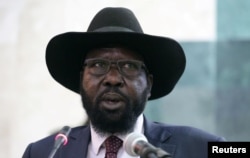
South Sudan's President Salva Kiir addresses the second session of the Transitional Government of National Unity at the Parliament in Juba, Feb. 21, 2017.
Call for inclusive government
Guterres said the government continues to impede access to humanitarians delivering lifesaving assistance.
He said an inclusive political process is a crucial aspect to moving the country forward.
As for the national dialogue President Salva Kiir announced late last year, the U.N. boss said "credible dialogue cannot take place at the point of a gun."
Guterres told the council that when civil society and opposition members "cannot meet or speak freely, when a significant proportion of the population cannot participate in the discussions, and when numerous communities are displaced or facing starvation, dialogue efforts are unlikely to succeed."

Festus Mogae addresses the 62nd session of the United Nations General Assembly, Sept. 26, 2007.
Cease-fire is not being respected
The chairman of the Joint Monitoring and Evaluation Commission (JMEC) also briefed the council Thursday. Festus Mogae said there is moderate progress in the implementation of the 2015 peace deal, but he said the parties to the agreement are not respecting the cease-fire deal.
"The situation is slipping out of control. It is time now for the international community to condemn in the strongest possible terms the violence, the killing, the human rights abuses and the destruction of homes. We must now stand together and do something about it," Mogae said.
The former president of Botswana said his office has received reports of fighting between government forces, rebels and other armed groups in various parts of South Sudan.
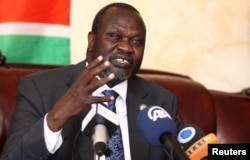
South Sudan's rebel leader Riek Machar addresses a news conference in Ethiopia's capital Addis Ababa, Oct. 18, 2015.
Civilians under attack in some counties
Aid agencies operating in South Sudan have reported cases of serious attacks by government forces on civilians in Leer, Mayendit and Wau Shilluk counties in the former Upper Nile State.
Mogae said government forces and rebels are actively fighting in the Unity and Upper Nile areas of South Sudan.
"The cease-fire and transitional security arrangement monitoring mechanism now reports deliberate planned conflict between the main parties to the agreement, the SPLA IG and the SPLA-IO (In Opposition) loyal to Dr. Riek Machar, as well as other emerging groups engaged in the destruction of lives and communities, in total violation of the cease-fire agreement," Mogae said.
The JMEC chief said the recently declared famine is a direct result of insecurity, armed violence and political exclusion from the peace process. He said peace can come to South Sudan if South Sudanese see their interests are being addressed by their leaders.
Disaster is near
Mogae urged the international community to move swiftly to avoid a complete disaster in South Sudan.
"We must urgently look again at all possible practical measures that we can take to alleviate the desperate suffering that millions of people are facing every day. All parties to the agreement are failing in their basic duty to protect the South Sudanese people," Mogae said.
Mogae also said he is still waiting to hear from the African Union on progress in establishing a Hybrid Court for South Sudan. He said collective efforts are needed to urgently address the country's worsening situation.
"And in the face of the ever-worsening situation, I believe that only a resolute and unified approach by IGAD, the African Union, United Nations and the international community as a whole can restore hope to the people of South Sudan," Mogae said.
Newer articles:
- Rape reaches 'epic proportions' in South Sudan's civil war - 25/03/2017 02:15
- UN Security Council again eyes sanctions on South Sudan - 25/03/2017 02:15
- South Sudan's Children Need Us To Take Action Now - 24/03/2017 15:24
- South Sudan famine: Russia and US disagree on where blame lies - 24/03/2017 08:10
- South Sudan bishop appeals for urgent humanitarian action - 24/03/2017 07:38
Older news items
- UN's South Sudan inquiry gets wider powers to pursue abuses - 24/03/2017 06:26
- UN’s South Sudan inquiry gets wider powers to pursue abuses - 24/03/2017 01:00
- U.S. warns South Sudan govt against 'deliberate starvation tactics' - 23/03/2017 15:15
- South Sudan rebels kidnap eight local aid workers - 23/03/2017 11:47
- South Sudan: The Tragedy Of Africa’s Ethnic Convulsion - 23/03/2017 01:00
Latest news items (all categories):
- South Sudan can leverage China’s AI path to bridge the digital divide - 16/09/2026 16:04
- Credible Elections Are No Longer Possible in South Sudan - What Next? - 16/09/2026 15:59
- South Sudan's president replaces electoral chief three months before scheduled polls - 16/09/2026 15:56
- Turkish Airlines is pulling out of 5 African routes, including South Sudan - 16/09/2026 15:23
- ‘Super El Niño’ deepens hunger crisis in South Sudan – WFP - 16/09/2026 15:19
Random articles (all categories):
- Kinshasa, Kigali row spells trouble for regional economic recovery - 12/11/2022 00:20
- U.S. condemns effort to extend South Sudan president's term - 05/07/2018 20:27
- UN food delivery to South Sudan resumes - 29/12/2014 12:56
- South Sudan's security bill allowing warrantless arrests becomes law - 25/08/2024 10:40
- EU aid chief says race against rain to stop famine in South Sudan - 16/04/2014 10:38
Popular articles:
- Who is the darkest person in the world, according to Guinness World Record? - 25/10/2022 02:34 - Read 149589 times
- School exam results in South Sudan show decline - 01/04/2012 17:58 - Read 28114 times
- Top 10 weakest currency exchange rates in Africa in 2023 - 19/07/2023 00:24 - Read 25196 times
- No oil in troubled waters - 25/03/2014 15:02 - Read 24464 times
- NDSU student from South Sudan receives scholarship - In-Forum - 29/09/2012 01:44 - Read 22414 times
