
Women and children are being slaughtered in South Sudan [1]by soldiers who said to be using knives for the massacres to save their ammunition.
The brutal conflict, sparking UN warnings over ethnic cleansing, is driving a devastating famine [2]that is threatening millions with starvation in the country.
One woman who fled violence in the city of Yei told how she saw her best friend and her children, including three-month-old baby, butchered.
“The children and the elderly, they slaughtered them,” Sylvia, 31, told Save the Children aid workers.
“When the armed groups get you with your children, they will kill all of you.
“They will take you from your homes and slit your throat. For the small children they stab them, then they die later.
“I've seen children tied to their dead mother and thrown in the river - soldiers have been doing this a lot.”
Sylvia fled after seeing her best friend murdered, taking in a baby girl she found abandoned at the roadside on her journey to neighbouring Uganda.
“When we began our journey, I saw with my own eyes two boys and one woman…they had been slaughtered,” she added, saying soldiers were using knives to save bullets.
“Children weren’t going to school, there was hunger everywhere. Children would die of illness.”
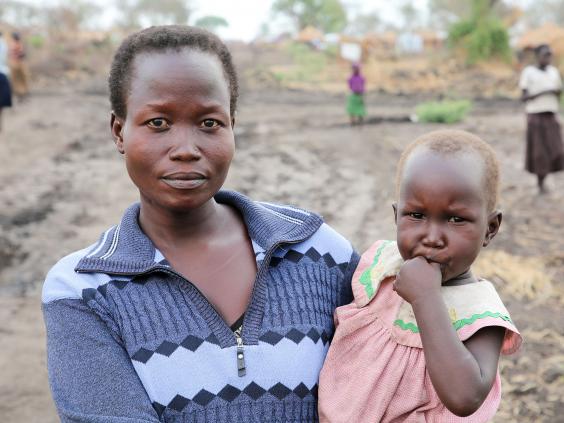
Sylvia, 31, left South Sudan after seeing her best friend and three month old baby slaughtered (Simon Edmunds/Save the Children)
A famine was declared in parts of South Sudan[3] last month in the first such catastrophe the world has seen in six years.
More than 5.5 million people – almost half the population – will not have a reliable source of food by July in what the UN says is a worsening man-made crisis, driven by the conflict and worsened by government inaction.
The world's youngest nation has been mired in civil war since 2013, when President Salva Kiir fired his deputy Riek Machar, sparking a war that has increasingly split the country along ethnic lines.
Fighting, massacres, looting and village burning has killed tens of thousands, caused widespread hunger and forced three million people from their homes – pitting Kiir's Dinka ethnic group against Machar's Nuer.
A report presented to the UN Human Rights Council in Geneva on Tuesday concluded that both government forces and non-state groups were targeting civilian populations on the basis of their ethnic identity with killings, abductions, gang rape and sexual violence on an “epic” scale.
Joy, a 14-year-old girl, was eight months pregnant when she travelled 50 miles to safety over four days in scorching heat.
“We ran away because the war has turned up on us as civilians,” she said.
“When they come, they come to slaughter you with a knife or a machete. We could not wait for that to happen.”
She left her mother and relatives in their home town, where there have since been reports of the entire population being massacred.
Joan, a village midwife who travelled with the teenager, recounted armed groups coming to rape young girls.
“Ten men can sleep with one woman, no problem if you die,” she added. “When you are a woman they rape you and kill you, we are much safer here.”
A UN survey found 70 per cent of women living in “protection of civilian camps” in the South Sudanese capital of Juba had been raped, the vast majority by police or soldiers, while a staggering 80 per cent had been forced to watch someone else being assaulted.
Thousands of refugees are pouring over the border every day into Uganda, where more than 500,000 people have arrived since last July, with almost 90 per cent women and children.
It has become Africa’s largest refugee country, seeing more than 1.5 million people flee their homes since the conflict erupted in South Sudan in December 2013.
A report by the Commission on Human Rights in South Sudan found that “ethnic cleaning is underway” in South Sudan amid a huge increase in human rights violations and abuses since a fresh wave of violence started in July.
A government redrawing of state borders has depopulated ethnic Shilluk and Nuer inhabitants of the Upper Nile region, with one incident seeing around 2,000 mostly Dinka people transported to Wau Shilluk town after fighting caused its residents to flee.
The UN has warned that the “indicators of genocide are in place”, [4]with the conflict acting as a smoke-screen for abuses, mainly committed by the Sudan People's Liberation Army (SPLA) and government security forces, but also by the SPLA Movement in Opposition (SPLM-IO).
The commission found that a “scorched earth policy” was exacerbating the famine by preventing humanitarian access by the UN and humanitarian agencies, while sexual violence on an industrial scale has become entrenched amid a culture of impunity.
Yasmin Sooka, chair of the Commission on Human Rights in South Sudan, called for investigations to immediately start documenting atrocities to allow future prosecutions.
“The famine is entirely manmade,” she told The Independent. “The escalating conflict in the country, lack of humanitarian access and increased displacement of people is a direct root cause of famine. What we’re seeing is catastrophic.”
Ms Sooka said that as well as funding, UN agencies need the government to provide access, and to reverse a hike in work permit fees of 100-fold for foreign aid workers to $10,000 (£82,000).
“That’s crazy because these are the people who are meant to assist you but you’re making it very difficult for them to do their work,” she added.
“Unless you have an end to the conflict and a genuine commitment to a political process that brings all of the parties together, you’re not going to see the end of the tunnel in South Sudan.
“The reasons these violations continue is because everybody knows they can get away with it, and until you set up an accountability mechanism to deal with the perpetrators there’s not going to be a change.”
The Disasters Emergency Committee is launching an emergency appeal to help 16 millions people facing malnutrition and starvation in East Africa, with the British Government matching the first £5 million donations pound for pound.
Priti Patel, the International Development Secretary, said UK aid was already funding food, water and emergency healthcare but more support is urgently needed to prevent a “catastrophe”.
“The international community must now follow global Britain’s lead to save lives and stop the famine before it becomes a stain on our collective conscience,” she added. “The world cannot afford to wait.”
To make a donation to the DEC East Africa Crisis Appeal visit www.dec.org.uk, call the 24-hour hotline on 0370 60 60 610, donate over the counter at any high street bank or post office, or send a cheque. You can also donate £5 by texting the word SUPPORT to 70000.
Reuse content[5]References
- ^ South Sudan (www.independent.co.uk)
- ^ famine (www.independent.co.uk)
- ^ famine was declared in parts of South Sudan (www.independent.co.uk)
- ^ “indicators of genocide are in place”, (www.independent.co.uk)
- ^ Reuse content (www.bing.com)
Newer articles:
- South Sudan ambush on humanitarian aid convoy kills 2 - 16/03/2017 08:40
- South Sudan 'will not pay $1m ransom' for Indian engineers kidnapped by rebels - 16/03/2017 06:11
- Escalation of fighting in South Sudan 'very worrying' - 16/03/2017 01:57
- ‘Strong Women Cannot Be Shaken’: South Sudan’s Refugee Sisterhood - 15/03/2017 11:08
- South Sudan gunmen 'kill 28' in Ethiopia - 15/03/2017 08:50
Older news items
- 'Last time I got food, armed men took everything': famine in South Sudan - 15/03/2017 00:34
- South Sudan, African Union stalling on human rights court: U.N. - 14/03/2017 23:06
- Why The Famine In South Sudan Keeps Getting Worse - 14/03/2017 14:20
- African Union appeasing South Sudan by failing to prosecute: U.N. - 14/03/2017 11:16
- UN expert warns of South Sudan 'population engineering' - 14/03/2017 11:08
Latest news items (all categories):
- Juba commissioner denies chasing foreigners - 07/10/2026 14:36
- Australia: 19-year-old from South Sudan arrested over a wild joy ride - 07/10/2026 14:33
- South Sudan’s aid crisis deepens as food stocks run low - 07/10/2026 14:29
- South Sudan’s Juba warns foreigners against running small-scale businesses - 07/10/2026 14:25
- Peace Dialogues foster social cohesion in Nyirol County after persisting tensions - 07/10/2026 14:23
Random articles (all categories):
- Sudanese priest shot dead in broad daylight - 26/06/2026 13:45
- China says hopes for better ties with South Sudan - 23/02/2012 08:59
- Upper Nile denies demanding former Sudan's FM to leave - 22/04/2008 10:19
- Should Bangladesh Lease Land from South Sudan? - 11/02/2022 12:20
- Sudan to reopen border with South Sudan: state media - Reuters - 07/10/2012 15:09
Popular articles:
- Who is the darkest person in the world, according to Guinness World Record? - 25/10/2022 02:34 - Read 150670 times
- School exam results in South Sudan show decline - 01/04/2012 17:58 - Read 28189 times
- Top 10 weakest currency exchange rates in Africa in 2023 - 19/07/2023 00:24 - Read 25301 times
- No oil in troubled waters - 25/03/2014 15:02 - Read 24531 times
- NDSU student from South Sudan receives scholarship - In-Forum - 29/09/2012 01:44 - Read 22491 times
