
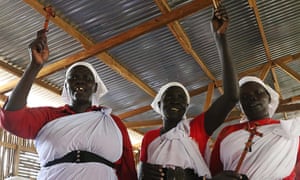
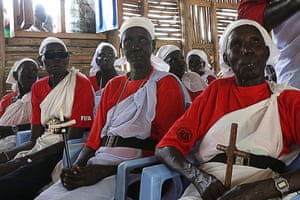
Dressed in red and white and holding wooden crosses in their hands, members of the Youth Mama choir raise their voices in unison.
“All nations will have peace,” the group chants in the Nuer language as music blasts from the sound system powered by a generator in this improvised church, built from wooden poles and corrugated iron sheets, in the South Sudanese capital Juba.
Youth Mama is no ordinary church choir. Consisting mostly of women, it has become famous for its inter-tribal composition and multilingual performances. The choir’s mission is simple: to unite and reconcile South Sudan’s 64 tribes. But after two years of conflict in which tens of thousands of people have died and more than two million have been displaced, it is is a daunting task.[1][2]
The choir was established in 2003 in Kakuma, Kenya, at a refugee camp for South Sudanese people fleeing the second civil war, which lasted from 1983 to 2005. As a melting pot of tribes and Christian denominations, Kakuma served as an incubator for the vision of peaceful coexistence.
Youth Mama started out as a prayer group, but its members soon discovered music was the most effective way of spreading their message. “All the churches are different and they have a different way of practising, but by singing, we could overcome that,” said Peter Mabior, the choir’s founder and priest at the Episcopal Church of South Sudan[3].
Following the 2005 peace agreement, which eventually ushered in South Sudan’s independence in 2011[4], the choir started organising road shows nationwide. Walking on foot for days to reach remote areas in Jonglei and Lakes, states known for frequent inter-communal clashes, the choir chanted songs of peace in different languages.
“When we march through South Sudan, you can really see the people come together,” says Mabior. Through its performances, Youth Mama’s popularity rose and its membership swelled to more than 2,000.
But with the onset of the most recent crisis, many of the choir’s peace building efforts came to a halt. The latest fighting began in December 2013 amid a power struggle between President Salva Kiir, a Dinka, and the former vice-president Riek Machar, a Nuer. It quickly acquired the traits of an ethnic conflict as both sides mobilised armed support along partly tribal lines.
When I bring together the [different tribes] some people don't like it, as they benefit from the fighting
Bishop Nathaniel Garang
As ethnicity became politicised, the work of grassroots reconciliation groups such as Youth Mama grew more difficult. “When I bring them together, the Nuer and the Dinka and the Murle and the Anuak, there are some people who don’t like that … because they benefit from the fighting,” says Bishop Nathaniel Garang, the leader of Youth Mama.
Most of Youth Mama’s Nuer members fled the capital Juba and the Dinka town of Bor. Few have returned since. “When the crisis began, people scattered, searching for safety. We haven’t been able to come together again,” said Gabriel Deng Zacharia, Youth Mama’s 29-year-old secretary.
Near Emmanuel Cathedral in Bor, Youth Mama’s multilingual school – which once taught tribal languages to foster understanding among tribes – stands deserted. Due to insecurity, which claimed the lives of some of Youth Mama’s members, the group was also forced to suspend many of its roadshows across Jonglei state.
Now that a peace agreement[5] has been signed, Youth Mama’s leaders hope the political settlement will provide the stability to revive its peace-making activities. But they also hope it could re-establish the church’s authority as a peacemaker. “We want to appeal to the international community to empower civil society organisations and faith-based organisations to promote peace in South Sudan,” said Zacharia.
Historically, the church has held an important roleas a mediator in South Sudan. During the second civil war[6], Youth Mama’s leader, Bishop Nathaniel, worked alongside the late liberation hero John Garang[7] to unite South Sudan’s tribes in the struggle against the Islamist regime in Khartoum. Together with Bishop Paride Taban, South Sudan’s most famous peacemaker, the two church leaders also mediated in the 1991 dispute between Garang and Machar.
Related: South Sudan: the bishop who brings home lessons of unity and peace[8]
In many ways, the current crisis appears reminiscent of the 1991 split in the Sudan People’s Liberation Army. Both were caused by a leadership crisis that ended up pitting tribes against one another, leaving civilians traumatised and full of mistrust. Church leaders believe the solution is reconciliation through traditional mechanisms. “[During the second civil war], the community elders did a lot. Even now it can be done. They have traditional ways of healing the pain and this can be led only by the church,” Taban said.
But even as the church claims to be the only institution in the country able to bridge the divide left by the conflict, its leaders admit their voices don’t carry as much weight as they once did. During the second civil war, the church worked with political leaders for a common cause: the liberation of South Sudan. Since independence, the relationship has changed. Several religious leaders voiced disappointment with the political elite, accusing them of dividing the people, being too consumed by power and not wanting to hear the truth.
Members of Youth Mama at a church in Juba, the South Sudanese capital. Photograph: Simona FoltynThe church might have lost some of its political clout, but it still enjoys widespread support. In spite of the suffocating afternoon heat, the church near Juba’s Serikat market is packed before a performance by Youth Mama.
Today, choir members are descendants of the Dinka, Murle, Mundari and Anuak tribes. Representatives of the Nuer, the second largest ethnic group, are conspicuously absent.
Outside, children and teenagers press their faces against the gridded windows to catch a glimpse of the singers. Many here hope theirs is the generation that can change South Sudan.
Rebecca Lueth, an elderly Dinka priest, says educating young people is a priority. She lost three children to fighting in the second civil war. In her grief, she turned to the church and has since campaigned for young people to lay down arms. “What is causing problems is the politicians who divide the youth,” she said. “That has a terrible effect on our unity as Christians. The two [leaders] cannot fight if they are not supported by the youth.”
References
- ^ South Sudan (www.theguardian.com)
- ^ two years of conflict (www.theguardian.com)
- ^ South Sudan (www.theguardian.com)
- ^ South Sudan’s independence in 2011 (www.theguardian.com)
- ^ peace agreement (www.theguardian.com)
- ^ second civil war (www.bbc.co.uk)
- ^ liberation hero John Garang (www.theguardian.com)
- ^ South Sudan: the bishop who brings home lessons of unity and peace (www.theguardian.com)
Newer articles:
- South Sudan rebel delegation and government begin talks in Juba - 22/12/2015 16:00
- Team of South Sudan rebels in Juba to prepare for new govt - 21/12/2015 23:36
- Q A: UN mission chief on challenges of S Sudan peace - 21/12/2015 12:29
- South Sudan: Rebels come to capital as part of peace deal - 21/12/2015 09:28
- Calgary South Sudanese community remembers massacre, calls for greater response - 21/12/2015 05:08
Older news items
- EU increases humanitarian aid to South Sudan by €20 million - 21/12/2015 03:37
- Sudanese refugee recounts forced deportation from Jordan - 20/12/2015 14:52
- South Sudan: Government Still Cracking Down On the Media in South Sudan - 20/12/2015 07:22
- UN concerned as Jordan begins deporting asylum seekers to Sudan - 18/12/2015 10:23
- Sudan: Economic Development 2015 - 17/12/2015 16:58
Latest news items (all categories):
- South Sudan can leverage China’s AI path to bridge the digital divide - 16/09/2026 16:04
- Credible Elections Are No Longer Possible in South Sudan - What Next? - 16/09/2026 15:59
- South Sudan's president replaces electoral chief three months before scheduled polls - 16/09/2026 15:56
- Turkish Airlines is pulling out of 5 African routes, including South Sudan - 16/09/2026 15:23
- ‘Super El Niño’ deepens hunger crisis in South Sudan – WFP - 16/09/2026 15:19
Random articles (all categories):
- Expel rebel asylum seekers, South Sudan urges IGAD - 25/04/2018 18:00
- South Sudan: one in seven people starving or severely malnourished - 26/09/2014 15:06
- Militia's rampage in South Sudan reveals weakness of U.N. mission - 04/01/2012 23:49
- South Sudan religious leader urges President Kiir to step down - 22/02/2018 22:12
- مشاركة القىوة السياسية الجنوبية في وضع دستور - 05/02/2011 00:00
Popular articles:
- Who is the darkest person in the world, according to Guinness World Record? - 25/10/2022 02:34 - Read 149587 times
- School exam results in South Sudan show decline - 01/04/2012 17:58 - Read 28114 times
- Top 10 weakest currency exchange rates in Africa in 2023 - 19/07/2023 00:24 - Read 25195 times
- No oil in troubled waters - 25/03/2014 15:02 - Read 24464 times
- NDSU student from South Sudan receives scholarship - In-Forum - 29/09/2012 01:44 - Read 22414 times
