
In South Sudan, per capita GDP hovers around $1,000. There is no postal system, and roads are muddy ruts. There is ongoing military conflict.
This doesn’t seem like the best place to invent a new automobile.
But that’s what Chris Low[1] is doing. The American expat first visited South Sudan (then part of Sudan) in 2008, when he helped build a center for orphans in a town called Yei, and he’s lived there off-and-on since. He’s had a difficult time with cars there.
“I’ve spent a lot of time fixing vehicles for different organizations I’ve worked with, and it is often an exercise in frustration because spare parts can be very difficult to source and proper mechanics are few and far between.” Amid the SUVs, the vehicle he found most useful was a small 150cc motorised tricycle with a utility bed in the back. But it required repeated rebuilds of the clutch, and was tough going on the rutted roads.
So Low reconsidered the problem. “I am a big believer of the idea of irreducible simplicity,” he says. “I wanted to build something that had the absolute minimum number of parts, especially parts that can't be sourced locally.”
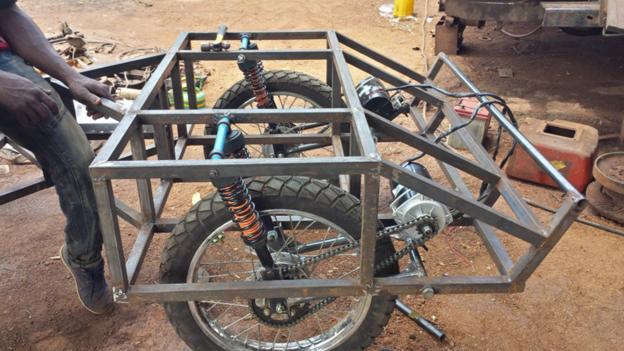
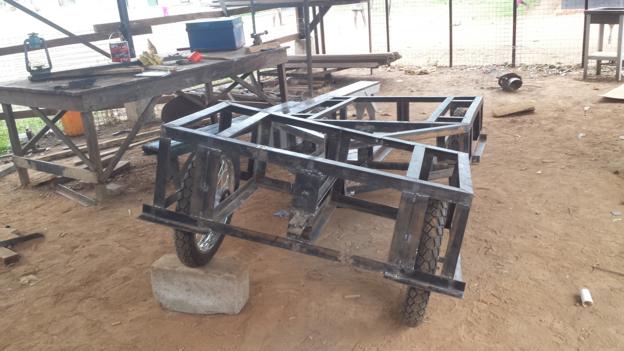
“I love working in local African metal workshops and seeing the way they can build anything from standard steel sections and scrap,” says Low. True to that vision, he began building a prototype out of angle iron scrapped from a fence. He figured that if he hit upon a basic design that could be locally manufactured, it could also be locally serviced and customized for anything from agricultural work to hauling construction materials to taking the sick to the hospital.
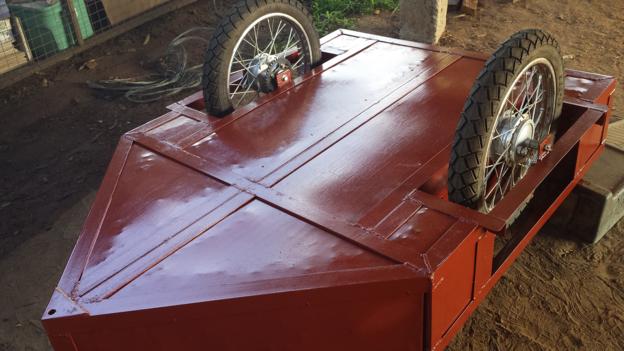
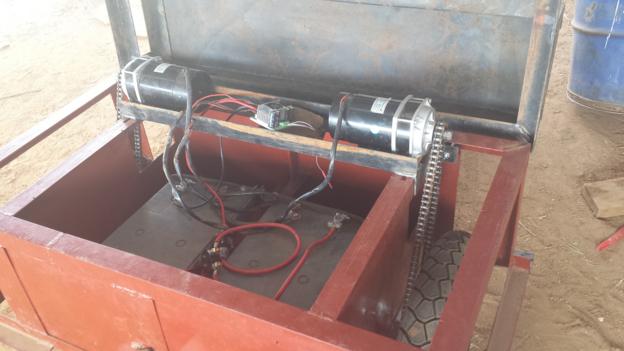
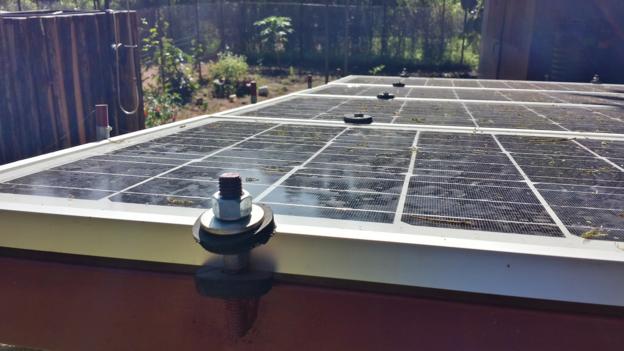
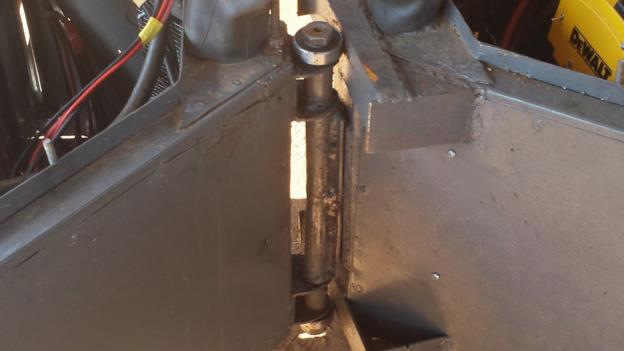
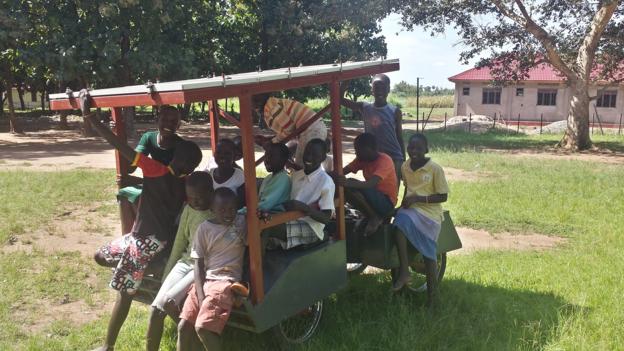
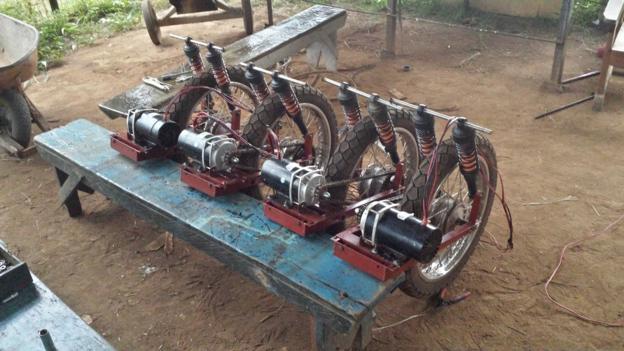
His creation is a four-wheeled vehicle on an articulating frame, an idea inspired by PUG off-road vehicles that have been around since the 1960s. A joint in the middle keeps all four wheels on the ground for traction and stability. But where PUGs and their ilk used an internal combustion engine and complicated drive shafts, Low’s chariot is all-electric, with a motor driving each wheel and a bank of solar panels suspended overhead.
An electric approach has other advantages. Though it’s rich in oil, South Sudan has no refineries, and gasoline supplies are limited. Low and his wife, a doctor in a hospital for women and children, were recently at a refugee camp near the Sudanese border, where gasoline prices approached $30 per gallon. “Other more remote places have no access to petrol at all,” says Low. “Fortunately, the sun is much more reliable than the distribution chain here.” Living off the grid — because the grid is unreliable — means that Low has plenty of experience installing and repairing photovoltaic panels.
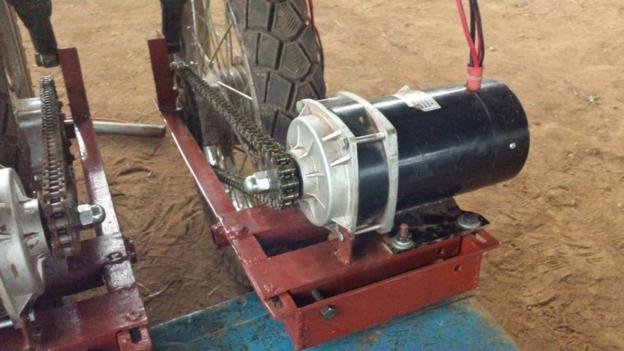
Those batteries — lithium ion if available, but the weight of lead-acid boxes will help with traction — power 650W motors which were ordered from China, shipped to Uganda, and then delivered to Low in a small airplane. The wheels are Chinese and Indian motorcycle parts, which are widely available and have built-in bearings, brakes, and sprockets, and cost only $65 including chain. By using them in an axle-free design, Low notes, “I have much greater ground clearance than on our Land Cruiser.”
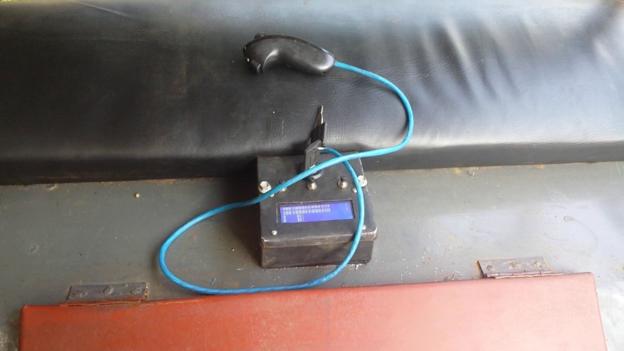
Steering is accomplished by varying the speed of the wheels, through a differential motor control system that’s still in development. And like the finest jet aircraft, Low’s vehicle is 100% fly-by-wire, steered by way of an old Nunchuk controller for a Nintendo Wii gaming console. The first prototype actually used a six-channel transmitter for a radio-controlled model airplane. “This offers me a lot of flexibility, is cheap, and I like the idea of remote control for some of the agricultural applications I am thinking of,” he wrote in his build notes on hackaday.oi. “This area still has a lot of unexploded land mines.”
Low estimates the vehicle has cost him about $3,500 to build — with solar panels and batteries accounting for about $2,000 of that sum. Once the design is fully vetted, he plans to release step-by-step build instructions, including cut lists and photographic guides to make the vehicle accessible to people without a technical background.
In 130 years of innovation, automotive designers have bested sand pits, boulders, swamps, snow, trenches, ice, mud, and the inscrutable terrain of other planets. The one obstacle none seem to be able to conquer is poverty.
If that’s a hurdle Chris Low can get his passengers over, then he’ll have designed the world’s most useful utility vehicle.
If you would like to comment on this story or anything else you have seen on BBC Autos, head over to our Facebook page or message us on Twitter.[2][3]
Newer articles:
- The Latest: UN Chief Scolds South Sudan Leader Over War - 29/09/2015 10:13
- With South Sudan at crossroads, Ban urges parties to reaffirm commitment to peace - 29/09/2015 10:09
- The Latest: UN scolds South Sudan head over shaky peace deal: 'I hope you will not betray us' - 29/09/2015 10:04
- Uganda Says Its Troops Not Leaving South Sudan Yet - 29/09/2015 07:30
- More Aid to South Sudan - 28/09/2015 15:01
Older news items
- South Sudan: women and girls raped as ‘wages’ for government-allied fighters - 28/09/2015 06:15
- South Sudan's men of dishonour - 28/09/2015 03:58
- South Sudan, rape headquarters of the world? - 28/09/2015 03:35
- Kenyatta Calls for International Support for South Sudan Peace - 28/09/2015 03:02
- Women held as sex slaves in South Sudan 'rape camps' - 28/09/2015 01:22
Latest news items (all categories):
- Juba commissioner denies chasing foreigners - 07/10/2026 14:36
- Australia: 19-year-old from South Sudan arrested over a wild joy ride - 07/10/2026 14:33
- South Sudan’s aid crisis deepens as food stocks run low - 07/10/2026 14:29
- South Sudan’s Juba warns foreigners against running small-scale businesses - 07/10/2026 14:25
- Peace Dialogues foster social cohesion in Nyirol County after persisting tensions - 07/10/2026 14:23
Random articles (all categories):
- Different Lifestyles between North and South Sudan - 16/09/2012 17:31
- Over 200,000 displaced by floods in South Sudan - 09/08/2020 18:00
- south_sudan_bangladesh_police-reuters.JPG - 03/01/2014 23:49
- Sudan-South Sudan dispute over oil-rich Abyei re-emerge - 25/08/2013 22:30
- South Sudan oil production down about 50 percent - 23/05/2014 00:00
Popular articles:
- Who is the darkest person in the world, according to Guinness World Record? - 25/10/2022 02:34 - Read 150686 times
- School exam results in South Sudan show decline - 01/04/2012 17:58 - Read 28190 times
- Top 10 weakest currency exchange rates in Africa in 2023 - 19/07/2023 00:24 - Read 25303 times
- No oil in troubled waters - 25/03/2014 15:02 - Read 24532 times
- NDSU student from South Sudan receives scholarship - In-Forum - 29/09/2012 01:44 - Read 22492 times
