
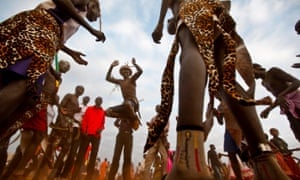
Three days after I arrived in Tambura, the people of the small village celebrated South Sudan’s first birthday. It was July 2012, and I was there as a volunteer for International Medical Corps. It was a joy to watch the celebrations in this place 460km from the capital, Juba. Hundreds of people were parading, dancing, and singing, reflecting the relief and hope that had come after four decades of war.
Related: Syria field post: 'I had to do procedures I'd never seen. YouTube helped a lot'[1]
I can’t complain about my life in Juba – you would not have variety, but you would find a little of everything. The restaurants were few, but they served global cuisines, and there were good bars that were usually filled with expats for after-office hangouts – they could be confused for being any European pub. After all, alcohol is the party anthem regardless of a nation’s instability. For fitness enthusiasts there were sports grounds. The roads were mostly potholes but at least they connected major areas of the city. Importantly, the team that I worked with was amazing – strangers quickly turned into friends in those resource-constrained settings.
My life in South Sudan[2] was quite normal until war broke out on the night of 15 December 2013. By then, I worked in operations for the Danish Refugee Council and I went to the field to set up logistics, healthcare, water and sanitation programmes. My heart would skip a beat with every gunshot I heard, and that continued for two to three days. Organisations who could afford to charter planes started to pull out their staff, initially from the capital and then later from the field offices. The airport was full of queues of people rushing to leave the country. Within a week, only about 20% of staff remained, including my colleagues Gaurav and Julian and me.
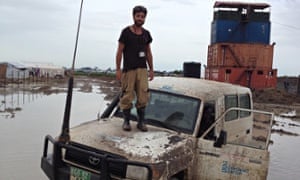
The remaining expats started to gather at the compound for the United Nations Missions in Sudan[3] (UNMis). The place was dirty and crowded. People would think of their family, their children back home, but no one was able to speak of their fear with each other. Gaurav was my superviser and hangout buddy, but we were unable to talk to each other. The emotions were so intense they were difficult to put into words.
When we would return to our residence in the evening, we would talk about digging an escape hole in our compound, just in case. I often looked around the room to spot a place to hide in case the gunfire started again. The news of an attack on a humanitarian base, lootings and killings had become normal. Only after a week did awestruck people start communicating with each other, building mutual confidence to survive, and discussing response strategies.
Related: Life under siege in Yemen: 'Bullets and shrapnel came into the house'[4]
By January, more humanitarian staff started arriving because organisations had started receiving emergency funds. I was deployed to Bentiu, a field site that had seen an attack only a week before. The situation was no better, corpses were lying on the road and the living conditions were harsh.
Slowly, things got better. More tents were added and more people arrived, but still the canteen in the UNMis compound was only able to cook rice and beans for several days, as they were running out of supplies and cargo could not arrive due to security concerns. The day the cargo finally arrived, the joy of the workers knew no bounds, they would now get a proper meal to replenish their energy after working in the hot and humid weather.
After four months of improvements, war broke out again in mid-April. From the early morning, armoured vehicles hovered around the UNMis base and fired bullets. We had to run towards the bunkers with all the energy and passion to survive. Sanjeev (another of my colleagues) dodged a bullet by a few centimetres. When we entered the bunker, we all were shivering.
One evening, the humanitarian team brought in more than 100 wounded civilians from the town. Without any clinic being set up, people were running here and there providing water and primary treatment to the wounded people lying all over the ground.
Related: 'A patient was killed and staff were beaten trying to protect him'[5]
On 19 April 2014 at around 3pm, I was standing outside one of my friends’ room (he had proper room unlike my tent), when I heard a strange sound and a huge blast. I ran inside, grabbed a helmet and a bullet-proof jacket and ran towards the bunker. Within the two minutes it took me to reach the bunker there had been another three blasts. That was the moment I earnestly begged God to save my life. Later we found out that it had been a BM 21 rocket launcher and had made a large hole where it landed.
By that time, my contract was coming to an end so I left Bentiu the next day. The moment our flight took off, I said to my colleague next to me: “Now that I think I am safe, I can tell my mom what I have been through.” Until then, I had not told my family anything.
The hope I had seen among the people when I first arrived in 2013 was no longer alive when I left in April 2014. I hope the situation is better now, and though I know a political consensus has not been reached yet, I hope their lives have become normal – by their own standards. Nothing makes you value life more than when you see death from so near.
Would you like to share your story of working in the field? Email
Join our community[6] of development professionals and humanitarians. Follow@GuardianGDP[7] on Twitter.
References
- ^ Syria field post: 'I had to do procedures I'd never seen. YouTube helped a lot' (www.theguardian.com)
- ^ South Sudan (www.theguardian.com)
- ^ United Nations Missions in Sudan (unmis.unmissions.org)
- ^ Life under siege in Yemen: 'Bullets and shrapnel came into the house' (www.theguardian.com)
- ^ 'A patient was killed and staff were beaten trying to protect him' (www.theguardian.com)
- ^ Join our community (register.theguardian.com)
- ^ @GuardianGDP (twitter.com)
Newer articles:
- South Sudan: 4 Killed as UN Compound Is Bombed - 20/05/2015 09:55
- Rebels Did Not Seize Oil Fields, South Sudan Government Says - 20/05/2015 09:23
- South Sudan Producing Oil Fields Seized In Rebel-Government Clash - 19/05/2015 15:25
- Trial opens of Christians accused of crimes against Sudan - 19/05/2015 14:22
- South Sudan groups targeting children, UN report says - 19/05/2015 12:01
Older news items
- Op-Ed: South Sudan – the endless brutality of killing and rape - 18/05/2015 17:09
- Violence in South Sudan targets children, UNICEF says - 18/05/2015 13:42
- South Sudan Bishop calls for strong families - 18/05/2015 13:13
- S.Sudan army advances as UN warns over 650,000 at risk - 18/05/2015 09:13
- South Sudan - Episcopal Church Committed to Relief Response in Protracted Conflict - 18/05/2015 02:00
Latest news items (all categories):
- Ramaphosa presses Kiir to implement peace deal ahead of South Sudan’s first elections - 09/10/2026 12:19
- South Sudan steps up Ebola alert after Kenya case - 09/10/2026 12:17
- Laotian man deported by U.S. to South Sudan leaves for Laos after year in detention - 09/10/2026 12:14
- Bullet and blast injuries … and a constant need for blood: inside South Sudan’s overwhelmed trauma wards - 09/10/2026 12:10
- MTN South Sudan and Regulator Pledge Cooperation to Expand Connectivity - 09/10/2026 12:01
Random articles (all categories):
- ALI BABA OF TODAY August 10, 2011 - 10/08/2011 01:00
- South Sudan shifts to floating exchange rate -minister - 15/12/2015 00:34
- New UN rep for South Sudan warns of 'huge challenge' - 02/09/2014 16:38
- South Sudan: Murle torture in Jonglei denied by army - BBC News - 25/05/2012 11:49
- South Sudan adds more security features to its visa - 06/06/2019 06:28
Popular articles:
- Who is the darkest person in the world, according to Guinness World Record? - 25/10/2022 02:34 - Read 150805 times
- School exam results in South Sudan show decline - 01/04/2012 17:58 - Read 28200 times
- Top 10 weakest currency exchange rates in Africa in 2023 - 19/07/2023 00:24 - Read 25311 times
- No oil in troubled waters - 25/03/2014 15:02 - Read 24536 times
- NDSU student from South Sudan receives scholarship - In-Forum - 29/09/2012 01:44 - Read 22496 times
