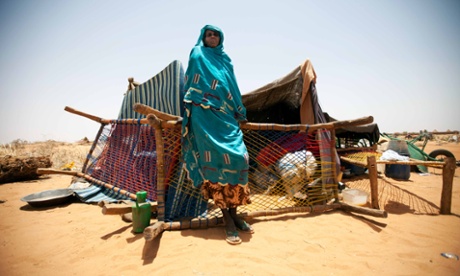
A Sudanese woman standing in front of her shelter in the Zam Zam camp for internally displaced people in North Darfur. Photograph: Albert Gonzalez Farran/AFP/Getty
On a particularly sweltering day in early May 2011, a soldier called Angelo Adam Juju Baba set out to have a drink. It was two months before South Sudan seceded[1], and just a month before a new war would break out in Angelo's region of Sudan[2], the Nuba mountains[3], though of course he did not know this yet.
Angelo was among those northern Sudanese members of the Sudan People's Liberation Movement who, having fought against Khartoum in the war that raged from 1983 to 2005, found themselves north of the border when the southern Sudanese finally won independence in 2011. This contingent became known as the SPLM-North
As Angelo was in an area controlled by the SPLM, marissa, the local beer made from sorghum, was openly on sale. Just under a dozen women competed for his business; Angelo eventually settled into one of the almost identical drinking spots, an area of shade created by some wooden poles supporting a roof made with a brightly coloured square of cloth. He sat down on an uneven wooden bench, and ordered.
Angelo could hardly have been farther from Khartoum's air-conditioned cafes, with their flatscreen TVs and iced coffees; apart from anything else, alcohol is prohibited in the areas of Sudan controlled by President Omar al-Bashir's National Congress party. The woman serving Angelo, whom I will call Maha, had spent three days making the marissa, a thick, dark liquid, which is so strong that the Nuba often describe it as food. Like many women in Sudan from non-Arab communities, brewing beer was the only work she could find. On a good day, Maha earns 10 Sudanese pounds, about two dollars."She has no choice," Angelo butts in. "There are no jobs here."
The vantage point of Maha's beer shack emphasises both the beauty and remoteness of Kauda's setting. Rocky hills splashed with vegetation curve away to the horizon. There aren't many concrete buildings, health centres or government offices in this part of the Nuba mountains. The roads in and around Kauda are not made of tarmac, or even murram, a gravel substitute widely used in both Sudans. In the rainy season the tracks around Kauda disappear under water, which pours down the sharply inclined hillsides all around the town.
The area saw some of the worst fighting in the second north-south civil war, after many of the Nuba joined the southern Sudanese in the fight against Khartoum. The Nuba proved to be among the SPLM's best soldiers, but their area suffered terribly[4]. The fighting in the Nuba mountains stopped in 2002, and its people did benefit, a little, from the peace that followed. Development worker Nagwa Konda, who was born not far from Kauda, says there were 300 schools in the SPLM-North areas by 2010, compared with only a handful in 1995.
However, the development that finally came was a sticking plaster over a terrible wound. Kauda, like so many areas on Sudan's periphery, had been neglected and exploited by the riverain elite for decades. The first school in Kauda was only built in 1945, and the rural areas all around were totally ignored. Even in the 1980s, Nagwa's cousins had to walk four hours to and from school every day. The Nuba were largely forced to cope without modern health care, and there were so few paid jobs that many people became domestic servants for Arab families.
Although Sudan's GDP per capita[5] was a respectable $1,435 in 2011, making it a lower-middle income country by international standards, large numbers of Sudanese are forced to get by on far less than this. Over the course of a year, Maha's earnings in her open-air beer tent probably work out at less than a dollar a day. Most of the teachers in the Nuba mountains are volunteers, living off the generosity of relatives and occasional handouts.
In Sudan as a whole, nearly half the population lives in poverty[6]. As might be expected, poverty rates vary tremendously from location to location. In Khartoum, a little over a quarter of the population is below the poverty line, while in North Darfur the figure is more than two-thirds. Of course, there is inequality in every country. But ever since its creation, Sudan's failure to spread its wealth in an equitable way has been one of its defining characteristics. Too many of its citizens are poor; too many areas of the country have seen little or no development. This contributed to people from numerous areas of the united Sudan taking up arms against the state.
In the years running up to and immediately after separation, there were three principal reasons for the poverty and underdevelopment that characterise so much of Sudan (though certainly not all of it). First, a large proportion of government spending is dedicated to the military security apparatus. Second, the high prevalence of corruption[7] increases the imbalance between those who have access to the resources of the state, and those who do not. Finally, any money left over has been heavily channelled into the riverain centre, benefiting the towns, agricultural schemes and politically connected people in and around the Nile valley.
• From A Poisonous Thorn in Our Hearts, by James Copnall. The book is now available in stores, and e-bookshops from Friday[8]
References
- ^ South Sudan seceded (www.theguardian.com)
- ^ More from the Guardian on Sudan (www.theguardian.com)
- ^ Nuba mountains (www.bbc.co.uk)
- ^ area suffered terribly (beta.justiceafrica.com)
- ^ Sudan's GDP per capita (data.worldbank.org)
- ^ nearly half the population lives in poverty (www.indexmundi.com)
- ^ high prevalence of corruption (www.transparency.org)
- ^ A Poisonous Thorn in Our Hearts (www.guardianbookshop.co.uk)
Newer articles:
- Civilians At War: White Army Mobilizes As Machar Aims For Oil Fields In South Sudan - 31/03/2014 16:53
- South Sudan: Urgent Supplies Reach Remote Areas in South Sudan, with Joint Operation - 31/03/2014 11:57
- South Sudan war displaced in 'acute' need, UN says - 31/03/2014 11:08
- Western Nations Issue Strong Statement on South Sudan - 31/03/2014 06:00
- South Sudan: new country, same old mistakes? - 31/03/2014 02:54
Older news items
- Over a million displaced by South Sudan conflict: U.N. - 30/03/2014 23:27
- South Sudan: Zim Planning South Sudan Deployment? - 30/03/2014 09:27
- 'One million' flee S Sudan conflict - 29/03/2014 16:26
- South Sudan: UN launches operation to reach remote areas - 29/03/2014 14:22
- UN warns conditions in South Sudan could worsen - 29/03/2014 11:08
Latest news items (all categories):
- Research ● Olga Algayerova: Small-State Diplomacy in an Era of Geopolitical Fragmentation - 28/10/2026 17:44
- The long journey back to the wild: The return of Przewalski’s horses - 28/10/2026 17:38
- South Sudan to begin voter registration in November ahead of December elections - 28/10/2026 17:12
- South Sudanese Liberation Hero Joseph Lagu Dies at 94 as President Kiir Declares National Mourning - 28/10/2026 17:03
- National average price spreads for maize: Across select East African countries - 28/10/2026 16:56
Random articles (all categories):
- Pangolins are a victim of political instability in South Sudan - 21/11/2019 09:56
- Conflict pushes South Sudan's healthcare system to breaking point - 08/07/2026 18:28
- Sudan Rebels, Opposition Party Form Political Alliance - 03/07/2009 17:26
- WFP SOUTH SUDAN VACANCY ANNOUNCEMENTS (18/10/2022) - 18/10/2022 11:09
- China to help S.Sudan develop mining, in talks on development loan - 09/09/2013 09:47
Popular articles:
- Who is the darkest person in the world, according to Guinness World Record? - 25/10/2022 02:34 - Read 151391 times
- School exam results in South Sudan show decline - 01/04/2012 17:58 - Read 28448 times
- Top 10 weakest currency exchange rates in Africa in 2023 - 19/07/2023 00:24 - Read 25549 times
- No oil in troubled waters - 25/03/2014 15:02 - Read 24752 times
- NDSU student from South Sudan receives scholarship - In-Forum - 29/09/2012 01:44 - Read 22727 times