
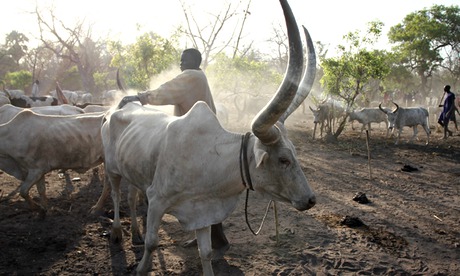
A cattle keeper in Cueibet, Lakes state, South Sudan, prepares his cows to go out to graze. Photograph: Jessica Hatcher for Guardian
At 6ft 5in, James Makol towers over his prize bull. He wallops it on the rump as plumes of ash from burning dung billow skywards. The bull seems oblivious. It is surrounded by hundreds, perhaps thousands, of similarly ash-covered cows belonging to Cueibet's Dinka people.
Only one thing disturbs this tranquil scene: the intermittent crack of rifle fire. Makol, 28, has an AK-47 strapped across his back. This is the first time he has carried a weapon in years. He says the number of guns in civilian hands declined after the 2009 peace agreement that prefaced South Sudan[1]'s official split from the north two years later.
Prior to the separation of the Sudans, there were thought to be up to 3.2m small arms[2] (pdf) in circulation, two-thirds of them in civilian hands. There have been numerous disarmament programmes[3] (pdf) since 2000 and officials have collected tens of thousands of weapons, but the process has been hampered by inadequate state security.
Makol bought his Russian assault rifle from a travelling salesman soon after the latest round of fighting started in mid-December. It cost three cows; the average street value of a single cow is more than $600 (£360). "I heard the Nuer have rebelled and are fighting the Dinka. Now, in case of an attack, I will be ready," he says.
Locals in South Sudan's Dinka and Nuer strongholds say that the recent political crisis, which pits the ethnic groups against one another, is concealing, and at times promoting, smaller, localised conflicts over cows.
Cattle herders in peaceful areas are buying guns amid fears that the conflict will spread to their homes. Others are exploiting the insecurity to settle old scores and steal millions of dollars of cows. Promises by the government to deliver justice are not being honoured. Consequently, some herders may take matters into their own hands.
On the morning of 7 February in Unity state, Nuer cattle keeper Ter Wiew was at home with his cows in Dhiak village when scores of armed men attacked. Officials believe the attackers were Dinkas from Lakes state. The attackers made off with 260 cows and left 10 people dead, including three women and two children.
A local medical officer, not named for his own safety, believes the attackers were predominantly cattle raiders. "People are taking advantage of the crisis – especially anyone who is armed. If this had been a government attack, there'd be no need to take cattle," he said.
According to officials, these armed men staged attacks across the Panyjiar county and have stolen some 6,500 cows.
The world's newest country is transitioning from traditional local justice to state mechanisms. Understanding cattle and their function in society is integral to understanding many of the conflicts in the state.
The prison in Rumbek, a Dinka stronghold and capital of Lakes state, houses 500 inmates in a facility designed for 150. Four of the 11 juvenile detainees face charges for cattle-related crimes. Matur, 15, and four other young cattle keepers are accused of killing a man who allowed his cows to destroy their crops.
Another young man is serving a two-year sentence for impregnating a girl out of wedlock. This may seem a disproportionate punishment, but on average a man must pay his prospective bride's family 50 cows in order to marry her, equivalent to about $30,000.
Cattle destroying crops and cattle theft are the two main causes of conflict in Lakes state, according to the governor's adviser for peace and reconciliation, Ezekiel Thiang. He considers one of the key challenges to be starting a dialogue with spiritual leaders, known as spear masters, who get young men fired up to go cattle rustling in exchange for hefty fees. The government, he says, is starting to acknowledge this.
The authorities in Lakes state, together with the United Nations mission in South Sudan, UNMiss[4], have developed an early warning system that maps out conflict hotspots and prioritises threats.
A deeply ingrained revenge culture makes that an uphill battle. If a Dinka is killed by a member of another clan or tribe, it is common for relatives to leave the body out for vultures. "It will create more anger from the youths so they go and fight back. You have to keep on revenging so you compensate for the people that were killed. It creates continuous confrontation", explains James Majok, a medical officer at the Sign of Hope[5] clinic.
Back at the cattle camp, as the boys take the cows to graze, a young Dinka man confesses that he has raided cows in the past, but it is a dangerous game. Twelve members of his community died last May in a raid by another Dinka group. No one retaliated, he says, because the government promised to investigate and return the cows.
Nearly a year on, nothing has been done, he says; state revenues are down because of reduced oil production, and funds are being diverted to prevent civil war. He doubts modern justice will prevail. Asked whether they will seek revenge, he says: "We've seen a lot of deaths related to the raids, so [the elders] decided to give it a break."
A day later, another eight cows were stolen from the herd. If official justice mechanisms continue to fail, he fears they will be forced to return to revenge attacks.
References
- ^ More from the Guardian on South Sudan (www.theguardian.com)
- ^ 3.2m small arms (www.smallarmssurveysudan.org)
- ^ disarmament programmes (www.saferworld.org.uk)
- ^ UNMiss (unmiss.unmissions.org)
- ^ Sign of Hope (www.hoffnungszeichen.de)
Newer articles:
- South Sudan faces 'spectre' of famine: US, EU envoys - 13/03/2014 13:59
- UNSC regrets delay in accord between Sudan, South Sudan - 13/03/2014 05:36
- South Sudan army battles rebels in key oil town - 13/03/2014 00:30
- South Sudan charges 4 high-profile prisoners with treason - 12/03/2014 07:38
- South Sudan: UN working to mitigate risks of rainy season - 12/03/2014 05:43
Older news items
- South Sudan: UN Admits 'Mistake' In Landmine Row - 11/03/2014 20:42
- South Sudan: UN working to mitigate risks of rainy season for displaced civilians - 11/03/2014 18:29
- South Sudan charges four high-profile prisoners with treason - 11/03/2014 18:10
- After coup allegation, S Sudan treason trial opens - 11/03/2014 16:00
- South Sudan leaders' treason trial opens - 11/03/2014 15:38
Latest news items (all categories):
- Juba commissioner denies chasing foreigners - 07/10/2026 14:36
- Australia: 19-year-old from South Sudan arrested over a wild joy ride - 07/10/2026 14:33
- South Sudan’s aid crisis deepens as food stocks run low - 07/10/2026 14:29
- South Sudan’s Juba warns foreigners against running small-scale businesses - 07/10/2026 14:25
- Peace Dialogues foster social cohesion in Nyirol County after persisting tensions - 07/10/2026 14:23
Random articles (all categories):
- South Sudan reciprocates, waives visa fees for Ugandans - 02/10/2021 11:00
- Genocide in the First Person: An Interview with Simon Deng - 09/04/2008 00:43
- Displaced youth in Wau receive sports equipment from Bangladeshi peacekeepers - 01/10/2021 12:00
- South Sudan accuses Khartoum of more border attacks - Chicago Tribune - 10/05/2012 05:12
- Civilians on the run after Southern battles - 14/05/2009 16:00
Popular articles:
- Who is the darkest person in the world, according to Guinness World Record? - 25/10/2022 02:34 - Read 150694 times
- School exam results in South Sudan show decline - 01/04/2012 17:58 - Read 28190 times
- Top 10 weakest currency exchange rates in Africa in 2023 - 19/07/2023 00:24 - Read 25305 times
- No oil in troubled waters - 25/03/2014 15:02 - Read 24532 times
- NDSU student from South Sudan receives scholarship - In-Forum - 29/09/2012 01:44 - Read 22492 times
