
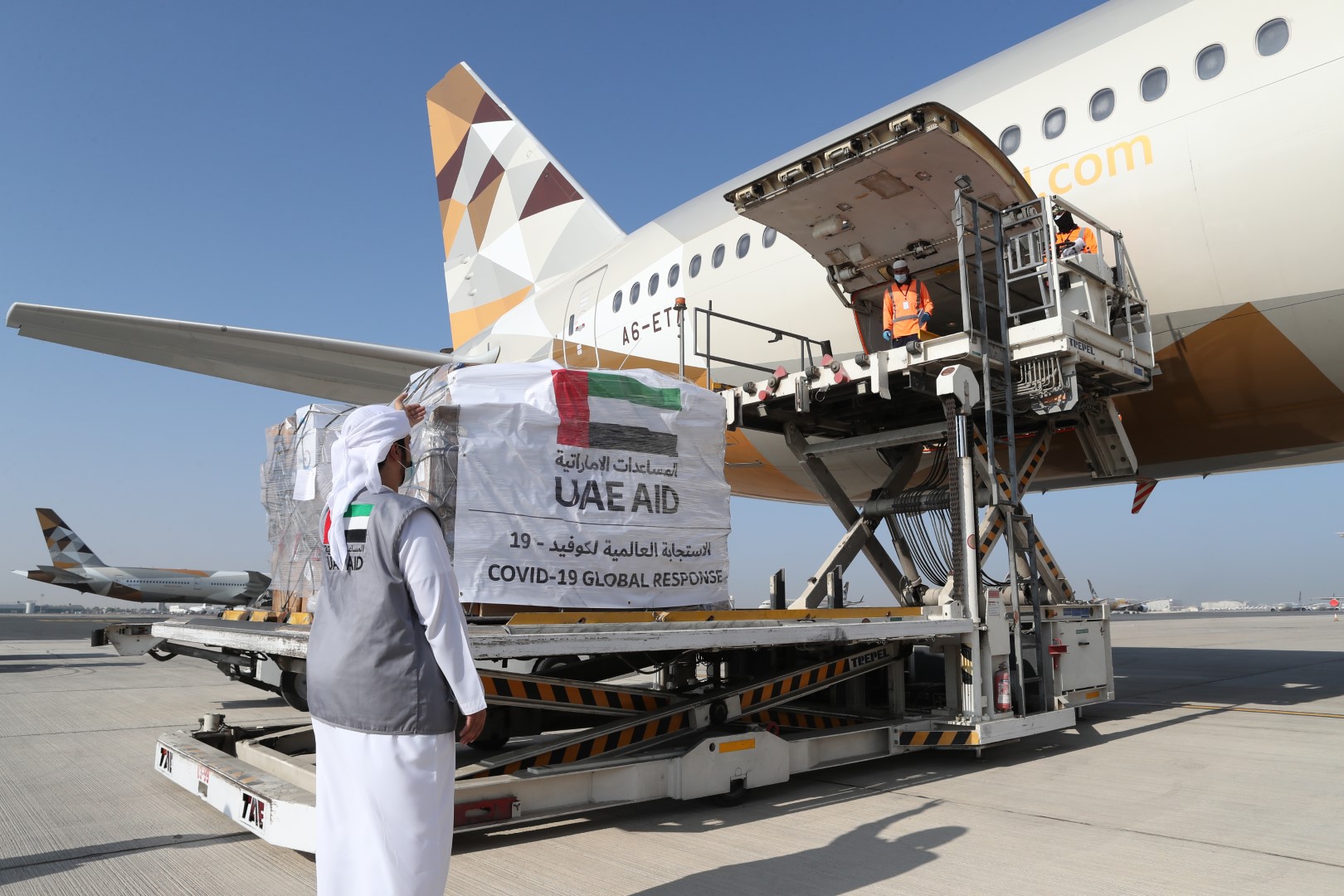
UAE AID (File Image)
The UAE has signed agreements with Sudan and South Sudan, strangling the two countries economically and politically, while openly supporting the Rapid Support Forces (RSF).
A report by the United Nations Panel of Experts on Darfur, under Security Council Resolution 1591, accused the UAE of supporting the Rapid Support Forces (RSF), citing compelling evidence, unveiled earlier this year. Its report documented the UAE’s conversion of Chad’s Um Jaras (Amdjarass) airport into a military and logistical supply hub for RSF weapons.
The report presented ample evidence of the UAE’s violation of the resolution’s arms embargo on Darfur. The UAE’s support for the RSF in Sudan’s war included using its political, economic and media influence to promote the militia and its leaders, as well as providing them with political sanctuary, a safe haven for their leaders and facilitating their movement across the region.
During the 2023 UN General Assembly, witnesses reported seeing Yousif Izzat, a Canadian national and advisor to the militia leader General Mohamed Hamdan ‘Hemeti’ Dagalo. The UAE provided Izzat with an identification badge to freely enter and move within the UN headquarters.
However, the UAE’s support steadily evolved into an attempt to economically strangle Sudan to ensure RSF’s future institutional political existence in the Sudanese arena. This reveals the UAE’s intentions in plundering Sudanese resources in a mafia-like way. The UAE, which de facto controls Sudan’s gold resources, also seeks to deprive Sudan of its other national income resources.
UAE makes $12bn deal with South Sudan
A newly leaked document revealed that in December the UAE entered into an agreement to be executed within 90 days with the Republic of South Sudan for a loan amounting to $12bn.
The loan is to be repaid by shipments of South Sudanese oil
The agreement was signed through a company owned by a member of the Emirati royal family (HBK DOP), Hamad bin Khalifa Al Nahyan, who previously attempted to acquire an Israeli football club (Beitar Jerusalem FC). Al Nahyan was thwarted by the league’s management after suspicions about the sources of his wealth and investments. The Israeli Football Association (IFA) stopped the deal after Hamad failed to issue the required documents, including a certificate of integrity.
It also found a “significant gap” between Al Nahyan’s declared capital and what he owns. An investigation by The Times of Israel revealed that of the $1.6bn alleged fortune of Al Nahyan, $1.5bn consists of non-tradable Venezuelan government bonds, which are worthless due to the country’s severe economic crisis.
This suggests that Al Nahyan is acting as an intermediate party in a transaction worth several folds more than the total value of his fortune and the combined value of his investments.
The agreement further stipulates that the loan is to be repaid over 20 years from the receipt of payments, divided into three stages – $5.3bn, $3bn and $3.7bn.
The terms of the agreement note that the loan is to be repaid by shipments of South Sudanese oil, which has been priced at $10 per barrel less than its market value. In the event of a decrease in oil prices, the difference is to be compensated with additional oil shipments. The agreement mandates the delivery of oil shipments one month prior to the payments for each loan stage.
The deal also directs the deposit of the loan into a UAE bank account, allocating 70% of its value (approximately $8.4bn) to infrastructure facilities, with South Sudan receiving 30% of the loan’s value.
The agreement grants the lending company the right to redirect the offer letter to any other party without obtaining the borrower’s (the state of South Sudan) consent.
Many of the terms of this agreement are unfair to South Sudan. However, no one can blame South Sudan’s state for how it manages its economic affairs, especially after the RSF caused the destruction of the Eastern Petroleum Transport Line in Sudan (which cost about $1.5bn to construct). South Sudan lost approximately 60% of its national income.
Stoking the war in Sudan
The agreement takes no account of the war in Sudan, while the UAE spares no effort in supporting the RSF to continue their war to control the country. Around 70% of the loan’s value is directed to infrastructure facilities, which would finance the construction of a new line to transport South Sudan’s oil through Kenya.
This will result in Sudan losing revenue from the transit fees for South Sudan’s oil, which amount to $1.5m daily (roughly $1.5bn annually), as well as the closure of the Kosti (Umdabaker) power station, which solely runs on fuel from South Sudan and generates 350MW, accounting for 45% of Sudan’s thermal electricity generation.
This loss includes the shutdown of Unit 2 of the Khartoum refinery, which produces 40% of Sudan’s need for petroleum products by refining South Sudan’s oil, valued at $3m daily (around $1.86bn annually).
The UAE is seeking to economically strangle Sudan in a long-term strategy to increase the chances and prospects of its agent, Hemeti, for political survival.
Of course, the prospects of this new economic cooperation are not separate from the UAE’s attempts to persuade neighbouring countries to change their positions and soften them towards its proxy militia, the RSF.
In June last year through the Abu Dhabi Fund for Development, the Emirati loaned $1,5bn to Chad and agreed to military cooperation.
The UAE is fuelling the war in Sudan and linking its cessation to political efforts to preserve the institutional presence of the RSF militia has surpassed the direct destruction of the country, and the displacement and humiliation of its people both inside and outside its borders.
The Emirates must be stopped at the boundaries. The UAE must end this economic extortion operation in the regions of the Sahel, the Great Lakes and the Horn of Africa.
Newer articles:
- South Sudan Peace Talks Poised to Commence in Nairobi on May 10, 2024 - 06/05/2024 11:15
- Japan and UNDP support the training of 150 Women and Men in Torit State - 06/05/2024 10:03
- Catholics in South Sudan voice ‘frustration, shock’ for missing priest and driver - 06/05/2024 08:07
- South Sudan names NBL-laden Olympic squad - 03/05/2024 12:48
- RDF Army Chief of Staff visits Rwandan peacekeepers in South Sudan - 03/05/2024 12:42
Older news items
- Thousands of desperate people still fleeing Sudan's war into South Sudan - 03/05/2024 12:29
- South Sudan open for Kenyan investors, central bank says - 03/05/2024 12:25
- South Sudan Joint Market Monitoring Initiative (JMMI) 1-7 April 2024 - 03/05/2024 12:20
- UAE company agreed to loan $13B to South Sudan in exchange for oil - 27/04/2024 16:44
- South Sudan auditor flags spending of IMF funds - 27/04/2024 16:41
Latest news items (all categories):
- South Sudan can leverage China’s AI path to bridge the digital divide - 16/09/2026 16:04
- Credible Elections Are No Longer Possible in South Sudan - What Next? - 16/09/2026 15:59
- South Sudan's president replaces electoral chief three months before scheduled polls - 16/09/2026 15:56
- Turkish Airlines is pulling out of 5 African routes, including South Sudan - 16/09/2026 15:23
- ‘Super El Niño’ deepens hunger crisis in South Sudan – WFP - 16/09/2026 15:19
See also (all categories):
Random articles (all categories):
- South Sudan: What Is Really Standing in the Way of Lasting Peace? - 11/02/2014 17:31
- ‘Different Contexts - Common Aspirations’ – International Youth Day event celebrates unity over differences - 14/08/2026 14:23
- محمد إبراهيم خليل: لسنا طرفا بصراع الاستفتاء - 17/08/2010 07:46
- South Sudan: Ban concerned over escalation of violence - 26/06/2016 04:33
- 1.3 mln South Sudanese children under 5 at risk of acute malnutrition: UNICEF - 31/07/2020 12:26
Popular articles:
- Who is the darkest person in the world, according to Guinness World Record? - 25/10/2022 02:34 - Read 149586 times
- School exam results in South Sudan show decline - 01/04/2012 17:58 - Read 28114 times
- Top 10 weakest currency exchange rates in Africa in 2023 - 19/07/2023 00:24 - Read 25195 times
- No oil in troubled waters - 25/03/2014 15:02 - Read 24464 times
- NDSU student from South Sudan receives scholarship - In-Forum - 29/09/2012 01:44 - Read 22414 times
